CCCEU voices deep concern, opposes use of EU subsidy law as protectionist tool amid probe into Chinese bidder for Lisbon railway project
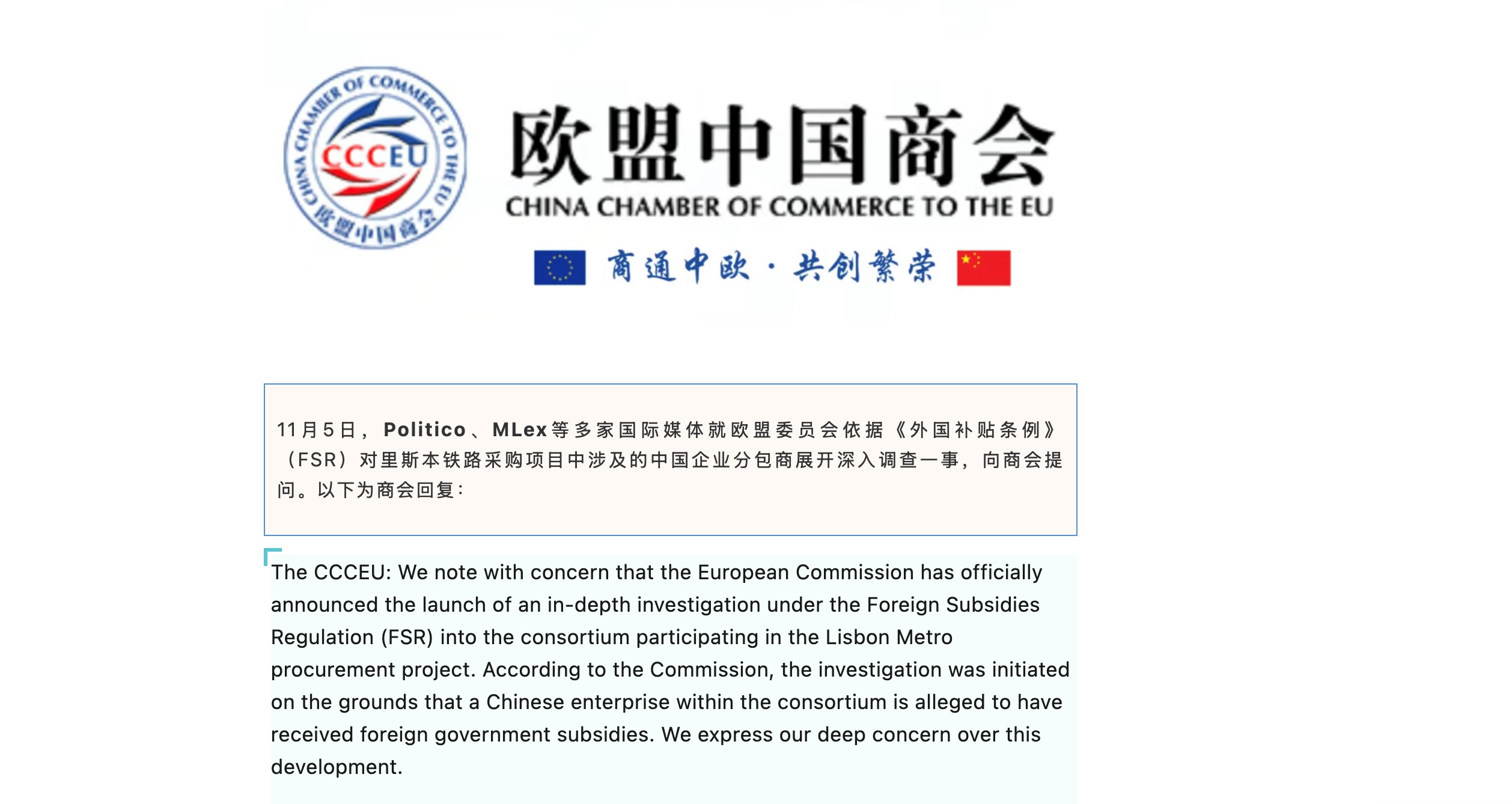
Photo: screenshot of the China Chamber of Commerce to the EU (CCCEU)’s official WeChat account
The European Commission on Wednesday launched an in-depth probe under the Foreign Subsidies Regulation (FSR) into a railway project in Lisbon, Portugal, to assess whether Chinese firms gained an alleged “unfair advantage” in the public tender due to foreign subsidies. In response, the China Chamber of Commerce to the EU (CCCEU) on Thursday urged the European Commission to implement the FSR in a truly objective, fair, and non-discriminatory manner, warning against its use as a tool of protectionism or exclusion.Based on a preliminary inquiry, the Commission claimed it found that the Portuguese unit of the Chinese rolling stock manufacturer might have benefited from foreign subsidies in its participation in an April bid to build Lisbon's new "violet" line, a surface stretch linked to the city's underground, Reuters reported.
The CCCEU said in a statement on its official WeChat account on Thursday that we note with concern that the European Commission has officially announced the launch of an in-depth investigation under the FSR into the consortium participating in the Lisbon Metro procurement project. According to the Commission, the investigation was initiated on the grounds that a Chinese enterprise within the consortium is alleged to have received foreign government subsidies. We express our deep concern over this development.
The FSR is a far-reaching regulatory instrument that grants the European Commission overly broad discretionary powers to scrutinize non-EU companies. While its stated goal is to safeguard fair competition within the EU internal market, the practical application of the FSR has instead created significant uncertainty and imposed heavy compliance burdens on foreign — particularly Chinese — enterprises. In the field of public procurement, the FSR has introduced substantial market access barriers that discourage participation and risk distorting fair competition, the CCCEU said.
We have received consistent feedback from Chinese enterprises indicating that, in several FSR-related investigations, they have faced disproportionate, discriminatory, and non-transparent treatment. Such practices risk sending a negative signal to international investors and could undermine the EU’s longstanding principles of openness, fairness, and non-discrimination — values that have long been the foundation of its economic success and global reputation, per the statement.
We therefore urge the European Commission to implement the FSR in a truly objective, fair, and non-discriminatory manner, and to ensure that it does not become a de facto instrument of protectionism or exclusion. Chinese enterprises have demonstrated strong competitiveness, compliance awareness, and commitment to Europe’s sustainable development, it said.
We believe that openness and cooperation — not suspicion and exclusion — are the right path toward building a resilient and mutually beneficial EU-China economic partnership, the CCCEU said.
Global Times
