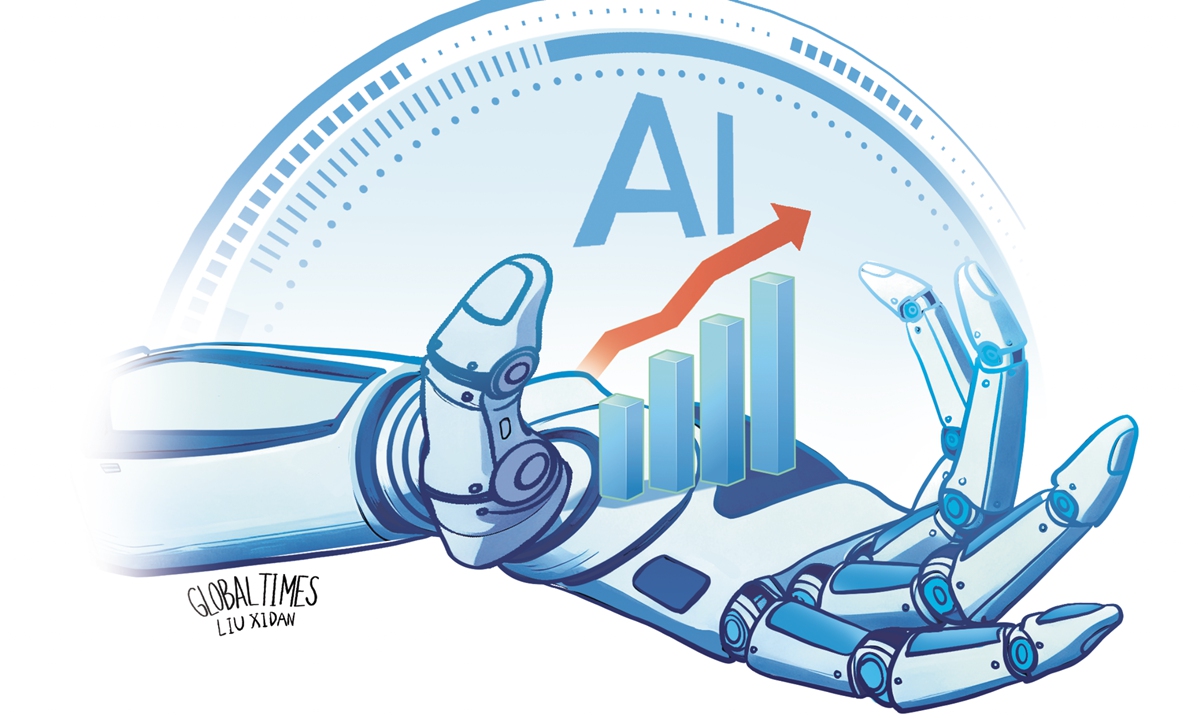
Illustration: Liu Xidan/GT
The artificial intelligence (AI) wave is reshaping business operations and growth worldwide. While automation has led to structural adjustments in corporate employment, the expansion of AI-related business is simultaneously creating new sources of revenue growth and generating new job opportunities.US tech company IBM will cut jobs this quarter, the company said on Tuesday, potentially affecting thousands of employees while it shifts focus toward its high-margin software segment, as Wall Street focuses on the company's ability to benefit from AI-linked cloud demand, Reuters reported.
Some analysts believe that layoffs at tech companies such as IBM triggered by AI are unusual because most of these companies' financial reports still show steadily rising profits, with AI-driven growth becoming a key contributor. This contradiction has sparked widespread global discussion about the relationship between AI, employment, and growth.
IBM's AI-driven products are a clear revenue growth engine. IBM's AI book of business grew to $9.5 billion in the third quarter, up $2 billion from the second quarter, and AI-driven mainframes boosted the company's infrastructure sales, Reuters reported in October.
AI is driving industrial transformation and rapid technological upgrading, pushing employment structures toward higher-end and more intelligent roles. At the same time, some traditional jobs will be eliminated or transformed, creating structural challenges for employment. For example, the widespread application of intelligent robots in manufacturing will have a certain substitution effect on the labor force, thereby reducing some jobs.
Meanwhile, AI has promoted the vigorous development of emerging industries and deeply integrated with the real economy, giving rise to many new industries, business formats, and models. According to the World Economic Forum's Future of Jobs Report 2025, AI and data-processing technologies are expected to create 11 million jobs while displacing 9 million jobs by 2030.
From a global perspective, the labor market changes triggered by AI vary significantly across countries. Employment markets in developed economies are generally more affected by AI but are also better-positioned to leverage the technology than some developing countries.
According to an IMF report Gen-AI: Artificial Intelligence and the Future of Work, 60 percent of jobs in advanced economies will be affected. In contrast, in emerging markets and low-income nations, the share of jobs affected by AI will be 40 percent and 26 percent.
China has shown remarkable resilience in addressing the employment challenges of the AI era. Through coordinated efforts combining policy support, corporate responsibility, and nationwide capacity building, China is exploring a path for AI innovation to coexist with employment stability. At the policy level, regions and government departments are accelerating the implementation of "AI+" initiatives, promoting the use of AI to empower a wide range of industries.
From the perspective of enterprises, AI is an inevitable trend of development, and its transformative impact cannot be avoided. However, through strategic planning, increasing investment, and proactive measures, businesses can turn potential challenges into opportunities.
To turn negative changes into opportunities, businesses need to respond more strategically to the transformations brought about by the AI wave. By balancing increased technology investment with workforce restructuring, companies can convert the adverse effects of AI into growth opportunities that benefit more people.
Moreover, companies that embrace AI not just as a tool for automation but as a driver for innovation are likely to gain a sustainable competitive advantage. By aligning technological adoption with human capital development, enterprises can ensure that the AI revolution becomes a catalyst for inclusive growth rather than merely a source of disruption.
The author is a reporter with the Global Times. bizopinion@globaltimes.com.cn
RELATED ARTICLES