Success of semiconductor industry is built on global collaboration: ASML China tells GT
By Published: Nov 07, 2025 10:36 PM

ASML Photo: VCG
The success of the semiconductor industry has been built on global collaboration, ASML China said in an interview with the Global Times on Friday.
Participating in the eighth China International Import Expo (CIIE) currently held in Shanghai, the Netherlands-based lithography tool maker described the mega import-themed event as a "bridge" to create opportunities to strengthen communication and exchanges both within and beyond the industry.
The company, taking part in the CIIE for the seventh time, said that the concept of "Shared Future" conveyed by CIIE aligns closely with ASML's corporate culture of "Collaborating," and being present at the CIIE also demonstrated the company's ongoing support for Chinese customers and markets within the boundaries of all applicable laws and regulations.
"We believe the continued success of the semiconductor industry depends on collaboration and innovation across all players in the value chain, and we are proud to contribute to this global ecosystem," the company said.
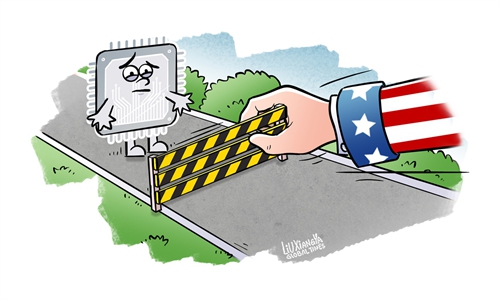
Some of the company's product exports to China have been under trade restrictions, and for that matter, ASML said "geopolitics are a matter of fact. We don't make the laws, we comply with all applicable laws and regulations including export control legislation in the countries in which we operate, while we continue to develop our technology and serve our customers to the best of our ability."
China remains an important part of the global semiconductor industry and a key market for ASML's long-term development. According to the company's recent third quarter financial results, it projected that China will account for over 25 percent of ASML's total sales in 2025.
In the most recent third quarter, China represented 42 percent of all ASML machine sales, the company said.
With China's intensive investment in smart manufacturing and artificial intelligence (AI), the company expects demand for relevant chips - particularly mainstream nodes - to remain strong.
"We maintain a fundamentally positive view of China's mainstream semiconductor nodes and believe the overall market remains healthy, continuing to play an important role in applications such as Internet of Things, automotive electronics, and consumer devices," the company said.
Commenting on the rise of Chinese AI such as DeepSeek and the rapid development of the AI sector, ASML said it believed that the rapid development of AI has strong potential to drive entire industry forward across many segments - not only driving demand for advanced chip technologies, but also greatly increasing the importance of the mainstream node segment - the backbone of large-scale, cost-effective, and energy-efficient AI deployment.
China's extensive AI application scenarios from DeepSeek to robotics, embodied intelligence, and AI-powered consumer devices also further fuel the demand for mainstream market growth such as sensors, power, analogs, among others, ASML said.
Chinese brands are now global leaders in sectors such as smartphones and electric vehicles. These industries are highly semiconductor-intensive, reinforcing steady demand across the value chain, the company said.
The Netherlands and China have recently experienced frictions in technological cooperation, particularly in the semiconductor sector.
Ministry spokesperson He Yadong said at a press conference on Thursday that the Netherlands' improper interference in the internal affairs of Nexperia has brought turmoil and chaos to these global chains, noting that China has promptly approved the relevant semiconductor export license applications of Chinese exporters and granted exemptions for eligible exports, working to facilitate the resumption of supplies from Nexperia China.
RELATED ARTICLES