Participants hail China's vibrancy in internet sector at Wuzhen Summit
From vision to action, nation's sharing of tech dividends highlighted
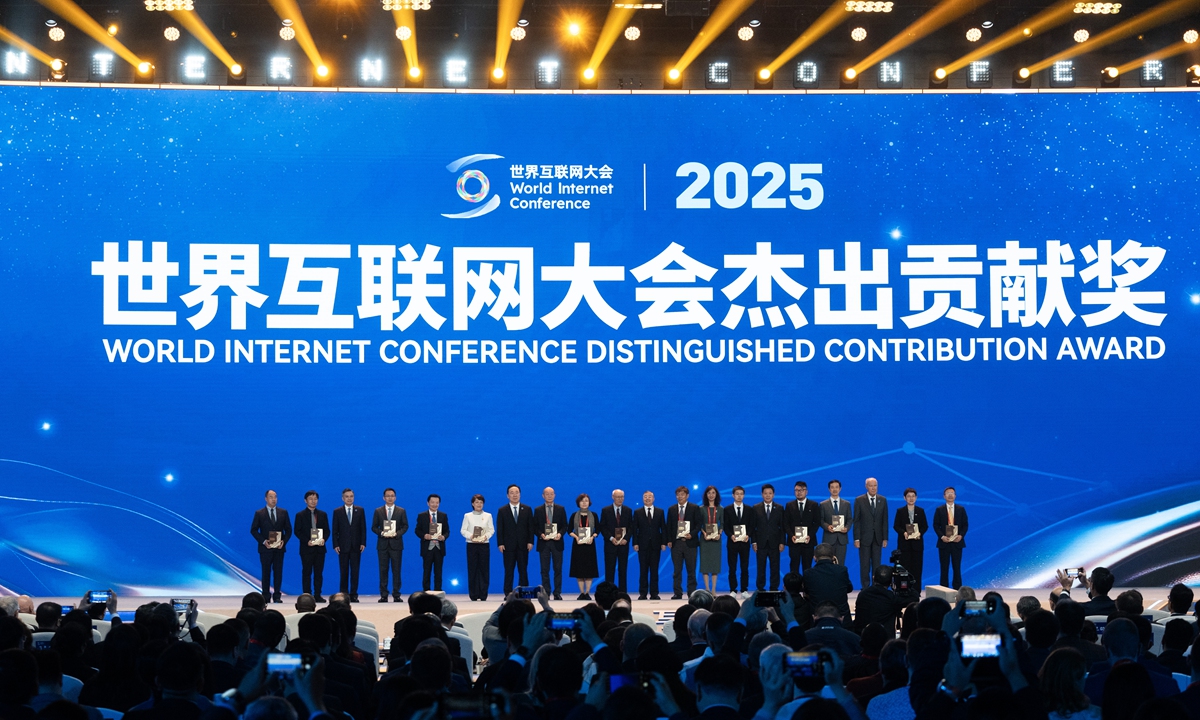
This photo taken on November 7, 2025 shows the distinguished contribution award ceremony during the opening of the 2025 World Internet Conference (WIC) Wuzhen Summit in Wuzhen, East China's Zhejiang Province. Photo: cnsphoto
The 2025 World Internet Conference (WIC) Wuzhen Summit kicked off on Friday in the ancient water town of Wuzhen in East China's Zhejiang Province, where global cyberspace representatives gathered to discuss internet- and technology-related topics and provide insights amid opportunities and challenges in digital development.
This year also marks the 10th anniversary of the concept of building a community with a shared future in cyberspace. Themed "Forging an Open, Cooperative, Secure and Inclusive Future of Digital Intelligence — Building a Community with a Shared Future in Cyberspace", this year's edition includes 24 sub-forums on topics such as the China-proposed Global Development Initiative, digital economy, AI and data governance, along with a series of activities.
During the summit, participants also hailed China's rapid development and fascinating innovation achievements in the sectors of internet and high technology, highlighting the country's contribution to benefiting other countries with its pragmatic actions. They also hailed China's open and inclusive approach, calling for closer cooperation to unlock the full potential of the digital field to enrich people's lives around the world.
From vision to action
With the rapid evolution of information technology, particularly the boom of artificial intelligence (AI), the vision of building a community with a shared future in cyberspace has become more vital to promoting the secure and stable development in cyberspace, industry participants said, noting that with the WIC as a platform, China has been a promoter of turning the vision into reality.
John Hoffman, CEO of the Global System for Mobile Communications Association, told the opening ceremony on Friday that "[The vision] was a call to build a digital future that benefits every person on our planet... Now, a decade on, let's look at where we are today. 4.7 billion people are now using mobile internet globally. In China, 80 percent of the population is connected to the mobile internet. The industry has built a thriving ecosystem that empowers the lives of users each and every day."
On the sidelines of the summit, John Higgins, chairman of International AI Governance Association, told the Global Times that "As people have over the years realized that the internet has no boundaries, there are common challenges and common approaches. Cooperation has become a more obvious thing to do. And so, I would say that the WIC has been one of those important drivers taking that forward... it has an important part to play in driving that international cooperation."
Noting that China's focus on technology and innovation, Higgins noted that people can talk about the importance of technology and innovation, but unless they invest in it and do positive things, it's just words. "So the examples I see... like the investment in places in Shanghai and in other parts of the country too, China puts substance behind those words, and that's what counts," he noted.
"Companies like Unitree with humanoid robots, DeepSeek with very large language models, Alibaba, Baidu, and telecom operators like China Mobile, China Unicom, and China Telecom... They were all there, contributing to our workshops and programming, showing demos and practical applications on how AI can help humanity in healthcare, agriculture and disaster management," Frédéric Werner, chief of Strategic Engagement at ITU and co-creator of the UN AI for Good Global Summit, told the Global Times.
China's contribution highlighted
In the Recommendations of the Central Committee of the Communist Party of China (CPC) for Formulating the 15th Five-Year Plan for National Economic and Social Development, China vowed to advance the Digital China Initiative.
As the country is accelerating innovation in digital and intelligent technologies, participants of the summit also hailed its contribution to bridging the digital gap via its pragmatic moves.
"Most of the infrastructure in my country is built by Chinese companies. In tech infrastructure, it is actually the Chinese companies which are doing the business with Botswana government," Bosupeng Moemedi, economist from the Ministry of Youth and Gender Affairs in Botswana said, noting that "As a developing country, we are looking forward to getting into digital economy. So digital economy will need a cybersecurity protection. What happens is as we start to mine our data, this needs to actually look to China as [the country] is advanced."
Chris Baryomunsi, minister for ICT and National Guidance of Uganda, told the Global Times that the digital divide remains a common challenge faced by many developing countries. The development of cyberspace should not lead to the strong getting stronger and the weak getting weaker, but rather foster inclusive growth where we stand together in the same boat. He noted that international organizations such as the World Internet Conference, along with some Chinese enterprises, are helping developing countries improve their network infrastructure through technology transfer and capacity building.
In Africa, a project under the China-Africa cooperation has provided satellite digital TV signals to 10,000 African villages; in Asia, the Asia Direct Cable, led and initiated by China, has delivered safer and more stable data connections for Asia-Pacific countries, particularly those in Southeast Asia; in Latin America, China has engaged in innovative cooperation with multiple countries using digital technologies to support the protection of tropical rainforest ecosystems and marine ecological environments, according to People's Daily.
Such practices fully demonstrate that "building a community with a shared future in cyberspace" is not an abstract concept, but a practical guide that can effectively address development challenges, the Ugandan official noted.
"China is one of only a few countries which is trying to bring countries together, to look at how best we can secure cyberspace and also how we can do new innovations in cyber. It's helping developing countries like those in Africa," Mudenda Mac Millan, senior conservation officer of the National Heritage Conservation Commission in Zambia, told the Global Times.
China is trying to bring almost everyone on board, Millan noted.
RELATED ARTICLES