What kind of sentiment made the news of the Fujian’s commissioning go viral?: Global Times editorial
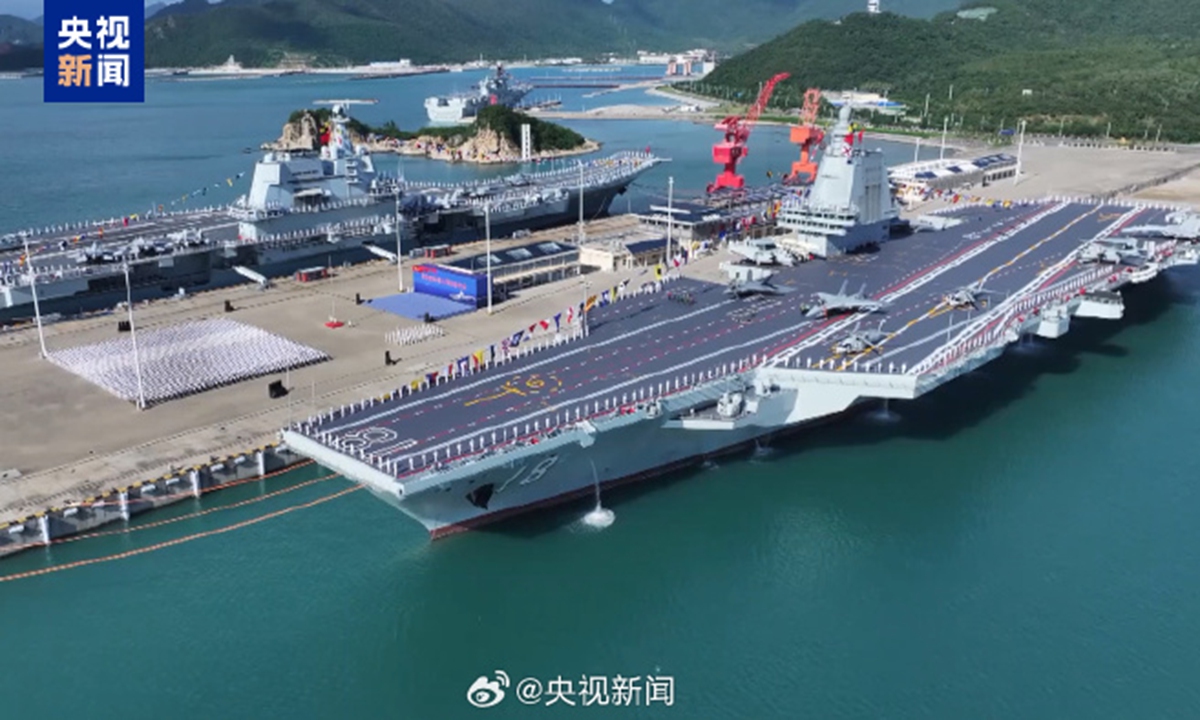
China's third aircraft carrier, the electromagnetic catapults-equipped Fujian (front), is officially commissioned at a naval port in Sanya, South China's Hainan Province on November 5, 2025. Photo: Screenshot from China Central Television
China's first aircraft carrier equipped with electromagnetic catapults, the Fujian, was officially commissioned on Wednesday. President Xi Jinping, also general secretary of the Communist Party of China Central Committee and chairman of the Central Military Commission, attended the ship's commissioning and flag-presenting ceremony, and boarded the aircraft carrier to inspect the vessel. The entry of China's third aircraft carrier into the PLA's combat sequence marks a historical juncture where the Chinese people's decades-long dream of building an aircraft carrier and their century-long aspiration to "become a maritime power" converge. It is also an important footnote in the great journey of a nation from being weak to strong.With the commissioning of the Fujian, China truly possesses all-weather aircraft carrier combat capabilities. From the Liaoning's journey of "from being nothing to something" to the Shandong's journey of "from being transformed to being domestically built," and now to the Fujian's journey of "from ski-jump to catapult," China, relying on its own strength and in just more than a decade's time, has completed in three major steps the journey of the aircraft carrier that took Western navies over a century to achieve. The Fujian is a crucial driving force behind the PLA Navy's new combat capabilities, not only providing the Navy with the most critical and reliable combat unit for far seas operations but also offering a solid guarantee of strength for the PLA to play a strategic supporting role in the nation's interests. The arrival of the three-carrier era signifies that the PLA Navy possesses an all-weather, long-range strike and defense combat system that can be deployed in rotation. It also marks a shift in the PLA Navy's strategy from coastal defense to far seas defense, which has a profound impact on reshaping the world's maritime power structure.
This is not only the fulfillment of a long-cherished dream for the Chinese people, but also a vivid reflection of China's spirit of independent innovation in the new era. It was Xi's decision that the Fujian adopt the electromagnetic catapult system. China is the second country in the world to master this technology and has already enabled its fifth-generation J-35 fighter jet to take off via electromagnetic launch and its KongJing-600 fixed-wing early warning aircraft to patrol the open seas. This is not merely a technical choice; it embodies strategic foresight, top-level planning, institutional advantage, and innovative thinking working in concert. It marks China's transformation from "striving to catch up" to "daring to lead," a path of technological self-reliance and self-strengthening in the new era. The rapid progress of China's aircraft carrier program is no coincidence.
The Chinese dream of building aircraft carriers carries a century of hardship and national aspiration. From the humiliation and tragedy of the First Sino-Japanese War to the confidence and composure of today's "three-carrier era," the journey toward the deep blue sea has been engraved with the steadfast footsteps of a nation's rejuvenation. Today, the Liaoning has achieved full combat readiness; the Shandong supports multiple aircraft types including the J-15 and J-35; and the independently developed and constructed Fujian equipped with electromagnetic catapults has officially entered service. No hegemony or pressure can stop China's march toward becoming a maritime power, nor can any force hinder China's determination or capability to safeguard global sea-lane security and protect its overseas interests. The commissioning of the Fujian fills the Chinese people with pride and inspiration. The wave of excitement online about the ship reflects a natural outpouring of national emotion.
The Fujian's entry into service has also drawn widespread international attention. Media outlets including the USNI News have expressed admiration for the technological advancements achieved by the Fujian aircraft carrier. But others that are long biased against China have covered the news in the narrative of the China-US naval competition, rehashing the old tune of the "China threat" rhetoric. Such remarks reveal an outdated Cold War mentality and an anxious state of mind. China's development of aircraft carriers has never been about "competing with anyone," but rather about meeting the needs of national security and technological progress, with the aim of safeguarding its sovereignty, security, and development interests. This stands in stark contrast to certain countries that frequently form military blocs and deploy carrier strike groups around the globe.
The Fujian's commissioning marks a solid step forward in the PLA Navy's development goal of transforming into a world-class force. As a responsible major power, China now possesses stronger confidence and more reliable means to uphold justice and moral principles. Since entering service in 2008, the hospital ship Peace Ark has completed 10 "Mission Harmony" humanitarian deployments. In Afghanistan and Tonga, the Y-20 transport aircraft streaks across the sky, carrying with it hope and peace. In this era defined by peaceful development, the Fujian represents China's capability and willingness to shoulder the responsibility of maintaining peace. It also stands as tangible support for creating an international environment free from coercion and conducive to shared development.
"How far is China from building an aircraft carrier" - 19 years ago, the Global Times Chinese edition posed that question on its front page, which is a symbolic footnote in the nation's journey toward strength and rejuvenation. Today, from the Fujian's deck, what launches into the sky is not only a fighter jet but also an ancient civilization's commitment to peace, dedication to innovation, and confidence in the future. The fleet that sails into the deep blue carrying a "heart for peace" will merge into the grand current of human progress, leaving an Eastern mark of the new era on the voyage toward a community with a shared future for humanity.
RELATED ARTICLES