HK remains mainland firms’ preferred platform for global expansion; InvestHK chief pledges further support
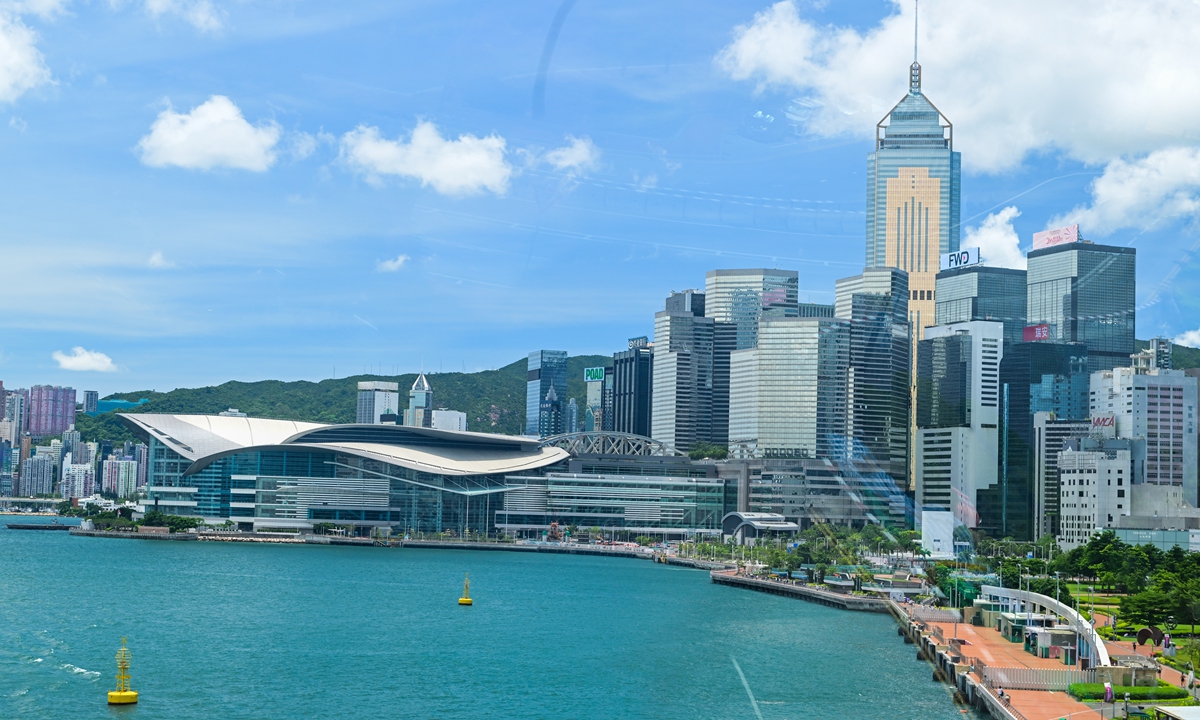
A view of Victoria Harbor, Hong Kong Photo: VCG
Leveraging its inherent business advantages and the dual opportunities under the "one country, two systems" framework, Hong Kong will continue to serve as a key two-way platform for attracting foreign investment and supporting Chinese mainland enterprises' global expansion, Ms Alpha Lau, director-general of InvestHK, told the Global Times in a written interview on Friday.These remarks came as Hong Kong companies take part in the ongoing 8th China International Import Expo (CIIE) in Shanghai, where 380 Hong Kong firms are participating this year, a record high.
The Hong Kong Special Administrative Region (HKSAR) government has set up a task force to support Chinese mainland enterprises in going global and to further help companies expand overseas, Lau said.
The task force provides a one-stop platform that coordinates government bureaus, departments, and relevant agencies to jointly tailor outbound expansion plans for enterprises, according to Lau. She added that it also works with partners including law firms, banks, and accounting firms to offer cross-departmental and cross-sector support, helping mainland enterprises accelerate their steps onto the global stage.
This year marks InvestHK's 25th anniversary. Over the past quarter century, the agency has assisted more than 7,700 overseas and mainland enterprises in setting up or expanding in Hong Kong, covering sectors including finance, innovation and technology, professional services, and sustainability, said Lau. These investments have created over 95,000 jobs, with cumulative direct investment exceeding HK$440 billion ($56 billion).
Lau noted that in the first nine months of 2025, InvestHK supported 482 mainland and overseas companies in setting up or expanding their operations in Hong Kong, up 10 percent year-on-year. Of these, 262 were from the Chinese mainland, making it the largest source. She said these companies are expected to bring more than HK$64.6 billion in direct investment and create over 9,200 jobs in their first year.
When asked what support Hong Kong can offer to mainland enterprises expanding overseas, Lau said these companies often encounter challenges in international payments, settlement and risk management. Hong Kong can address these needs with its international financial products, as well as logistics, insurance, and arbitration.
Lau highlighted Hong Kong's role as a key hub under the Belt and Road Initiative (BRI), providing financing and professional services to support infrastructure, energy, and technology projects in Global South economies. InvestHK is also working to attract more overseas banks and financial institutions to set up in Hong Kong, strengthening the city's role as a bridge for two-way capital flows, Lau told the Global Times.
Meanwhile, Lau noted that many Chinese mainland enterprises are themselves major buyers or sellers of commodities such as energy, metals and raw materials, or are involved in engineering and infrastructure projects under the BRI. Hong Kong provides a platform for these enterprises to conduct direct commodity trading.
Supporting mainland enterprises to expand overseas and serving as a key connector has long been an essential part of the city's policy agenda. The Hong Kong Chief Executive John Lee Ka-chiu earlier underscored support for mainland enterprises to "go global" in the 2025 Policy Address.
Mainland enterprises going global can establish Corporate Treasury Centres and regional headquarters in Hong Kong for cross-boundary settlement, remittance, financing, and related functions, the document said.
"They can also tap Hong Kong's professional, high value-added supply-chain services in fields such as accounting and law to help them explore overseas markets. In addition, they can leverage Hong Kong's strengths in marketing to connect with global buyers and build international brands," it added.
"Hong Kong has long been the preferred platform for mainland enterprises seeking to expand globally," said Lau, adding that as of 2024, a total of 2,620 mainland companies had established operations in the city, and more than 1,400 were listed in Hong Kong.
Notably, the city remains one of the world's most active IPO markets.
As of September 2025, there had been 69 new listings in the city, raising more than HK$180 billion and providing strong capital momentum for enterprises, Lau told the Global Times. Hong Kong ranked first globally in total IPO proceeds, while local market turnover also hit record highs — the Hang Seng Index has gained more than 30 percent so far this year, with average daily turnover exceeding HK$250 billion, Lau added.
The task force on supporting mainland enterprises in going global, with its events in Shanghai held alongside the CIIE, saw Hong Kong officials reaffirm the city's commitment to supporting mainland firms' overseas expansion.
On Thursday, the chief executive of the HKSAR attended the event and reiterated that Hong Kong will continue to align proactively with national development strategies and work with the mainland to open a new chapter of win-win cooperation.
Lee noted that Hong Kong is pleased to see a growing number of mainland enterprises using the city as a platform to raise capital, set up international headquarters, treasury centers, research and development hubs, and supply-chain management centers as they expand globally, according to the HKSAR's official website. He said Hong Kong will continue to strengthen its dual role as a "super connector" and "super value-adder," positioning itself as the best platform and partner for mainland companies going global.
Prior to this, Lee visited the Hong Kong pavilion at the CIIE and voiced support for the participating enterprises.
During the CIIE, Hong Kong companies promoted quality Hong Kong brands and products to mainland and overseas buyers, showcased diversified professional services and encouraged mainland firms to leverage Hong Kong's expertise and global platform to expand overseas and tap international business opportunities, the Xinhua News Agency reported on Thursday.
RELATED ARTICLES