ARTS / CULTURE & LEISURE
Gibbon unearthed in tomb of China’s first emperor Qinshihuang’s grandmother verified to be new extinct species
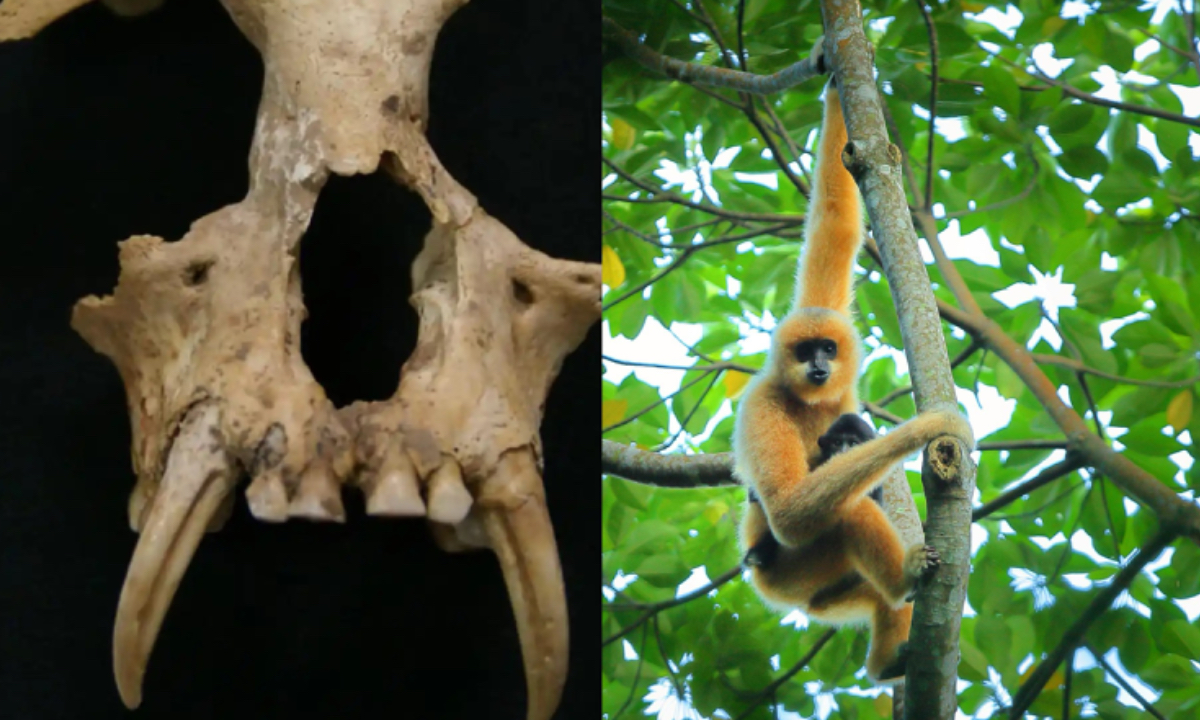
The skull of Junzi imperialis (left) and a Hainan gibbon Photo: Xinhua News Agency
An international team led by Chinese scientists has discovered that a gibbon unearthed from the tomb of grandmother of Qinshihuang, the first emperor of the Qin Dynasty (221-206BC), represents an extinct new species of Nomascus.
The research, titled "Genome sequences of extant and extinct gibbons reveal their phylogeny, demographic history, and conservation status," was published in Cell on Friday local time.
Using ancient mitochondrial DNA sequencing, the team determined that the gibbon remains excavated from Empress Dowager Xia's mausoleum in Xi'an, Northwest China's Shaanxi Province, belonged to a new species of Nomascus.
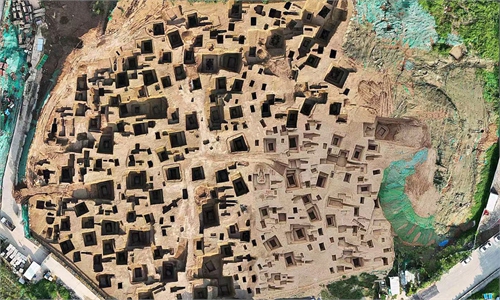
In 2004, archaeologists from the Shaanxi Academy of Archaeology uncovered a collection of animal bones, including gibbon remains, in Pit No. 12 during excavations at the mausoleum of Empress Dowager Xia.
A 2018 morphological study by Chinese and British researchers concluded that it represented a new genus and species of gibbon, and named it the "Junzi imperialis," which was thought to be extinct.
In 2025, a research team led by Fu Qiaomei, a research fellow at the Institute of Vertebrate Paleontology and Paleoanthropology (IVVP), Chinese Academy of Sciences (CAS), extracted and sequenced ancient DNA from the gibbon's teeth.
The results showed that the Junzi imperialis does not belong to a separate genus but is instead a new species, according to the Xinhua News Agency on Saturday.
"We corrected the previous classification and confirmed that the Junzi imperialis is a new species of Nomascus. It is closely related to today's Hainan gibbon," said Wu Dongdong, corresponding author of the study and a researcher at the Kunming Institute of Zoology at CAS.
The Pit No. 12 where the gibbon was found is located at the southeastern side of Empress Dowager Xia's tomb area, which lies in the southern suburbs of Xi'an. Other animals found in the same pit included leopard cats, lynxes, Asiatic black bears, and red-crowned cranes, along with bronze chains and feeding utensils.
"This suggests that more than 2,000 years ago, while she was alive, Empress Dowager Xia enjoyed keeping rare birds and exotic animals as pets in the imperial gardens. After her death, these animals were likely buried with her as part of the funerary rites, reflecting the ancient belief of treating the dead as the living," said Hu Songmei, a co-author of the Cell article and research fellow at Shaanxi Academy of Archaeology.
Researchers, from a genomic perspective, further confirmed that genomic history can reveal climate impacts and inform conservation of threatened gibbons.
The research was led by the Kunming Institute of Zoology of CAS, in collaboration with institutes including the IVVP of CAS, Sun Yat-sen University, the Shaanxi Academy of Archaeology, Shandong University, and National Museum of Scotland.
Global Times
RELATED ARTICLES