IN-DEPTH / IN-DEPTH
As long as we talk in a way others can understand, a friendship that crosses mountains and oceans will grow: Zambian vlogger and actor
Editor's Note:
Having enjoyed a long history, friendly exchanges between China and Africa have deepened in recent years, covering various fields such as politics, economy, and culture. The Global Times is launching a China-Africa Rhapsody series, aiming to showcase the profound human connections and development visions between the two peoples by sharing the true stories of Chinese people in Africa and African people in China. From touching stories of China-Africa cooperation and exciting collisions of youthful ideas to debunking fallacies concocted by some Western sources about China-Africa collaboration, this series hopes to promote closer cooperation and deeper understanding between the peoples of China and Africa.
This installment shares the stories of two young representatives active on China-Africa social networks and in various exchange settings, who talk about their affection for China and views on using digital means to further enhance exchanges between China and Africa.
"Ba Ta Jia De!"
This folksy Shaanxi dialect exclamation, roughly equivalent to "Whoa!" or "Hey!" and serving as a "mood trigger" for locals to express surprise or admiration, paired with his exaggerated facial expressions complete with playful winks, has earned Kawawa Kadichi's Douyin account over 60 million likes. Known online as the "Shaanxi black kid," Kadichi has come a long way since first arriving in China as an international student in 2015. From gaining recognition among Chinese audiences for his role as a trainee astronaut in The Wandering Earth II, to recently joining a Global Times China-Africa cultural exchange forum, he has become an unexpected cultural bridge, fostering connections that resonate with Generation Z.
Sincere exchange, shared belonging
Kadichi's connection with China began with a casual invitation from a high school classmate: "Want to go to China together?" "He joked around a lot, so I didn't take it seriously," Kadichi recalled. It was his mother who prompted him: "Why not give it a try?" Having been obsessed with kung fu movies since childhood, Kadichi decided to take a chance. He passed the international student exam and, at just 18, boarded a flight to Xi'an alone in 2015.
Upon arriving in Shaanxi, Kadichi threw himself into exploring Xi'an. After class, he would wander local food streets with Chinese classmates; on weekends, he'd crouch in urban villages watching elderly men play chess. Gradually, he deciphered the meaning of "Ba Ta Jia De" -- the locals' go-to exclamation. "It's an all-purpose expression conveying surprise or excitement," he explained. Later, this phrase became the opening line for countless of his short videos.
Looking back on his four years of study from 2015 to 2019, Kadichi says his sense of belonging to China grew from small, daily moments: the canteen aunt adding extra minced meat sauce to his meal, a classmate handing him a hand warmer on snowy days, strangers patiently guiding him when he got lost. "This is no longer a foreign land, China is my second hometown," he said. So when he graduated, he stayed in Xi'an.
Today, Kadichi keeps a busy schedule with dual roles: as an actor and short-video creator with millions of followers on Douyin. He is currently filming a new movie set for the 2027 Spring Festival release, traveling between domestic and international locations. At the same time, he recently established a media company in China which aims to "build a cultural bridge between China and Africa, bringing China's stories to Africa, and showcasing Africa's diversity to Chinese audiences."
The most exciting recent event for Kadichi was the "Global South Dialogue: Influence Together" held by the Global Times at the end of October. Exchanging ideas with artists like Wu Kenji and Ming Dao, as well as influential online creators such as the band The Landlord's Cat, performer Swag, and content creators like MENGXI, The Victorias, Chu Jiu, and Ikelilee, provided him with fresh perspectives on China's cultural and creative industries.
During the exchanges, music emerged as a key bridge of cultural connection. Wu highlighted the strong rhythm and vitality of African music, noting its profound influence on global rhythmic styles and its great potential for integration with Chinese music. He recognized the uniqueness of both African and Chinese cultural vitality in fostering innovative musical fusions.
The Landlord's Cat expressed deep affection for African music and indigenous instruments like the djembe, admiring their inherent rhythm and passion, while Swag admired the distinctive pronunciation, melody, and vocal riffs of African R&B, drawn to the unique flair African artists bring to this genre.
During the discussion with Kadichi, the guests agreed that short-form video platforms serve as a powerful tool for breaking stereotypes and promoting mutual understanding among young people worldwide. The Victorias couple explained that they use humorous videos to showcase their cultural characteristics and gain insights into interesting aspects of Chinese culture in return, while Chu Jiu noted that ordinary people, not just professional creators, can share daily life moments online, allowing audiences to experience each other's lives up close, such as the impressive makeup art by African creators she encountered. MENGXI stressed the importance of young people grounding their creative expressions in their own cultural heritage before integrating new ideas, a principle that underpins meaningful cross-cultural exchange.
Bridges beyond differences
As a long-time participant in China-Africa exchanges, Kadichi admits he's faced challenges: "Before coming to China, I thought all Chinese people wore qipao or other style's hanfu. Now I love China's traditional culture, but I still find it hard to explain customs accurately to people in Africa using only English or my mother tongue." This has only strengthened his resolve to use means of film and digital platforms. "Short videos' visual impact and films' emotional power turn abstract cultural differences into relatable details, that's the key to breaking down barriers," he said.
Since launching his short-video journey in 2017, Kadichi has captivated audiences with his authentic, off-the-cuff charm. Whether he's capturing the sizzle of oil poured over Shaanxi noodles or sharing anecdotes in the local dialect, his content continues to feel fresh, with this sense of contrast in style being central to his appeal.
This popularity opened him doors to the film and television industry. Reflecting on his roles in Ebola Fighters, Arrival is Everything, and The Wandering Earth II, Kadichi identified a common theme: "They all tell stories of China and Africa supporting each other through hardships." He was deeply moved by the fearlessness of Chinese medical teams in Ebola Fighters and the warmth of Chinese doctors training African interns in Arrival is Everything.
"China's film and TV industry is telling cross-cultural stories from more diverse perspectives. It not only gives foreign actors like me opportunities to shine but also lets more people feel the warmth of China-Africa friendship," he noted.
Looking ahead, Kadichi plans to return to Zambia at the end of this year to create content showcasing his hometown's customs and culture for Chinese audiences. This sincere intention has won warm responses from both sides: Zambian media have covered his story, with newspapers passed around by his hometown neighbors; on Chinese social media, fans leave messages like "Can't wait for you to take us on a virtual tour of Zambia."
Reflecting on his journey, the Zambian youth shared a core insight: his experience has taught him that cultural differences shouldn't be barriers, but can instead become unique bridges to bring people closer.
"Now, as I start my own company and work on new films, and even plan to return to Zambia to tell stories from my hometown, it's all about passing on this understanding. Whether you're Chinese or African, as long as we're willing to talk about life in a way the other can understand, a friendship that crosses mountains and oceans will naturally grow," he said.
Having enjoyed a long history, friendly exchanges between China and Africa have deepened in recent years, covering various fields such as politics, economy, and culture. The Global Times is launching a China-Africa Rhapsody series, aiming to showcase the profound human connections and development visions between the two peoples by sharing the true stories of Chinese people in Africa and African people in China. From touching stories of China-Africa cooperation and exciting collisions of youthful ideas to debunking fallacies concocted by some Western sources about China-Africa collaboration, this series hopes to promote closer cooperation and deeper understanding between the peoples of China and Africa.
This installment shares the stories of two young representatives active on China-Africa social networks and in various exchange settings, who talk about their affection for China and views on using digital means to further enhance exchanges between China and Africa.
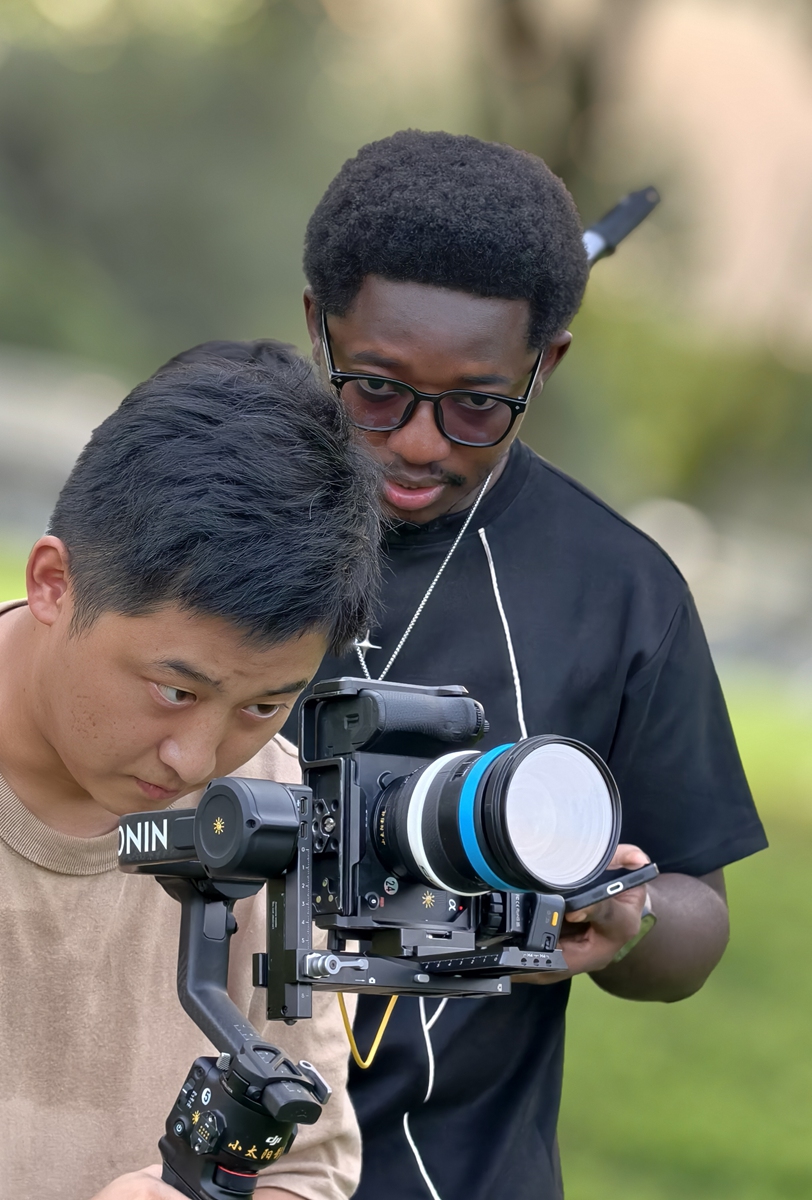
Kawawa Kadichi (right)discusses shooting ideas with a Chinese photographer on the set of a variety show on September 3, 2025. Photo: Courtesy of Kadichi
"Ba Ta Jia De!"
This folksy Shaanxi dialect exclamation, roughly equivalent to "Whoa!" or "Hey!" and serving as a "mood trigger" for locals to express surprise or admiration, paired with his exaggerated facial expressions complete with playful winks, has earned Kawawa Kadichi's Douyin account over 60 million likes. Known online as the "Shaanxi black kid," Kadichi has come a long way since first arriving in China as an international student in 2015. From gaining recognition among Chinese audiences for his role as a trainee astronaut in The Wandering Earth II, to recently joining a Global Times China-Africa cultural exchange forum, he has become an unexpected cultural bridge, fostering connections that resonate with Generation Z.
Sincere exchange, shared belonging
Kadichi's connection with China began with a casual invitation from a high school classmate: "Want to go to China together?" "He joked around a lot, so I didn't take it seriously," Kadichi recalled. It was his mother who prompted him: "Why not give it a try?" Having been obsessed with kung fu movies since childhood, Kadichi decided to take a chance. He passed the international student exam and, at just 18, boarded a flight to Xi'an alone in 2015.
Upon arriving in Shaanxi, Kadichi threw himself into exploring Xi'an. After class, he would wander local food streets with Chinese classmates; on weekends, he'd crouch in urban villages watching elderly men play chess. Gradually, he deciphered the meaning of "Ba Ta Jia De" -- the locals' go-to exclamation. "It's an all-purpose expression conveying surprise or excitement," he explained. Later, this phrase became the opening line for countless of his short videos.
Looking back on his four years of study from 2015 to 2019, Kadichi says his sense of belonging to China grew from small, daily moments: the canteen aunt adding extra minced meat sauce to his meal, a classmate handing him a hand warmer on snowy days, strangers patiently guiding him when he got lost. "This is no longer a foreign land, China is my second hometown," he said. So when he graduated, he stayed in Xi'an.
Today, Kadichi keeps a busy schedule with dual roles: as an actor and short-video creator with millions of followers on Douyin. He is currently filming a new movie set for the 2027 Spring Festival release, traveling between domestic and international locations. At the same time, he recently established a media company in China which aims to "build a cultural bridge between China and Africa, bringing China's stories to Africa, and showcasing Africa's diversity to Chinese audiences."
The most exciting recent event for Kadichi was the "Global South Dialogue: Influence Together" held by the Global Times at the end of October. Exchanging ideas with artists like Wu Kenji and Ming Dao, as well as influential online creators such as the band The Landlord's Cat, performer Swag, and content creators like MENGXI, The Victorias, Chu Jiu, and Ikelilee, provided him with fresh perspectives on China's cultural and creative industries.
During the exchanges, music emerged as a key bridge of cultural connection. Wu highlighted the strong rhythm and vitality of African music, noting its profound influence on global rhythmic styles and its great potential for integration with Chinese music. He recognized the uniqueness of both African and Chinese cultural vitality in fostering innovative musical fusions.
The Landlord's Cat expressed deep affection for African music and indigenous instruments like the djembe, admiring their inherent rhythm and passion, while Swag admired the distinctive pronunciation, melody, and vocal riffs of African R&B, drawn to the unique flair African artists bring to this genre.
During the discussion with Kadichi, the guests agreed that short-form video platforms serve as a powerful tool for breaking stereotypes and promoting mutual understanding among young people worldwide. The Victorias couple explained that they use humorous videos to showcase their cultural characteristics and gain insights into interesting aspects of Chinese culture in return, while Chu Jiu noted that ordinary people, not just professional creators, can share daily life moments online, allowing audiences to experience each other's lives up close, such as the impressive makeup art by African creators she encountered. MENGXI stressed the importance of young people grounding their creative expressions in their own cultural heritage before integrating new ideas, a principle that underpins meaningful cross-cultural exchange.
Bridges beyond differences
As a long-time participant in China-Africa exchanges, Kadichi admits he's faced challenges: "Before coming to China, I thought all Chinese people wore qipao or other style's hanfu. Now I love China's traditional culture, but I still find it hard to explain customs accurately to people in Africa using only English or my mother tongue." This has only strengthened his resolve to use means of film and digital platforms. "Short videos' visual impact and films' emotional power turn abstract cultural differences into relatable details, that's the key to breaking down barriers," he said.
Since launching his short-video journey in 2017, Kadichi has captivated audiences with his authentic, off-the-cuff charm. Whether he's capturing the sizzle of oil poured over Shaanxi noodles or sharing anecdotes in the local dialect, his content continues to feel fresh, with this sense of contrast in style being central to his appeal.
This popularity opened him doors to the film and television industry. Reflecting on his roles in Ebola Fighters, Arrival is Everything, and The Wandering Earth II, Kadichi identified a common theme: "They all tell stories of China and Africa supporting each other through hardships." He was deeply moved by the fearlessness of Chinese medical teams in Ebola Fighters and the warmth of Chinese doctors training African interns in Arrival is Everything.
"China's film and TV industry is telling cross-cultural stories from more diverse perspectives. It not only gives foreign actors like me opportunities to shine but also lets more people feel the warmth of China-Africa friendship," he noted.
Looking ahead, Kadichi plans to return to Zambia at the end of this year to create content showcasing his hometown's customs and culture for Chinese audiences. This sincere intention has won warm responses from both sides: Zambian media have covered his story, with newspapers passed around by his hometown neighbors; on Chinese social media, fans leave messages like "Can't wait for you to take us on a virtual tour of Zambia."
Reflecting on his journey, the Zambian youth shared a core insight: his experience has taught him that cultural differences shouldn't be barriers, but can instead become unique bridges to bring people closer.
"Now, as I start my own company and work on new films, and even plan to return to Zambia to tell stories from my hometown, it's all about passing on this understanding. Whether you're Chinese or African, as long as we're willing to talk about life in a way the other can understand, a friendship that crosses mountains and oceans will naturally grow," he said.
RELATED ARTICLES