ARTS / CULTURE & LEISURE
Booming musical market in China: a cultural symphony of exchange
By Published: Nov 10, 2025 10:17 PM

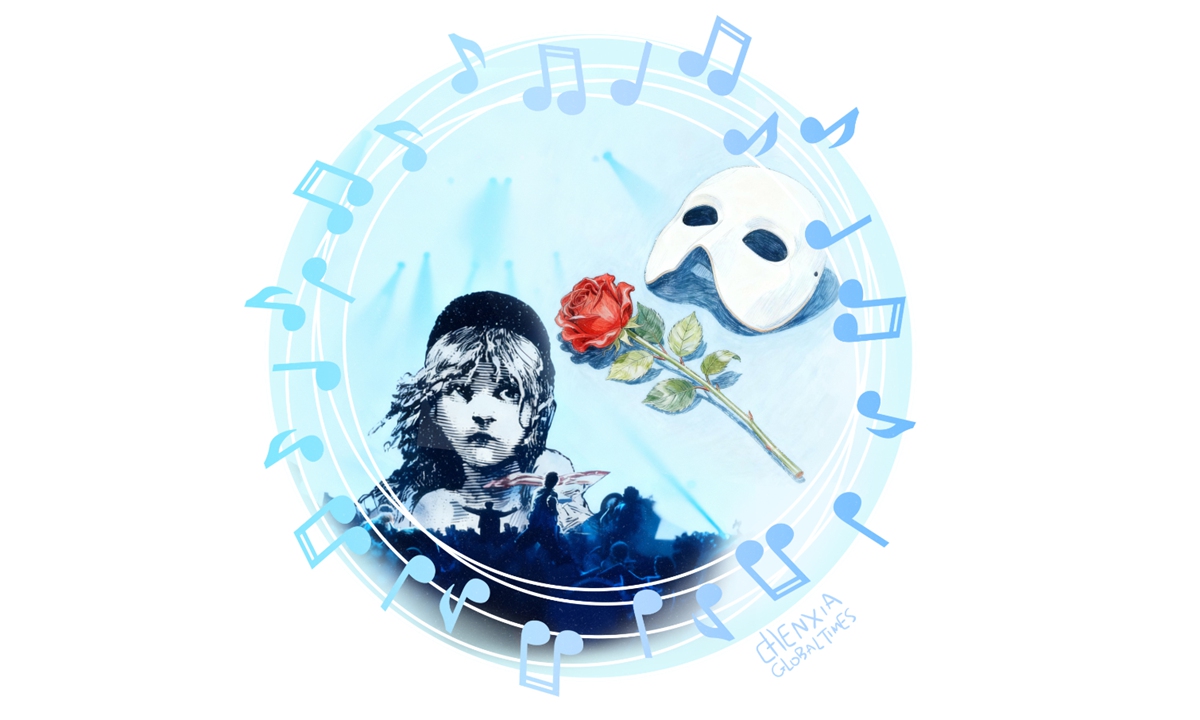
Illustration: Chen Xia/GT
On November 4, the original English production of Les Misérables returned to Shanghai for a 55-day, 64-performance residency. Just two days later, on November 6, the original The Phantom of the Opera announced 24 shows in Beijing from November 11 to 30, its third staging in a decade at the Tianqiao Performing Arts Center. These back-to-back premieres underscore the surging demand for international musicals in China, transforming the country into a pivotal hub on global touring circuits.From London's West End and New York's Broadway to French romances and German-Austrian classics, top-tier overseas productions are increasingly prioritizing China. Their footprint is expanding beyond first-tier cities like Shanghai and Beijing into emerging markets such as Nanjing, Chengdu, and Wuhan.
This influx has evolved China's musical theater from a niche interest into a vibrant economic and cultural force, fueled by audience passion and market maturity.
The journey began over two decades ago. "In 2002, Les Misérables arrived in China, followed by Cats in 2003, and The Sound of Music and The Phantom of the Opera in 2004," recalls Zhang Xiaoding, general manager of the Shanghai Grand Theatre. "That era marked the initiation of domestic audiences into musical theater, progressing from novices to today's dedicated enthusiasts. The past 20 years have witnessed accelerated growth in China's musical market."
Data from the China Association of Performing Arts and Dengta Institute, released in August, confirms this momentum: Box office revenue of musicals for the first half of 2025 rose 15.1 percent year-on-year, with a surge in international classics. Productions like Notre-Dame de Paris, Sunset Boulevard, and Chicago enjoyed multi-city runs, drawing packed houses.
A striking trend is "cross-city theater-going" among young fans. For the Shanghai-exclusive residency of SIX, 30.8 percent of attendees traveled from other cities, illustrating cultural consumption's ripple effect. "Traveling to a city for a specific show" has become a lifestyle, boosting regional infrastructure and vitality. As touring routes widen, they signal improved venues and heightened cultural engagement nationwide.
The musical markets in cities like Nanjing, Chengdu and Wuhan are experiencing rapid growth. The expanding touring routes of overseas productions in China reflect both the improvement of cultural infrastructure and enhanced regional cultural vitality.
Chinese audiences contribute more than revenue; they bring sophistication and fervor. Musicals, as a synthesis of music, drama and spectacle, forge emotional bridges across cultures. French works' lyrical romance and German-Austrian productions' philosophical depth align seamlessly with Chinese aesthetics - emphasizing melody, poetic expression, and tragic resonance. Curtain calls often erupt into collective choruses, creating transcendent moments.
A viral video from January captured this magic: during Notre-Dame de Paris in Shanghai, the audience sang along in French to "Le Temps des Cathédrales." Online praise flooded in - "Shanghai audiences are so sophisticated" and "This is the spirit of Shanghai: constant learning and improvement." The French cast's response, "Thank you, Shanghai," transformed the finale into genuine intercultural dialogue.
Deeper connections drive success. Mozart l'Opéra Rock reimagines the composer's rebellious life through rock energy, echoing modern Chinese youths' quests for self-actualization. Tragic elements in these melodies strike profound chords, peaking in shared singalongs that unify performers and viewers.
Social media amplifies this enthusiasm. On Bilibili, Xiaohongshu (Red Note), and similar platforms, fans share reviews, fan art, and secondary creations, blending art with personal expression. The Notre-Dame de Paris singalong video exemplifies organic promotion, drawing new aficionados and sustaining the ecosystem.
As the market matures, China has been shifting from importing to exporting. Collaborations blend foreign expertise with local talent, upgrading the industry. Sustainable growth demands mastering production mechanisms and nurturing originals rooted in Chinese narratives.
A milestone is The Butterfly on the Bund 1939, the first Chinese original musical to secure a long-term overseas residency. In Seoul's Daehakno (nicknamed as University Street) of South Korea - home to nearly 200 theaters - this Shanghai-set story of cheongsam-clad characters performed 85 shows in its debut run, averaging 95 percent attendance and attracting over 15,000 viewers.
This provides a new paradigm for the "going out" of Chinese culture, proving that stories with authentic local characteristics can resonate internationally. Its success demonstrates that Chinese original musicals, rooted in local culture, can find acceptance and appreciation overseas, encouraging more attempts to "go global."
Yang Jia, a professor at the Shanghai Theatre Academy and Tony Award voter, advocates balance: "Chinese musicals must take root in our culture while absorbing international techniques. We should fuse traditional stories with the modern stage to craft an Eastern philosophical aesthetic."
Musicals bridge worlds. Chinese viewers glimpse global perspectives, while international audiences encounter China's openness through the stage. This bidirectional exchange composes a new chapter in civilizational dialogue, harmonizing tradition and innovation.
In this symphony, overseas musicals do more than entertain - they cultivate shared humanity, propelling China's cultural confidence onto the world stage. In this two-way artistic exchange, a dialogue between civilizations is writing a new chapter.
The author is a reporter with the Global Times. life@globaltimes.com.cn
RELATED ARTICLES