Illustration: Xia Qing/GT
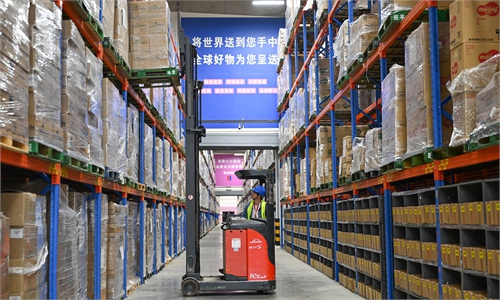
Once a domestic shopping festival, China's Double 11 now straddles two fronts - driving massive sales at home while testing the reach of its cross-border e-commerce network. According to the Xiamen Daily on Monday, the city's cross-border e-commerce supervision center is in its peak export season. Inside the facility, conveyor belts run at full speed as boxes of shoes, apparel, and home goods move through inspection and customs clearance. Each step, from order verification to release, demonstrates how efficiently Chinese products are reaching consumers worldwide.Xiamen's experience is far from unique. As the Changjiang Daily recently reported, a cross-border bonded warehouse in Wuhan, Central China's Hubei Province, is also operating at full capacity. A manager at one logistics company noted that some cross-border shipments now achieve "next-day delivery."
Each year, the Double 11 festival serves as a real-world test for cross-border logistics networks. Whether a parcel arrives the next day - or even the same day - provides a tangible demonstration of how far China's cross-border logistics sector has progressed. For overseas consumers, these shrinking wait times provide a clear, firsthand sense of the speed and efficiency now possible in global delivery.
The accelerating pace of cross-border e-commerce logistics is underpinned by a complex, interconnected system. From faster customs clearance to expanded flight schedules and data-driven supply chain management, industry-wide improvements have made rapid international delivery possible.
One example from recent years is the adoption of the "9610" model for cross-border e-commerce at an increasing number of Chinese ports. The model applies to individuals or e-commerce enterprises and uses a list-based verification and summary declaration approach, significantly improving clearance efficiency and reducing costs. According to reports, this system allows goods to bypass traditional customs procedures at border checkpoints, streamlining clearance and cutting both time and cost. Together with numerous other incremental improvements across supply chains, these measures have collectively propelled the advancement of China's cross-border logistics.
China has taken concrete steps to support cross-border e-commerce. In the Government Work Report released this March, authorities pledged to promote cross-border e-commerce by improving logistics services for cross-border delivery and boosting the development of overseas warehouses.
This year's Double 11 offers a vivid and tangible glimpse of progress in cross-border delivery. The ongoing development and continuous refinement of China's cross-border e-commerce logistics network not only facilitate the expansion of Chinese exports, but also make it easier for foreign products to access the Chinese market. In this way, the system is fostering a two-way flow of goods that strengthens both domestic and global trade.
As delivery times for cross-border e-commerce products get shorter, the sector is unlocking even greater opportunities. Faster logistics services not only enhance the consumer experience but also allow businesses to respond to demand with unprecedented speed, expanding the potential for trade and market reach.
The benefits of China's cross-border e-commerce extend well beyond its own borders. Thanks to integrated industrial, supply, and logistics networks, the sector enjoys cost efficiencies, wide platform reach, and a diverse array of product offerings. This accessibility enables small and medium-sized enterprises, as well as individual consumers around the world, to engage more readily in international trade.
Bolstered by growing competitiveness and capacity, China's cross-border e-commerce is moving steadily toward high-quality development. Concurrently, China is strengthening pragmatic cooperation with trading partners across the globe. As the sector reaches record highs, it is generating positive spillover effects for other economies, offering international businesses expanding opportunities in a dynamic marketplace.
In 2024, China's cross-border e-commerce imports reached 555.25 billion yuan ($78 billion), up 4.1 percent year-on-year, accounting for 3 percent of China's total imports that year. While maintaining stable cooperation with traditional trading partners in Europe and North America, China has also deepened engagement with economies from other regions including Southeast Asia and Latin America.
The 2025 Double 11 shopping festival is set to offer a clear measure of the progress achieved in international logistics. Looking ahead, China's cross-border e-commerce is expected to maintain strong momentum, underpinned by digital transformation initiatives, ongoing policy support, and broader efforts toward high-level opening-up in foreign trade.
Continued advancements in logistics will further consolidate the sector, creating a dynamic marketplace and fostering deeper engagement between Chinese and international consumers. The bustling activity at Xiamen's e-commerce supervision center provides a snapshot of this long-term evolution, signaling a more vibrant and interconnected global cross-border shopping ecosystem.
The author is a reporter with the Global Times. bizopinion@globaltimes.com.cn
RELATED ARTICLES