Illustration: Xia Qing/GT
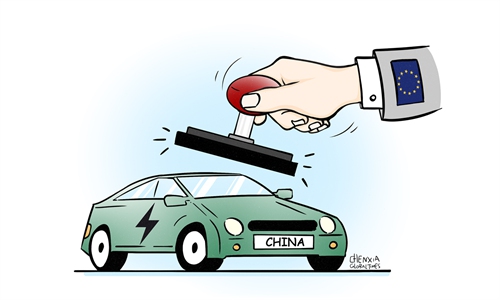
Austrian private railway company Westbahn recently announced plans to put four long-distance trains manufactured by Chinese giant trainmaker CRRC into operation, marking the first time for Chinese-made double-decker trains to run on Austrian rails.Yet, this landmark development has sent ripples through the European railway industry, with insiders expressing fears that China's "low-cost competition" in the electric vehicle sector might be replicated in the railway industry, the French daily Le Monde reported on Monday.
Yet, this phenomenon is less a case of scrutiny of a specific commercial transaction than a reflection of the anxiety of some in Europe. They cling rigidly to the narrative that "Chinese manufacturing succeeds by undercutting prices," turning a blind eye to an undeniable reality: no global railway equipment procurement decision is ever based solely on price.
The true rationale behind Westbahn's choice is clear. As Marco Ramsbacher, managing director of Westbahn's board of directors stated, the choice of CRRC was driven by quality, innovation, and delivery time, according to media reports. This shows that the entry of Chinese trains into the European market is not driven by a so-called "low-price strategy" but by superior product performance and service capacity.
Simply misinterpreting such a market choice as a case of "low-cost competition" reflects underlying worries about a potential decline in one's own competitiveness. It is not uncommon to see that when local suppliers fail to meet delivery demands, some Chinese companies step in to fill the gap with their comprehensive strength. This is a natural outcome of optimal resource allocation in the global market. To groundlessly attribute this success to "low prices" ignores both the arduous research and development efforts of Chinese businesses and the remarkable strides made in China's industrial upgrading.
In today's era of deeply integrated economic globalization, no product can maintain a market edge relying solely on low prices. Chinese manufacturing's ability to reach markets worldwide and win over billions of consumers lies in its decades of accumulated advantages, which include a comprehensive industrial chain, efficient production management systems, and mature supply networks.
Take CRRC's breakthrough in Europe, for example. Europe's railway system boasts world-leading technical standards and complex operational requirements. CRRC's ability to overcome the strict access barriers of the European railway market stems neither from lower bids nor from policy favors, but from technical solutions tailored to Europe's railway networks, rapid delivery capabilities that meet urgent construction timelines, and safety reliability proven through long-term business practice.
Chinese manufacturing has achieved leapfrog development in high-end manufacturing and technological innovation. From high-speed rail, photovoltaic products, and new-energy vehicles to 5G equipment, these products of Chinese manufacturing all rest on a foundation of reliable quality, continuous technological iteration, and comprehensive after-sales service. The reputation they have built globally is first and foremost one for "quality," with price advantage secondary.
Even in the consumer goods sector, examples of enhancing product value through design upgrades, brand empowerment, and user experience optimization are ubiquitous, completely shattering the stereotype of "winning the market through low prices." This transition from "scale advantage" to "technological advantage" is the core confidence that sustains Chinese products' success in global markets.
For a high-end equipment product to gain a foothold in highly regulated and competitive markets like Europe's, it must possess comprehensive competitive advantages across technology, quality, service, and cost control. To reduce this achievement to "relying on low prices" is to ignore the arduous efforts behind China's industrial rise.
As Chinese manufacturing accelerates its transformation into "smart manufacturing," such a biased narrative rooted in outdated perceptions will ultimately be shattered by an ever-growing array of high-end products, leading technologies, and global brands from China.
RELATED ARTICLES