ARTS / CULTURE & LEISURE
Chess and AI: human element indispensable in future landscape
Photo: VCG
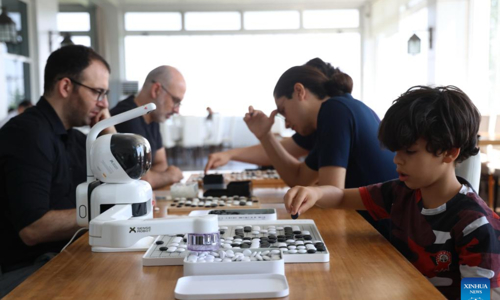
An artificial intelligence robot simultaneously playing against two human chess players drew crowds of onlookers at the 8th China International Import Expo on Monday. Using visual recognition to read the board and AI algorithms to decide moves in real time, it demonstrated the precision and power of modern chess-playing technology, once again reminding people how profoundly AI is reshaping chess games.Earlier in 2025, the Chinese Weiqi Association announced that a young player had been found using AI assistance during a national Go championship. The association imposed a severe penalty of revoking her ranking and banning her from competition for eight years. The association stated that it would take the new trends in AI development in the game of Go, known as Weiqi in China, seriously.
In fact, similar controversies have surfaced across the international chess world. Professional players in South Korea, Japan, and other countries have also been suspended for using AI tools to cheat in official matches.
This is not an isolated incident, but rather an unavoidable question for the world of chess in the age of AI.
Since AlphaGo defeated South Korean grandmaster Lee Sedol in 2016, AI has continuously reshaped the chess and Go worlds. That historic "man-versus-machine" match not only marked the moment when AI surpassed human capability in complex strategic games, but also became a turning point in the history of human cognition.
In the past, a brilliant move on the board represented talent and enlightenment. Today, such flashes of inspiration have become replicable and predictable within the logic of AI algorithms. Against such a backdrop, cheating is not only a matter of breaking rules, it serves as a reminder of the limits of human thought.
"AI has transformed the Go world, now, many amateur players who train with AI have already developed the ability to compete with professionals," said Ding Hao, China's first post-2000 chess player to win three world championships.
Ding practices with AI every day. He noted that while humans tend to make a chain of mistakes after losing their composure, AI's calm precision can in turn help players stay composed. For his generation, the presence of AI has already become second nature.
"AI brings us closer to perfection, but also farther from ourselves." This sentiment captures the psychological dilemma of players in the AI era: In the relentless pursuit of victory, humanity is gradually losing the courage to dance with uncertainty.
"The intervention of AI is driving chess into its second 'revolution,'" Wang Yuefeng, a professional Go player of eighth dan rank, told the Global Times on Tuesday. "The first 'revolution' was a shift from intuition to rationality, when ancient players relied on experience and insight; the second is a shift from rationality to coexistence, where AI becomes an extension of human thought."
"How to coexist with algorithms has become an unavoidable question for a new generation of players," Wang said. "Rejecting AI is unrealistic; the real challenge lies in how we use it."
According to Wang, AI can be a tool for improving skill, or a shackle that limits creativity. Players must learn to rebuild intuition beyond data and preserve their human imperfection amid perfect algorithms.
Wang sees AI as a "frame of reference," not a "final answer," seeking new possibilities within the directions that algorithms suggest. This conscious transformation, he said, "represents the hope of true symbiosis between human intelligence and artificial intelligence."
In the chess games of the future, humans may no longer play alone, but they will still have the right to ask: When algorithms can calculate everything, what is still worth holding onto?
Perhaps the answer lies in that fleeting moment of hesitation, intuition, and courage - the human heartbeat behind every move, something no AI can ever replicate.
The author is a reporter with the Global Times. life@globaltimes.com.cn
RELATED ARTICLES