Why China-Spain relationship has become a model of international interaction: Global Times editorial
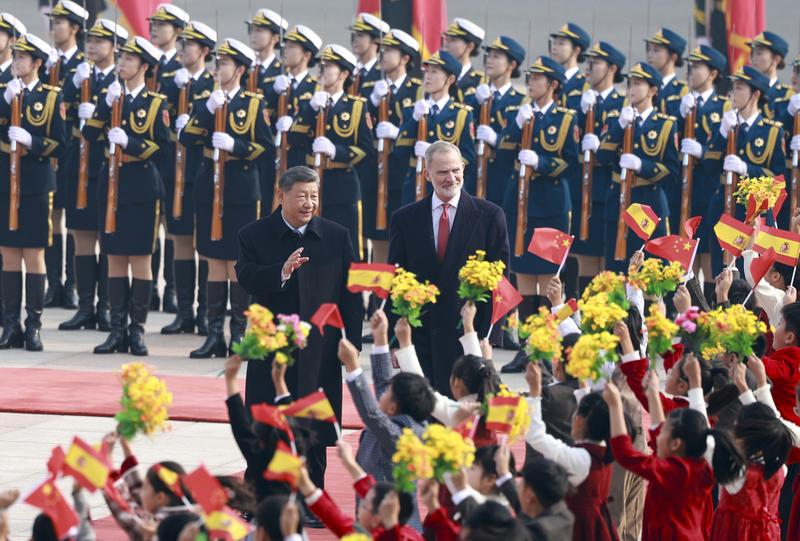
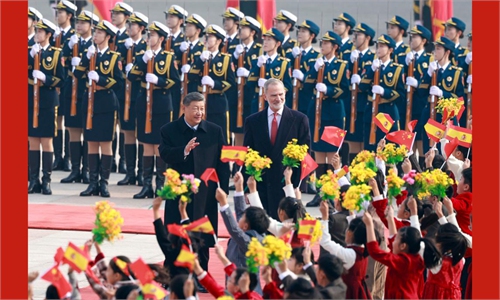
Chinese President Xi Jinping holds a welcome ceremony for King Felipe VI of Spain at the square outside the east gate of the Great Hall of the People prior to their meeting in Beijing on November 12, 2025. Photo: Xinhua
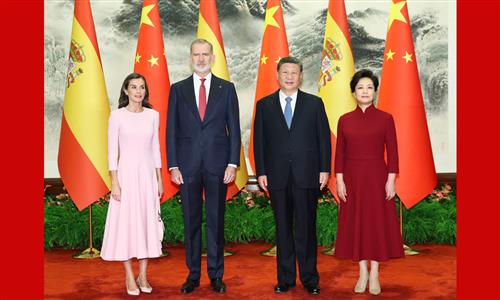
Chinese President Xi Jinping met with King Felipe VI of Spain, who is on a state visit to China, at the Great Hall of the People in Beijing on Wednesday. This marks King Felipe VI's first state visit to the country after his enthronement and the last visit by a Spanish monarch to China took place 18 years ago. As the two countries celebrate the 20th anniversary of the establishment of their comprehensive strategic partnership, Spain has engaged in royal-level interactions with China through a high-level state visit, which highlights the importance it attaches to China-Spain relations and sends a clear signal of cooperation.
During the meeting, the two heads of state spoke highly of China-Spain relations. President Xi stated that over the past 50-plus years since the establishment of diplomatic ties, the two sides have always viewed and developed bilateral relations from a strategic height and long-term perspective, respected and supported each other, and contributed to each other's success. This has set a model of pursuing amicable ties and common development by countries with different history, culture and social systems, and played an important role in promoting openness and cooperation in the world and upholding international fairness and justice.
Following the meeting, the two heads of state jointly witnessed the signing of 10 cooperation documents in trade and economy, science and technology, and education, among others, adding a new chapter to the steady development of China-Spain relations.
Underscoring that China values the traditional friendship with Spain and its unique role in international and regional affairs, President Xi said that China is willing to work with Spain to build a more strategically resilient and dynamic comprehensive strategic partnership with greater international influence. These remarks have garnered extensive global attention, behind which lies a convergence of deep mutual trust and shared vision between the two countries. Strategic resilience stems from respect for each other's core interests; dynamism arises from the economic complementarity and innovative synergy; and international influence is built upon equal coordination within a multilateral framework. King Felipe VI's visit has drawn significant international attention. China-Spain cooperation has advanced in a steady and solid manner. Spain is now China's fifth-largest trading partner within the EU, while China has become Spain's largest trading partner outside the EU. Spanish ham has made its way onto Chinese dining tables, while Chinese electric vehicles, smartphones, and computers have entered the Spanish market. Additionally, China will extend its visa-free entry to Spanish citizens. Since the beginning of this year, Spain has achieved a "grand slam" of visits to China, from its head of state, prime minister to foreign minister. China and Spain are approaching each other and developing together based on mutual respect and pragmatic rationality.
As a key EU member, Spain's China policy has consistently maintained coherence and stability. This stems from its clear understanding of a multipolar world and its conscious pursuit of strategic autonomy amid global transformation. While some countries are still debating how to position their relations with China, Spain has already made its choice through concrete actions. Spain has consistently opposed any "decoupling" or "severing of supply chains" with China. In July of this year, Spain signed a contract worth 12.3 million euros with Huawei, despite external pressure. Currently, Chinese companies such as CATL, Envision, and Chery are investing in factories in Spain, and BYD is also likely to establish its third European factory there. These projects will not only fill critical gaps in Spain's new energy industry chain but will also drive local employment and technological upgrades.
Many have noted that the King of Spain chose Chengdu, Sichuan Province, as the first stop of his visit to China this time. With the deepening of coordinated regional development and the formation of advantageous industries in various regions of China, opportunities for cooperation with countries around the world, including Spain, have objectively expanded. The Spanish government has opened a consulate general in Chengdu, and Sichuan Airlines has launched a direct flight route from Chengdu to Madrid. Trade, tourism, and cultural exchanges between the two countries are thriving. Currently, more than 40 Spanish companies have established operations in Chengdu, and the Chengdu High-tech Zone and the Barcelona Science Park in Spain have engaged in in-depth cooperative projects in areas such as clean technology and smart energy. The choice of this first stop alone demonstrates that China-Spain cooperation is flourishing in multiple areas.
Although the two countries are separated by thousands of miles, both have a long and splendid historical civilization, value their cultural traditions, and uphold an open and inclusive national character. As the world enters a new period of turbulence and transformation, the pursuit of peace and development remains a long and arduous journey. In this context, the healthy development of China-Spain relations holds significant importance that transcends bilateral ties.
This way of coexistence, based on mutual respect, equality and mutual benefit, between China and Spain, not only aligns with the fundamental interests of the peoples of both China and Spain, but also provides valuable insights for the development and progress of China-EU relations and the world as a whole. The practices of both countries have demonstrated that countries are fully capable of transcending differences in social systems and ideological divergences. Through dialogue and consultation, they can build consensus and work together to turn the aspirations of their peoples for a better life into reality.
RELATED ARTICLES