PLA Daily reveals training data of China’s three carriers; expert says statistics demonstrate far seas capabilities
By and Liang Rui Published: Nov 13, 2025 03:12 PM

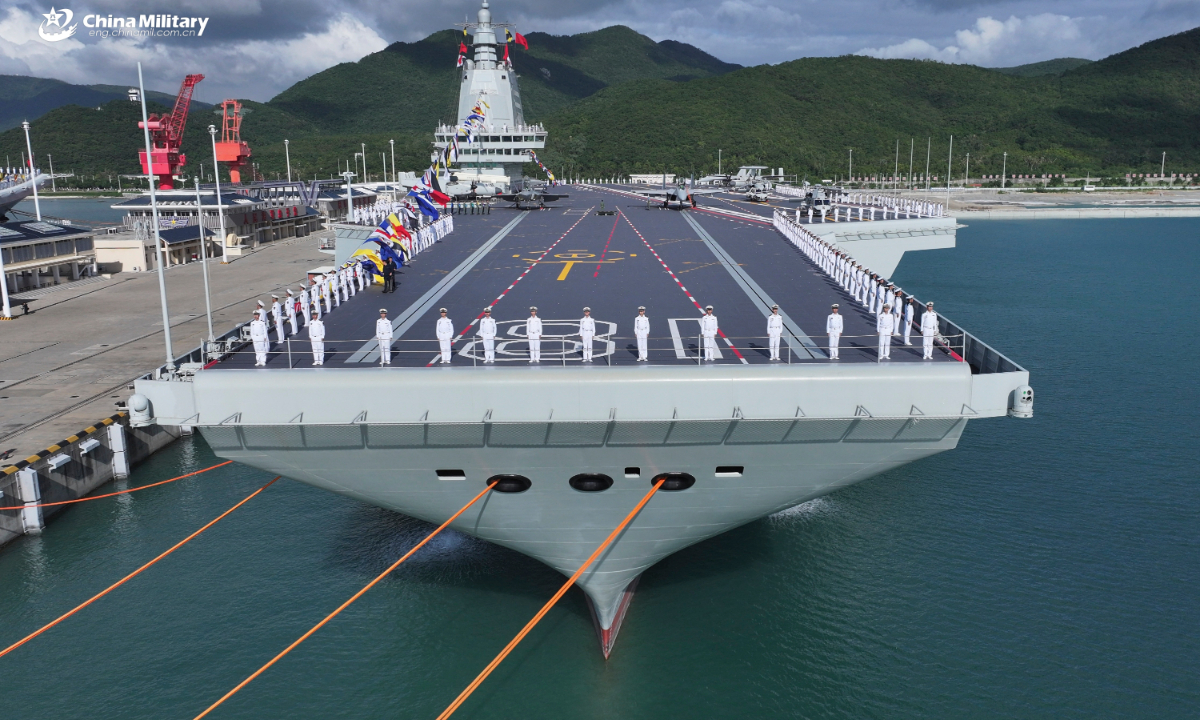
Sailors man the rails during the commissioning and flag-presenting ceremony of the Fujian (Hull 18), China's first aircraft carrier equipped with electromagnetic catapults, in South China's Hainan province on November 5, 2025. Photo: China Military Online
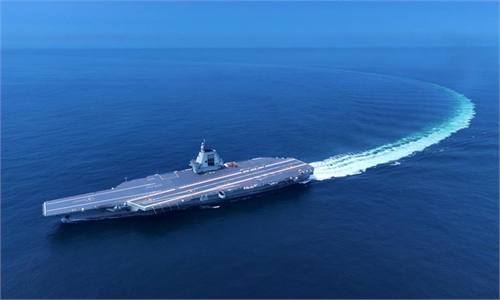
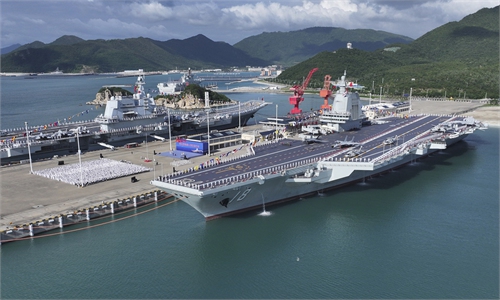
With the official commissioning of the aircraft carrier Fujian into the Chinese People’s Liberation Army (PLA) Navy last week, China has officially entered the era with three aircraft carriers. The PLA Daily on Thursday revealed a set of data about the three aircraft carriers and their training exercises, with an expert saying the statistics demonstrated the carriers’ far seas capabilities.
The data was released in a PLA Daily report titled “Our aircraft carriers, our era,” which was described as a distillation of achievements reached in training exercises.
“The aircraft carrier Liaoning is not a training ship or experimental ship as mistakenly assumed by netizens. From the moment it was commissioned, it has been aimed at preparing for war and combat. Aircraft have long been fully deployed on the ship, and regular open-sea combat readiness training has been conducted,” the PLA Daily report quoted Zhang Hongyang, an officer at the navigation department of the Liaoning, as saying.
In 2024 alone, the Liaoning has sailed for nearly 30,000 nautical miles, Zhang said.
Although the aircraft carrier Shandong has only been in service for less than six years, the total number and frequency of carrier-based aircraft sorties it has launched are beyond people's imagination, said Wei Lanke, an officer at the aircraft takeoff and landing support unit of the Shandong, according to the PLA Daily report.
Wei revealed that the number of aircraft sorties on the carrier Shandong in the past two years alone is several times the total of the previous four years.
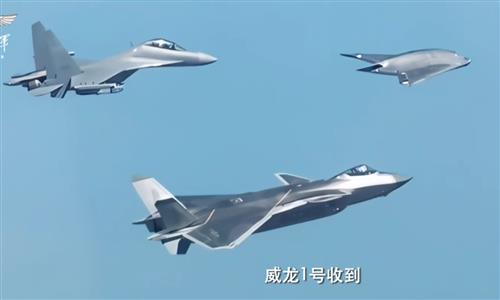
In their first electromagnetic catapult launches on the aircraft carrier Fujian, the three types of carrier-based aircraft, namely the J-35, J-15T, and KJ-600, successfully conducted dozens of launches, all achieving success on the first attempt, said Tian Wei, an officer at the aviation support department on the Fujian, the PLA Daily reported.
This was predicated on tens of thousands of land-based simulation drills and dead-load vehicle catapult tests, as well as countless all-nighters and relentless efforts, Tian said.
Zheng Ziqian, a carrier-borne fighter jet pilot, was quoted by the PLA Daily as saying that “during every far seas mission, I conduct combat sorties almost every day. Every aerial encounter and engagement with foreign military aircraft stems from the confidence forged by over 1,000 combat-oriented training sorties.”
Zhang Junshe, a Chinese military affairs expert, told the Global Times on Thursday that this set of data showed that China’s aircraft carriers have already achieved operational capabilities in far seas to conduct maritime defense missions.
With the increasing number of aircraft on board the newly commissioned Fujian, the overall combat capabilities of Chinese aircraft carriers will grow even stronger, the expert said.
When asked when the Fujian will be fully equipped with carrier-based aircraft, Leng Guowei, a PLA Navy spokesperson, told reporters on Saturday that carrier-based aircraft are the core of an aircraft carrier's combat capability. While the Fujian was under construction, the research, development and testing of supporting equipment, including carrier-based fighter jets such as the J-35, J-15T and J-15D, the KJ-600 carrier-based fixed-wing early warning aircraft, and the Z-20 series carrier-based helicopters, have also been steadily advancing as planned.
As for when full deployment of carrier-based aircraft onboard will be achieved, the spokesperson said that he shares the same expectations as everyone else and believes it will not be long.
RELATED ARTICLES