ARTS / CULTURE & LEISURE
Glazed pagoda model returns home to Nanjing after 110 years
A century-long odyssey
By Published: Nov 13, 2025 08:44 PM

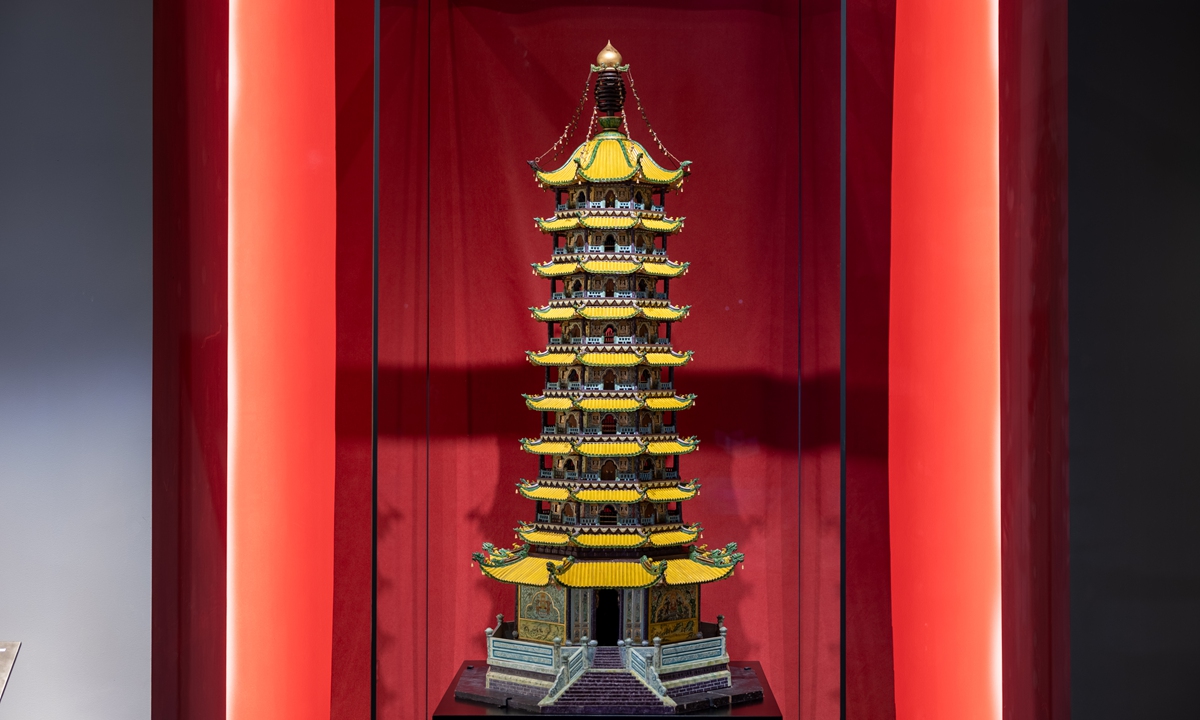
The wooden model of Nanjing's lost Glazed Pagoda Photo: Courtesy of the Nanjing's Great Bao'en Temple Ruins Museum
From Chicago in the US to Nanjing in China, the flight spans 13 hours and more than 11,000 kilometers. But for a finely crafted wooden model of the legendary Chinese glazed pagoda, the voyage home took more than one century.Last August, while scrolling through Xiaohongshu, a Chinese social media platform, Qiu Linwan caught a post showing 84 pagoda models exhibited in Singapore.
As the head of exhibitions at the Nanjing Great Bao'en Temple Ruins Museum, she recognized one of them instantly: It was a model of the Glazed Pagoda that she and her colleagues had spent years researching.
"That's our pagoda!" Qiu recalled in an interview with the Global Times on Wednesday. "I was so excited! It was like a window of hope swinging open."
She immediately shared her discovery with the museum's director, Wang Wenxi.
Back then, the two were tracking artifacts linked to the Great Bao'en Temple, which was largely destroyed in the 19th century. They knew from academic papers that institutions like the British Museum and the Metropolitan Museum of Art in New York held at least 19 architectural fragments from the Nanjing temple.
"We wanted a clearer picture of what was still out of China," Wang told the Global Times.
When they saw the post about the model of the Great Bao'en Temple pagoda, also known as the Porcelain Tower in the West, both Wang and Qiu were thrilled, as it offered the most complete representation to date of the structure, once considered one of the architectural wonders in the world.
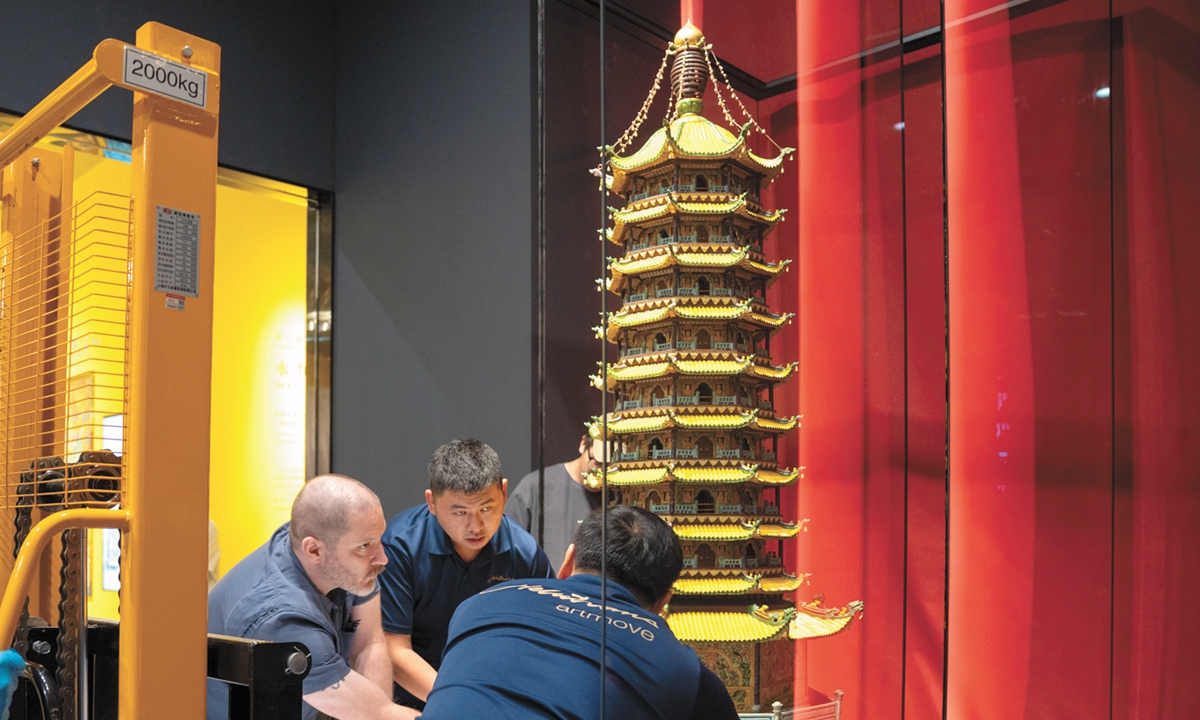
Staff members carry the wooden model of Nanjing's lost Glazed Pagoda into the Great Bao'en Temple Ruins Museum in Nanjing on September 19. Photo: Courtesy of the Nanjing's Great Bao'en Temple Ruins Museum
Architectural legacy
The original Porcelain Tower, built during the Ming Dynasty (1368-1644) by the Emperor Zhu Di in honor of his mother, rose 78 meters in an elegant, octagonal form of nine stories, adorned with glazed tiles and bells.
By the time Scottish photographer John Thomson visited Nanjing in 1871, it was already a ruin. His photograph captured little more than a large dew-collecting basin that once sat atop the pagoda, and a monk leaning against it.
Once regarded by the world as one of the Seven Wonders of the Medieval World, it even inspired the design of the pagoda in London's Kew Gardens. The complex had been destroyed in warfare 15 years earlier.
So where did this model come from, and why was it exhibited in Singapore? After Qiu's extensive research, the model that resurfaced in Singapore, however, told a more vivid story - one shaped by an unexpected blend of craft, persistence, and coincidence.
It was made around 1910 by young apprentices at the Tushanwan Orphanage, an institution established by Western missionaries in late-Qing-era Shanghai. Under the guidance of German missionary Aloysius Beck, who had grown fascinated by Chinese architecture, nearly 300 youths participated in a project to construct detailed wooden models of pagodas from across China.
Beck had sent letters and telegrams to churches nationwide, asking for information and drawings of local pagodas. The scope extended from Jiangsu and Zhejiang provinces in the east, to Gansu Province in the west, Guangdong Province in the south, and Liaoning Province in the northeast of the country.
But just as the models were completed, the original commission was canceled. To recoup costs, Beck arranged for their display at the 1915 Panama-Pacific International Exposition in San Francisco. Two years later, the Field Museum of Natural History in Chicago purchased 84 of them.
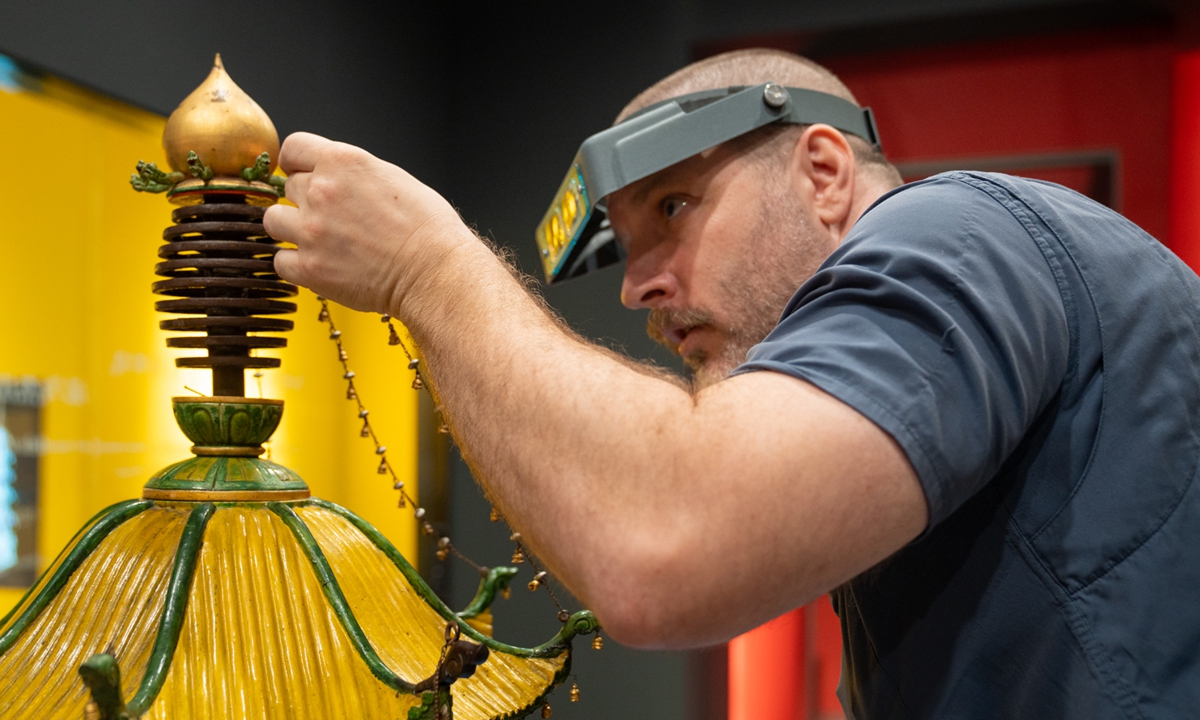
A staff member interacts with the wooden model of Nanjing's lost Glazed Pagoda. Photo: Courtesy of the Nanjing's Great Bao'en Temple Ruins Museum
Long way home
For decades, the models remained at the Field Museum. Then, in 2007, all but three were sold into private hands - eventually acquired by Singapore's Asian Civilisations Museum. To reassemble the full set of the models for a special exhibition, the Singapore museum borrowed the remaining three from Chicago, including the Great Bao'en Temple model. The show, "Pagoda Odyssey 1915: From Shanghai to San Francisco," opened on May 31, 2024.
That's when Qiu Linwan's determined efforts began.
She emailed the Field Museum, proposing a loan of the Glazed Pagoda model for an exhibition in Nanjing.
"I emailed every address I could find - assistants, the director's office," she said.
It wasn't until early 2025 that she got a reply from Lauren Hancock, the head registrar for anthropology collections at the Field Museum. Her answer was tentative but open. Qiu submitted a formal loan request. Again, it met with silence.
She understood the hesitation. The model, nearly two meters tall, is fragile, with delicate wooden bells and a need for precise climate control - conditions the Nanjing museum, opened in 2015, was still working to guarantee the preservation of such a wooden artifact.
"They didn't know us, and our facilities didn't fully meet their standards. So why should they lend it?" Qiu said.
In March 2025, she requested a video call. She prepared a detailed slide deck and showed five Field Museum staff members the Nanjing team's detailed plan: a custom-built display case, a carefully designed transport route, and even modifications to the museum's doorway to accommodate the 2.41-meter crate without tilting the pagoda.
"They were genuinely moved by our sincerity," she noted.
Welcome home!
In September, the model flew from Singapore to Nanjing. When the cargo plane landed safely, Qiu finally relaxed. On October 1, as part of the museum's 10th-anniversary exhibition, the pagoda model went on display.
"Welcome home!" one Nanjing resident wrote on the comment board.
For Nanjing residents and museum staff alike, the homecoming is deeply symbolic. "Visitors have always asked what the original Glazed Pagoda looked like, and why such a large site has so little left," Qiu said. "Now, they can see."
"I think this is where it belongs, where it can be most appreciated," said Daniel J. Kaping, conservator at the Field Museum of Natural History, who accompanied the model from Singapore to Nanjing, as he watched local residents admiring the model so much.
Director Wang Wenxi said she hopes the model could stay in Nanjing. "It has been lost for too long. Nanjing is the most fitting place for it. This touching story needs a happy ending."
Wang and her team are still in talks with the Field Museum, in the hope of finding a way to keep the model for Nanjing residents.
For a pagoda that once inspired architects in London and awed Western travelers across centuries, the model's return closes a circle - not just of miles, but of memory.
RELATED ARTICLES