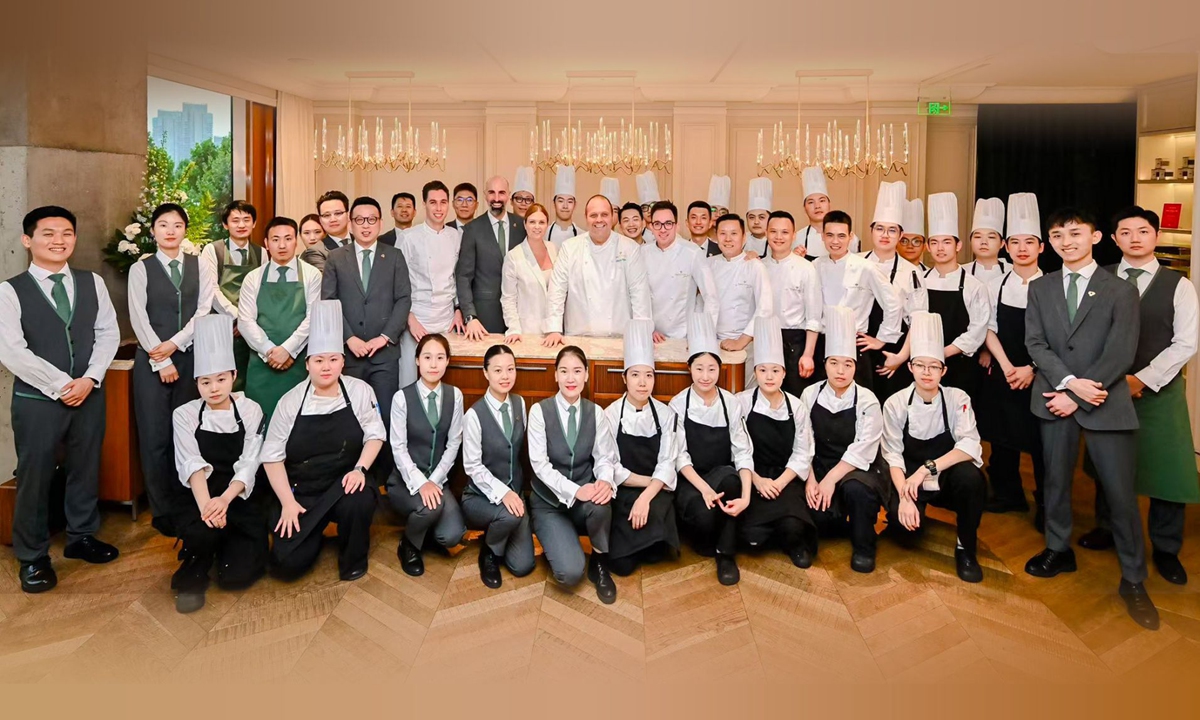
The kitchen and dining room team of an Italian restaurant in Shanghai Photos on this page: Courtesy of Da Vittorio
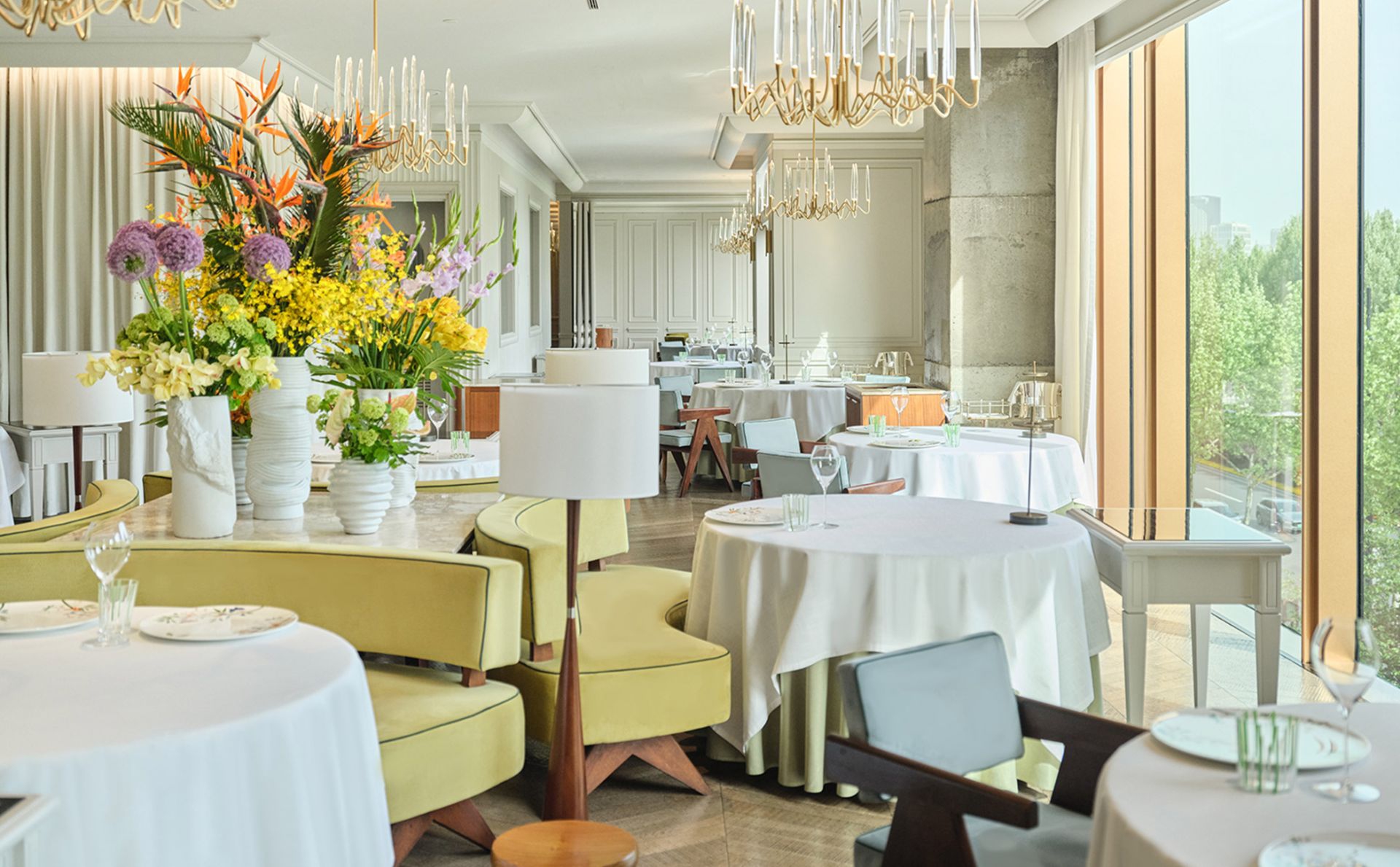
An interior view of an Italian restaurant in Shanghai
In the world of Chinese consumption, Italian food and wine have played and continue to play a leading role among foreign cuisines, with all the lights and shadows that characterize this position. Indeed, while Italian food, one of the most famous in the world with its equally varied wine pairings, arrived in this land relatively late, there was an undeniable surge in past decades, especially around the time of the Shanghai Expo in 2010.
The days when French dominance over "Made in Italy" seemed to depend solely on the presence of large Carrefour and Auchan supermarkets in China are now long gone, and the red- and blue-branded hotel chains are far behind us. In reality, above all, there existed and still largely exist customs constraints regarding health on certain products, such as beef and fruit. Despite these constraints, Italian food, or rather the agri-food sector of "Made in Italy," has made progress, and along with it, the restaurant industry has seen the opening of mid-range establishments - typical Italian trattorias - rather than fine-dining restaurants such as Niko Romito, Da Vittorio, 8 1/2 Otto E Mezzo Bombana, and Caffè Armani, opened in Shanghai and Beijing.
"The key to the success of Italian cuisine is its identity," explained Umberto Bombana, who arrived in Asia from Bergamo in 1993 and is one of the few chefs in the region awarded three Michelin stars for his restaurant in Hong Kong. "Unlike others that draw from here and there, regardless of how good each may be, Italian cuisine, like French and Japanese, has a codified register; for this reason, you always know what will arrive at your table."
Italian cuisine made its debut in the Chinese market in the early 1990s in hotels and through some entrepreneurial initiatives of small family-run joint ventures between Italians and Chinese. The greatest difficulties for these operators were sourcing the basic ingredients to cook, especially the so-called fresh ones. However, through fairs and events during a period of development and opening of the Chinese economy, they represented Italy in the best possible way.
After 2004, activities stabilized, and thanks to some Chinese importers who had food import licenses, consumption began to increase significantly. A significant figure was reported in a publication from the Italian Consulate in Shanghai in June 2014: if before 2004 many imports passed through Hong Kong and the Shenzhen area in South China and were therefore difficult to trace, from that year onwards, Italian agri-food exports rose from almost zero to 350 million euros (about $400 million) in just nine years. In the first seven months of 2025, Italy recorded agri-food exports worth 291 million euros, with a year-on-year value increase of 9.71 percent. This figure should be viewed in light of the fact that overall Italian exports to China fell by 7 percent year-on-year. Therefore, despite a market share in China of only 1 percent, Italian agri-food is gaining ground in China. In particular, exports of fresh cheeses saw a leap of 38.7 percent in the early months of 2025, according to Assocaseari, the Italian industry association.
"There is a gradual recovery in consumption also because some Italian products are entering the Mediterranean cuisine present in China with Greek and Spanish nationalities," confirmed Massimiliano Boccia, manager of Emporium, an import company based on the island of Taiwan with a branch in Shanghai, dealing with Italian food products including Farine Caputo, Ponti, and Latteria Sorrentina. The dairy sector covers various products ranging from cheeses to powdered milk for both industry and infants, as well as casein, lactose, butter, and yogurt. However, Italy is practically absent from the export of long-life milk.
Another weakness of "Made in Italy" lies in the cured meat sector. After two decades of negotiations hindered by a long-standing swine fever issue in Sardinia, only limited import protocols have been approved - allowing prosciutto crudo (Italian dry-cured ham) and mortadella (Italian sausage) to be shipped from pre-authorized slaughterhouses - while other cured meats that would likely attract Chinese consumers remain excluded. Nevertheless, Senfter and Beretta have activated local production with good results for years. In particular, Senfter, a company from South Tyrol of northern Italy with 160 years of history, is a successful story in China, where Helmuth Senfter arrived in 1995, and after years of trade, he began producing cured meats in Jiaxing in East China's Zhejiang Province, not far from Shanghai, in a highly technological 20,000 square meter facility.
They process around 8,000 pieces per month using fresh, non-frozen legs of lean Chinese pork, sourced through a supply chain featuring Europeanized genetics. Today, the production of prosciutto crudo with a twelve-month aging represents the predominant core business, and within the production area, there are three other segments: cooked ham that must compete with similar products already historically present in China, especially in the north, salami with an Italian brand innovation in the fermentation process, and lastly, sausages. As for beef, it cannot be imported from Italy, while there are no bans from South America, Australia, and New Zealand. In the fruit and vegetable sector, only Italian kiwifruit have received approval for import. The dry pasta sector is well represented in China with the most significant Italian brands, and demand is growing, while Italian rice is imported only for restaurants for risottos.
In the coffee segment, dominated by large international brands like Starbucks or Chinese brands like Luckin Coffee, Cotti, and Manner, which together total over 50,000 points of sale, Italian brands occupy a growing niche. "The first category is premium, which synthesizes lifestyle and experience with clientele such as luxury restaurants," explained Walter Lumino, managing director of Illy Caffè in China, the Trieste-based company with over 90 years of history. "The second is B2B with seven points of sale and dozens of distributors. The third is B2C with domestic and cross-border online sales of canned and capsule products." However, much work remains to be done by intergovernmental commissions to finalize other products that can complement the development and enhancement of Italian cuisine. Among the associations that deal with the dissemination of "Made in Italy" products and culinary knowledge, the Italian Academy of Cuisine is primarily carrying out this task while awaiting UNESCO's decision on whether to designate Italian cuisine as an intangible cultural heritage of humanity in mid-December. The Global Food Trade Show, which opened on Wednesday in Shanghai, would be an excellent test to verify the recovery of Chinese consumption of "Made in Italy" food products.
RELATED ARTICLES