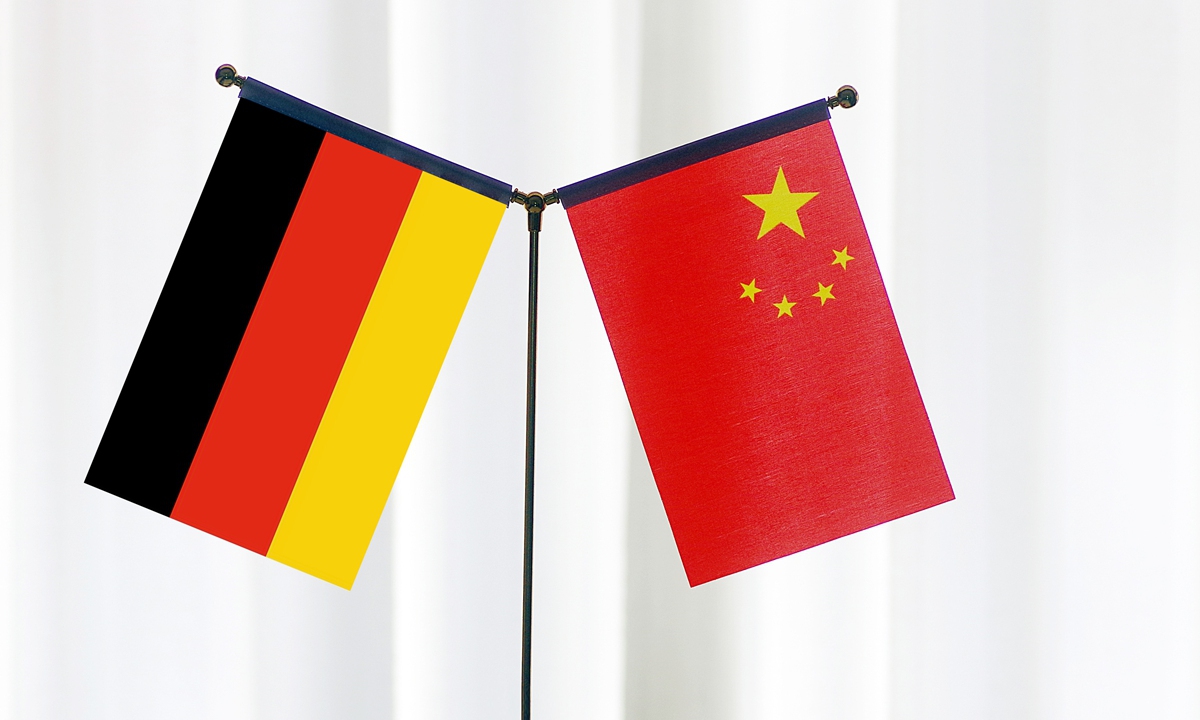
China Germany Photo:VCG
The fourth China-Germany High-Level Financial Dialogue will be held in Beijing on November 17, as agreed between the two countries.
Member of the Political Bureau of the CPC Central Committee, Vice Premier of the State Council and the Chinese lead person of the Dialogue He Lifeng will co-chair the Dialogue with Vice Chancellor, Federal Minister of Finance and the German lead person of the Dialogue Lars Klingbeil, a spokesperson for the Chinese foreign ministry announced on Friday.
The talks come amid a backdrop of frequent bilateral trade between the two economies.
China overtook the US as Germany's largest trading partner in the first eight months of 2025, regaining the top spot as higher tariffs weighed on German exports to the US, Reuters reported on October 22, citing preliminary data from the German statistics office.
German imports and exports with China totaled 163.4 billion euros ($190.7 billion) from January to August, while its trade with the US amounted to 162.8 billion euros, according to Reuters calculations.
In addition, political and business exchanges between China and Germany have remained active this year. On Tuesday, Chinese Minister of Commerce Wang Wentao held a video call with Katherina Reiche, Germany's economy and energy minister, during which they exchanged views on bilateral and China-Europe trade issues.
Wang said that China and Germany are each other's major economic and trade partners. Wang emphasized that China will continue advancing high-standard opening-up, and that it will foster a world-class business environment and continue to offer development opportunities for foreign companies, including German firms, according to a notice on the ministry's website.
Noting that bilateral economic and trade cooperation benefits both sides, Reiche said Germany is willing to strengthen dialogue and exchanges with China, expand mutually beneficial cooperation, and work toward more balanced and sustainable trade.
At the recently concluded 9th China-Germany Automotive Conference in Changchun, Northeast China's Jilin Province, German business leaders and industry representatives called for deeper cooperation with China's automotive sector, arguing for mutual engagement while voicing opposition to unilateralism and protectionist measures.
"We need open borders because only effective competition between companies, engineers, and researchers drives the wheel of progress in the world," Hans-Peter Friedrich, former vice president of the German Bundestag and chair of the Germany-China Parliamentary Group, told the Global Times during the conference.
"The people in my delegation, for example, who came here to Changchun, also believe that we must now make it clear in the political discussions in Germany that cooperation with China is an advantage for everyone," he added.
Despite the solid, mutually beneficial economic ties between China and Germany in 2025 - a year that marks the 50th anniversary of diplomatic ties between China and the EU - some German politicians tend to take a tougher line on issues related to China, as shown in the appointment of an expert commission by Germany's parliament to rethink trade policy toward China and reportedly push forward a faster "de-risking" agenda.
According to Reuters on Thursday, the commission of industry associations, labor representatives and think tanks will review energy and raw material imports along with Chinese investment in critical infrastructure, and submit recommendations to the German government.
"Risk management will play a larger role in the future China strategy," claimed Juergen Hardt, foreign-policy spokesperson for the ruling conservative bloc, according to the report.
"Driven by ideological bias and US pressure, some German politicians are pushing the idea of 'de-risking' with China. But this irrational narrative will not alter the broader trajectory of China-Germany cooperation, whether in economic ties or global affairs," Zhang Jian, vice president of the China Institutes of Contemporary International Relations, told the Global Times on Friday.
Zhang warned that protectionism and development behind closed doors will not help enhance Germany's international competitiveness but only put it at risk of self-isolation and industrial backwardness. He added that the potential for China-Germany comprehensive cooperation remains substantial.
RELATED ARTICLES