Alibaba slams FT's unverified military support claim as 'completely false' and 'malicious'
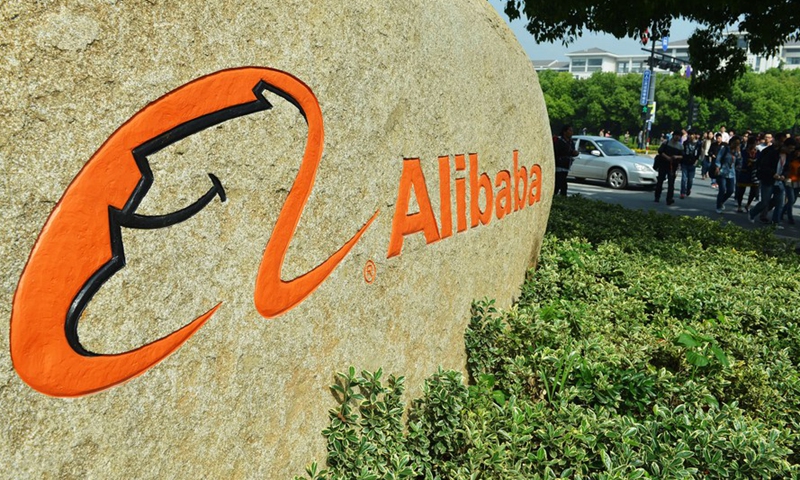
File photo shows Alibaba employees entering the company's headquarters in Hangzhou, East China's Zhejiang Province. Photo: Xinhua
Alibaba Group condemned a report by the Financial Times citing a White House memo claiming Alibaba is helping the Chinese military target the US, according to a statement Alibaba sent to the Global Times on Sunday.
"The assertions and innuendos in the article are completely false," Alibaba Group said in the statement.
The FT's Saturday report, citing a White House national security memo that includes declassified top-secret "intelligence," claimed that Alibaba provided tech support for Chinese military "operations" that the White House believes threaten US security.
However, the FT report neither specified which military capabilities or actions were involved nor mentioned what response measures the US intended to take, Zhang Xiaorong, director of the Beijing-based Cutting-Edge Technology Research Institute, told the Global Times on Sunday, adding that the memo is baseless speculation.
"We question the motivation behind the anonymous leak, which the FT admits it cannot verify. This malicious PR operation clearly came from a rogue voice looking to undermine President Trump's recent trade deal with China," the Alibaba statement read.
The FT said in its report that "it could not independently verify the claims" and said that "the memo did not specify what the PLA is alleged to be targeting in the US."
On Saturday, Liu Pengyu, a spokesperson for the Chinese Embassy in the US, wrote on X that "without valid evidence, the US jumped to an unwarranted conclusion and made groundless accusations against China."
"It is extremely irresponsible and is a complete distortion of facts. China firmly opposes this," Liu said in the post responding to FT's post of the Alibaba report.
Zhang pointed out that this is not the first time that US governmental agencies claim that Chinese tech companies have connections with military, using such accusations to defame or suppress Chinese firms, from ZTE to Huawei and Tencent.
The timing of the FT report was also worth noting, analysts pointed out, just after US media outlets reported that Alibaba is preparing to overhaul its main mobile artificial intelligence (AI) app to resemble OpenAI's ChatGPT and plans to rename it "Qwen" from the previous "Tongyi Qwen."
Alibaba's rivals, including start-up Minimax, are rolling out ever-more advanced AI models, each trying to outdo sector leaders like OpenAI and DeepSeek on performance, said Bloomberg on Thursday.
The US has already generated a "Qwen Panic," which it seems has not been limited to Silicon Valley but has spread to the political field, said Zhang.
Alibaba's Qwen large-scale model has become a globally leading open-source AI model, posing a challenge to similar US products. The US is intending to replicate the "Huawei suppression model" by using political framing to suppress Alibaba, Zhang noted.
"In the past, the US used a vial of laundry detergent as 'evidence' to launch a war; now, it doesn't even need the detergent," said Zhang.
An X user Tulsi Soni, who follows daily updates about AI, posted on Saturday with a screenshot of the FT's report, saying that the panic in the US over Qwen's open-source rise has spread from Silicon Valley to the White House.
"Here's the irony: The biggest US models are going closed-source, while the biggest Chinese models are going open-source. This isn't just a technical difference, it's an ecosystem choice, and global developers are voting with their downloads," Soni wrote.
Alibaba is among the first groups of Chinese tech companies that developed open-source large models. AI models of the Qwen family have been downloaded more than 600 million times since 2023, ranking first, while having generated more than 170,000 derived models, according to statistics sent from Alibaba to the Global Times.
This is probably where the term "Qwen Panic" comes from. However, this is more about depicting the intense technological chase, analysts said.
They also noted that the sense of crisis in the US from the perspectives of technical competition and cost competition is similar to the technological storm brought by China's AI model DeepSeek earlier this year, and it has nothing to do with national security.
RELATED ARTICLES