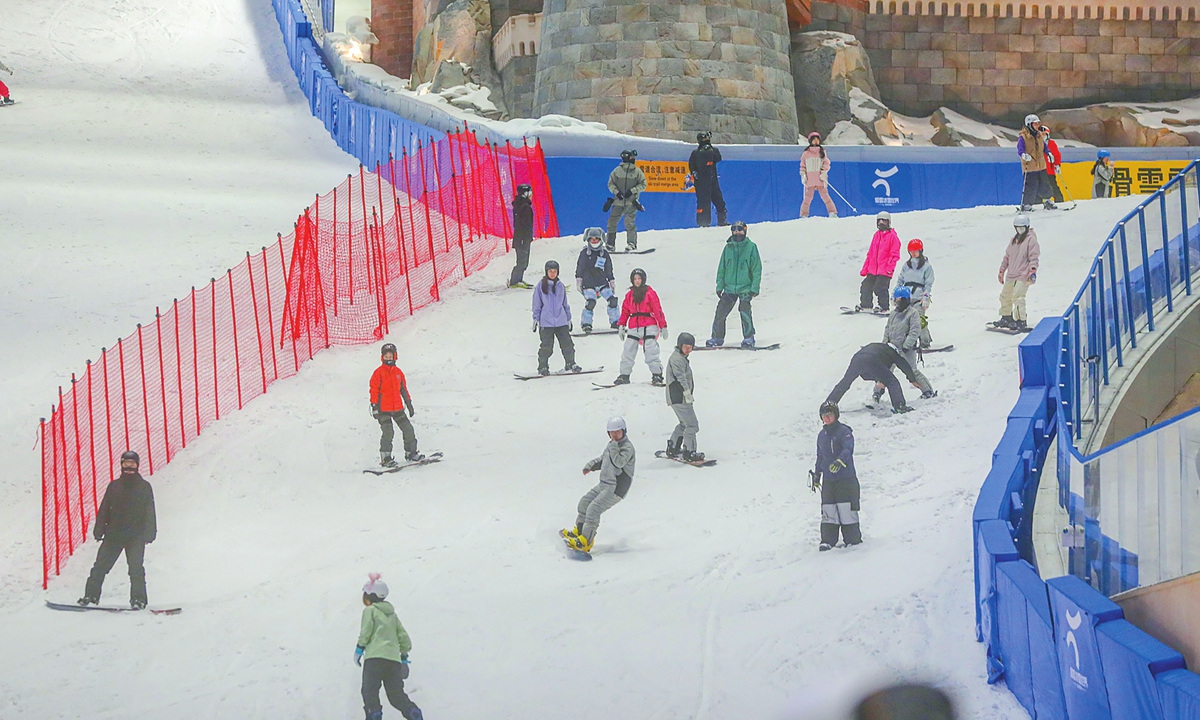
Ski enthusiasts enjoy their time at an indoor snow center in Shanghai. Photos on this page: IC
As winter arrives, ice and snow facilities across northern China have opened, signaling a strong start to the 2025-2026 ski season. Several resorts opened earlier this year, reflecting not only upgraded operation capabilities but also rising enthusiasm for winter sports across the country. New visitors from southern regions are joining traditional ski enthusiasts, evidence of a growing nationwide interest in skiing, snowboarding and other winter activities.
This surge is tied to China's broader economic trends amid its ongoing structural consumption upgrade and pursuit of high-quality experiences, with ice and snow sports emerging as a key driver of winter spending, experts said. Industry insiders said that ski resorts and surrounding businesses, from hotels to equipment rental, are benefiting from longer ski seasons, illustrating how winter sports are fueling both leisure trends and regional economic growth.
At Wanlong Ski Resort in Chongli district, Zhangjiakou, North China's Hebei Province, operations began as early as October 21 after a cold snap allowed for artificial snowmaking. "We've been getting about 4,000 to 5,000 visitors per day on weekends and around 2,000 on weekdays since we opened," Liu Yu, a public relations manager at the resort told the Global Times on Sunday. "The peak will come during the winter school holidays, when weekend daily traffic reaches about 8,000 people."
Wanlong upgraded its snowmaking system this year to enable an earlier opening. "As soon as we opened, hotels, restaurants, ski-gear shops and other supporting businesses in Chongli did too, which helped activate the entire local winter-sports economy," Liu said.
To prepare for the new season, Nanshan Ski Resort in Beijing's Miyun district expanded its children's nursery slopes, added new snowmaking machines and increased rental equipment and storage facilities. The resort also introduced promotional activities to attract more visitors, the resort said in a statement.
In Fuyun county, Northwest China's Xinjiang Uygur Autonomous Region, Koktokay international ski resort opened on October 12 and has been receiving close to 3,000 visitors daily, CCTV News reported on November 8.
With its high latitude and elevation above 2,000 meters, the resort typically sees about 240 days of snow cover each year, operating from October to May. Xinjiang has also issued ice and snow consumption vouchers for the new season, with the first batch of 10,000 valid for 11 ski resorts across the region, said the report.
Liu noted that participation in winter sports has risen steadily since the Beijing 2022 Winter Olympics. "This year we've clearly seen a surge in first-time visitors, including many from non-traditional winter-sports regions such as the Yangtze River Delta, the Pearl River Delta and Sichuan-Chongqing," he said.
Jiang Yiyi, a tourism and sports expert at Beijing Sport University, said that a series of major events, including the Winter Olympics, Asian Winter Games and National Winter Games, have significantly raised public awareness of winter sports. "Once people are familiar with these sports, they're more willing and able to get out onto the ice and snow," she said. "This has laid a solid foundation for the growth of China's ice and snow economy, and especially boosted related consumption in accommodation, catering and others."
Growth across the chain
On September 29, Shenzhen Qianhai Snow World in Shenzhen, certified by Guinness World Records as the world's largest indoor ski center, began trial operations. Covering 100,000 square meters with five slopes and a vertical drop of 83 meters, the facility welcomed more than 5,000 visitors on opening day and over 200,000 during the October National Day holidays, CCTV News reported on October 19.
A report by China Sports Daily noted that China's winter-sports infrastructure has expanded rapidly over the past two decades. In 2003, venues were scarce, but by 2024 the number had reached 2,678 nationwide. CCTV News reported that China now has 79 indoor ski centers, up 33.9 percent from the previous year, with 16 more under construction, citing an industry report.
The Recommendations of the Communist Party of China Central Committee for Formulating the 15th Five-Year Plan stated that special initiatives should be advanced to boost consumption, and the supply of high-quality consumer goods and services should be expanded. Jiang noted that the ice-and-snow industry has become a key driver of consumption during winter months, when residents' willingness to travel is relatively low.
On October 16, a report on the ice and snow industry development for 2025 was released, stating that the size of China's ice and snow industry expanded from 270 billion yuan ($38.03 million) in 2015 to 980 billion yuan in 2024, and is expected to reach 1.0053 trillion yuan in 2025.
Consumer spending has also risen sharply. During the 2024-2025 season, participation and related consumption exceeded 187.5 billion yuan, up more than 25 percent year-on-year. Ski resort spending reached 78.6 billion yuan, while consumption within two kilometers of ski areas grew 27.97 percent, giving a strong boost to local retail, transport and dining businesses, said the report.
A ski instructor surnamed Wen in Chongli told the Global Times on Sunday that demand for instruction is booming. "Our snowboard and ski instructor certificate programs have already filled two classes of 60 people each," she said. "Parents have also booked winter holiday youth training camps for January."
The thriving ice and snow economy reflects China's ongoing consumption upgrade. Jiang said that after China's per capita GDP reached $10,000 in 2019, demand for upgraded consumption and diverse sports began to grow significantly, which has greatly promoted the development of ice and snow sports.
The growth of winter sports has also driven rapid expansion in China's winter-sports equipment manufacturing. The number of related enterprises has increased from around 300 in 2015 to about 900 in 2023, Xinhua News Agency reported.
As winter tourism, sports participation and equipment output continue to expand, Jiang said the winter sports industry has become a major driver of consumption during the winter travel season, supporting momentum across China's wider consumption growth.
RELATED ARTICLES