Alibaba officially launches Qwen app to challenge ChatGPT in AI-to-consumer market
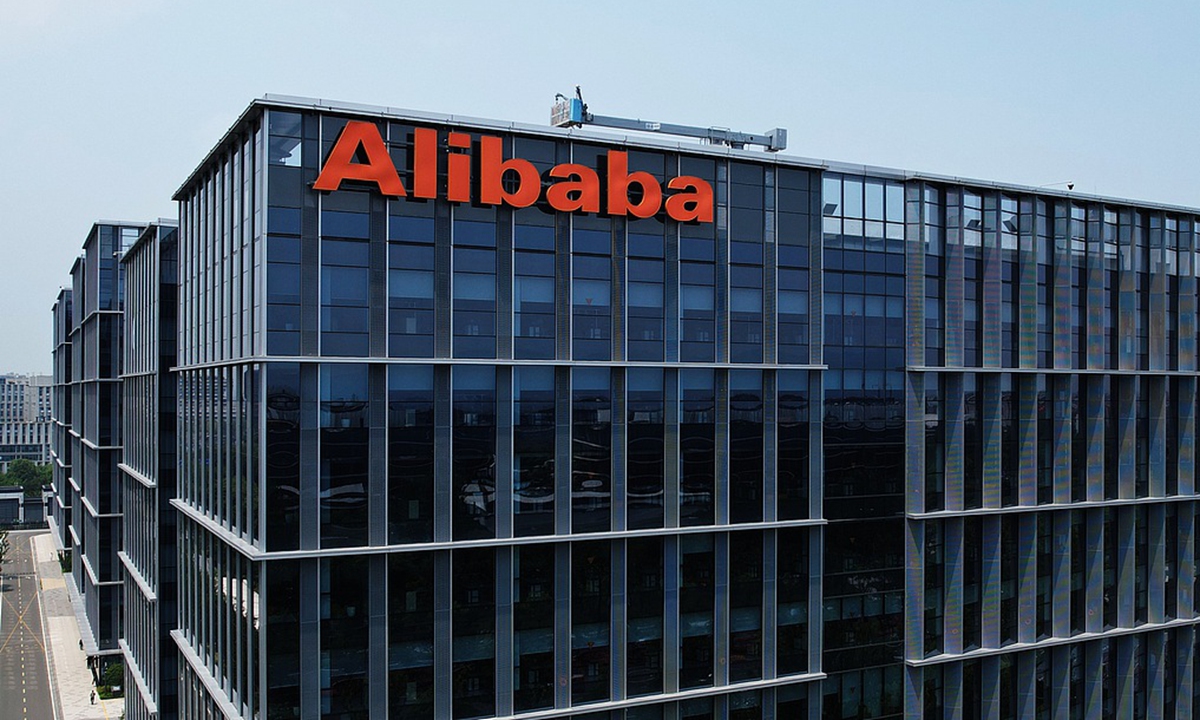
Alibaba headquarters building in Hangzhou, East China's Zhejiang Province on November 16, 2025. Photo: VCG
Alibaba on Monday announced its "Qwen" initiative as the company moves aggressively into the AI-to-consumer (AI to C) market, Alibaba told the Global Times in a statement on Monday. On the same day, the trial version of the Qwen app was launched.
A Chinese expert noted that domestic tech firms have long focused their artificial intelligence (AI) monetization strategies on the enterprise, or business-end (B-end), market. The launch of the Qwen app marks a pivotal shift in Alibaba's approach, signaling a move toward the consumer, or C-end, market — a shift that also reflects the broader ambitions taking shape across the country's computing sector.
Powered by Qwen3, the app aims to compete directly with OpenAI's ChatGPT by offering free access and embedding itself into various daily-use ecosystems.
By rolling out more advanced AI applications, Chinese computing giants, including ByteDance's Doubao and Tencent's Yuanbao, are intensifying their push to capture domestic user traffic in competition with leading overseas AI platforms.
The current version of the Qwen app is an early release with initial task-handling capabilities.
For instance, a single instruction can prompt the app to complete a research report within seconds and automatically generate a multi-page PowerPoint presentation, a representative from Alibaba Cloud told the Global Times on Monday.
Alibaba plans to connect services such as mapping, food delivery, ticket booking, office tools, education, shopping and healthcare to the Qwen app to expand its capabilities.
The growing push by Chinese companies to bring AI to the consumer market is a positive development for the country's AI ecosystem, said Chen Jing, vice-president of the Technology and Strategy Research Institute.
China had previously held back on large-scale deployment due to limits in foundational model capabilities, leaving many firms and individuals with only early "chatting" experiences rather than deeper use cases such as AI coding or AI-assisted office work, said Chen.
China's domestic large-language models have reached a strong technical threshold, with many open-source models matching the performance of leading US closed-source systems while offering a significant cost advantage, Chen said.
"Thanks largely to contributions from Chinese developers, high-level large-model capabilities have become broadly accessible worldwide, making model performance no longer a scarce resource," Chen told the Global Times on Monday.
Beyond the domestic market, the company noted that "an international version of the Qwen app will be launched soon," aiming to leverage Qwen's overseas traction to compete directly with ChatGPT for global users, according to Alibaba's statement.
The Qwen model behind the app has long been regarded by developers as a core pillar of China's open-source ecosystem and one of the most widely adopted models among enterprises.
Alibaba began developing Qwen three years ago, and it has since grown into one of the world's leading open-source AI models, with global downloads exceeding 600 million, Alibaba said.
Before the launch of the Qwen app, Chinese open-source models had already begun gaining traction in AI to C services.
Industry data collected by research firm DataEye showed on November 11 that in October, global AI app downloads across Apple's App Store and Google Play, including the Chinese mainland, reached an estimated 490 million, excluding repeat installs.
ChatGPT, Google Gemini, Perplexity, Doubao and InShot ranked as the top five apps, with Doubao accounting for 4 percent of total global downloads across both platforms.
In August, the user base of Baidu's large-language model Ernie Bot surpassed 300 million, a milestone in the large-scale adoption of China's domestic AI models, data from Baidu's developer platform showed.
With broader adoption, China is likely to see a surge in vertical applications, as industry players learn to build their own products on open-source models, Chen said. Individuals will also begin using AI more actively to upgrade white-collar skills and integrate AI into daily services.
He said that strengthening user stickiness and building a sustainable commercial loop will require progress on several fronts. First is deeper specialization, which involves embedding Chinese AI into core workflows so that it evolves from a general "personal assistant" into an integrated part of how companies and individuals work.
RELATED ARTICLES