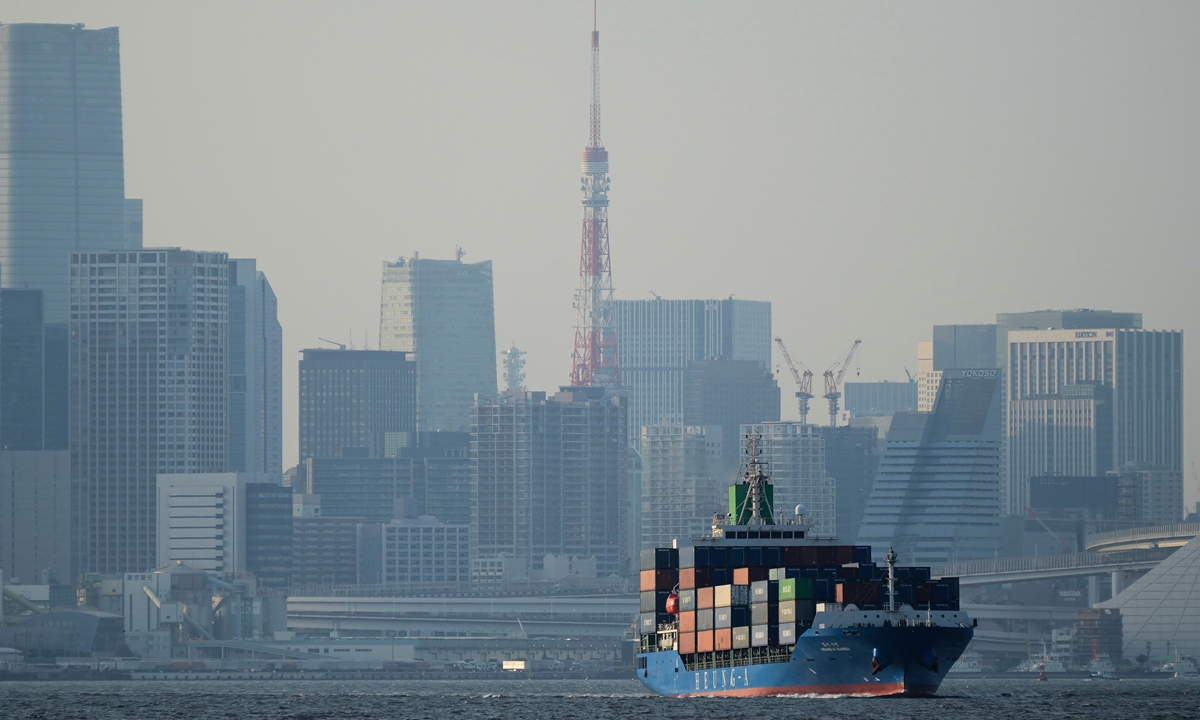
Tokyo Tower is seen amid tall buildings as a container ship leaves a cargo terminal in Tokyo, Wednesday, April 9, 2025. Photo: VCG
Japan's economy contracted an annualized 1.8 percent in the third quarter of 2025, marking the first contraction in six quarters, the Xinhua News Agency reported, citing government data released on Monday.
Real GDP fell 0.4 percent quarter-on-quarter, according to the Cabinet Office.
The figures lay bare the sluggishness of the Japanese economy and expose deeper vulnerabilities stemming from a complex interplay of external shocks and internal contradictions, raising a critical question: How much room does Japan's economy really have left for maneuvering amid these overlapping challenges?
A closer look reveals that the internal growth momentum of Japan's economy is weakening, while the external environment is becoming increasingly complex and severe.
In terms of trade, exports of goods and services shrank 1.2 percent quarter-on-quarter in the third quarter, with US tariffs delivering a direct blow to Japan's export-oriented economy. Shipments from automakers, a cornerstone of Japanese industry, plummeted. As a traditional strength of Japan's economy, the manufacturing sector already faces internal challenges, and the superimposed effect of US tariffs has further pushed up the costs of Japanese exports, directly undermining their price competitiveness in the US market.
The lackluster performance of domestic demand in Japan is even more concerning. Data from Japan's Cabinet Office indicated that private consumption, which accounts for more than half of economic output, grew 0.1 percent. That was a slowdown from 0.4 percent in the second quarter, indicating that high food costs increased consumers' reluctance to spend, according to the report.
Preliminary figures released by Japan's Ministry of Internal Affairs and Communications on Friday showed that the Tokyo core consumer price index rose 2.8 percent year-on-year in October, remaining above the Bank of Japan's 2 percent inflation target. In particular, prices of food were up 6.7 percent year-on-year.
Japan's Ministry of Agriculture, Forestry and Fisheries announced on Friday that rice prices continued breaking records with the average retail price rising to 4,316 yen ($27.90) during the week from November 3 to 9, including tax, per 5 kilograms, a record high since May, according to Japanese media reports. The continuous rise in these daily living costs is quietly reshaping consumer behavior and the expectations of Japanese people.
The struggle of Japan's economy is further epitomized by the Bank of Japan's monetary policy dilemma. On the one hand, sustained inflation calls for monetary tightening; on the other hand, fragile domestic demand and a towering public debt burden make the economy highly vulnerable to rising interest rates. According to The New York Times, Japan's debt-to-GDP ratio has remained above 200 percent for the past five years, underscoring the severity of its fiscal constraints.
Notably, amid this broader economic gloom, Japan's inbound tourism sector and stock market performance have stood out as bright spots. So far this year, Japan's Nikkei 225 stock index has gained more than 28 percent, while inbound tourism has remained robust. However, the core driver behind these positive trends exposes a deep-seated problem in Japan's economy: the weak yen. The yen has fallen about 4.5 percent against the dollar so far this quarter, the most among its Group of 10 peers, according to Bloomberg.
While a weaker yen has indeed attracted many foreign tourists and much overseas investment, injecting short-term external vitality into Japan's economy, it has also come at a steep cost for a country heavily dependent on resource imports. Soaring prices for imported energy, food, and other raw materials have been passed on to domestic consumers, further eroding people's purchasing power. This highlights a fundamental contradiction: a factor that makes Japan appear "attractive" to external markets is quietly undermining the foundations of its domestic economy.
Worse still, when external demand is strong, a weak yen can boost exports and mask underlying weaknesses in domestic consumption and investment. But when external demand slows, this internal fragility becomes a major constraint on growth.
In this precarious context, any policy move that may exacerbate external uncertainty calls for high vigilance. Japanese Prime Minister Sanae Takaichi's recent egregious remarks over the Taiwan region are undoubtedly adding unnecessary risks to Japan's already fragile economy.
Japan's economy is not without policy and market room for maneuver, but its recovery and transformation hinge on a stable external environment. Amid the superimposition of multiple predicaments such as fiscal pressure, inflationary troubles, weak domestic demand, and external tariff shocks, the Japanese economy has virtually no room for trial and error.
If Tokyo continues to make reckless moves on sensitive issues or introduces additional geopolitical risks, it will only further intensify uncertainty, amplifying downward economic pressure. With its room for economic maneuver shrinking further, Japan's path to recovery will become increasingly arduous.
RELATED ARTICLES