China's express delivery sector posts strong growth in first 10 months of 2025: State Post Bureau
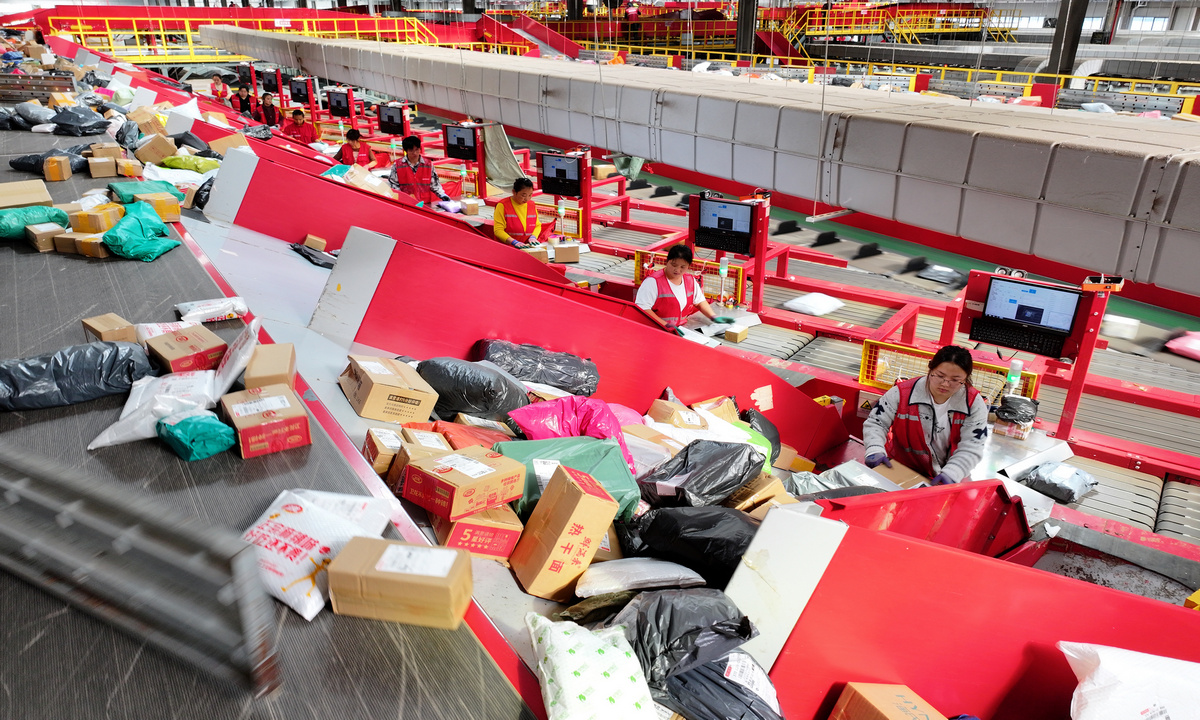
Workers sort parcels at an express delivery company in Yangzhou, East China's Jiangsu Province, on November 11, 2025. China's Double 11 shopping festival is hitting its peak, with major domestic e-commerce platforms and courier firms seeing a surge in cross-border parcel shipments. Photo: VCG
China's express delivery sector handled 162.68 billion parcels in the first 10 months of 2025, marking a 16.1-percent year-on-year increase, Xinhua News Agency reported on Tuesday, citing data from the State Post Bureau.
According to the Xinhua report, business revenue of the express delivery sector reached 1.22 trillion yuan during the period, an 8.5-percent rise year-on-year.
Breaking it down, same-city express deliveries hit 13.14 billion parcels, a 3 percent year-on-year increase, while cross-region deliveries surged 17.6 percent to 146.12 billion parcels, Xinhua reported.
From a regional perspective, the express delivery volumes in eastern, central, and western China accounted for 70.9 percent, 19.7 percent, and 9.4 percent of the total, respectively. Compared with the same period last year, the central region's share increased by 1.1 percentage points, while the western region's share rose by 0.6 percentage points, according to China Media Group (CMG).
In the first 10 months, express delivery volume in multiple regions including Northwest China's Shaanxi Province, Ningxia Hui Autonomous Region, and Xinjiang Uygur Autonomous Region grew by more than 30 percent, CMG said.
Express delivery companies made growing investment in infrastructure and extended their service reach, strengthening transportation coordination with aviation, railways, and other sectors.
"The express delivery industry showed a stable performance in the first 10 months, with market scale showing a robust expansion, demonstrating strong development vitality. This reflects the sustained enthusiasm in the domestic consumer market and the continued deepening of residents' online shopping habits. As a key link connecting supply and demand, the express delivery sector plays an increasingly prominent role in facilitating commodity circulation," Wang Peng, an associate researcher at the Beijing Academy of Social Sciences, told the Global Times on Tuesday.
In terms of regional structure, the rising share of central and western China indicates stronger coordinated regional development, accelerating the release of consumption potential in those areas, further expanding the national consumer market, and making overall development more balanced, Wang added.
In the first 10 months, the total retail sales of consumer goods reached 41.217 trillion yuan, up by 4.3 percent year-on-year, and online retail sales reached 12.79 trillion yuan, up by 9.6 percent year-on-year, data from China's National Bureau of Statistics showed.
Wang said that the widespread adoption of the internet and e-commerce have laid a solid foundation for growing online consumption. As consumer demand continues to upgrade, the pursuit of high-quality and personalized goods has driven consumption optimization in the country.
In addition, policies aimed at boosting domestic demand have been consistently implemented, improving the consumption environment and enhancing residents' spending power, providing strong support for the stable growth of the consumer market, the expert noted.
China's longest-ever Double 11 shopping festival concluded on November 14, with many e-commerce platforms announcing record-breaking transaction volumes. For instance, Tmall reported that nearly 600 brands surpassed 100 million yuan in sales during the Double 11 period, as 34,091 brands doubled their year-on-year sales.
"The Double 11 shopping festival, as a grand consumption extravaganza, is expected to drive express delivery volumes to new peaks, further highlighting its powerful role in stimulating consumer spending. Meanwhile, high-quality express delivery services will better meet consumers' diverse needs, giving an additional boost to the consumer market," Wang noted.
RELATED ARTICLES