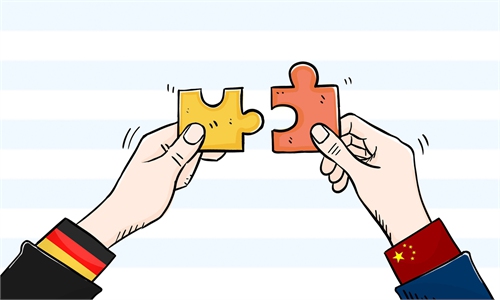
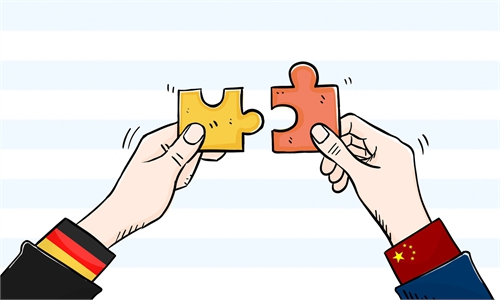
GT Voice: Port of Hamburg throughput attests to resilience of China-Germany cooperation
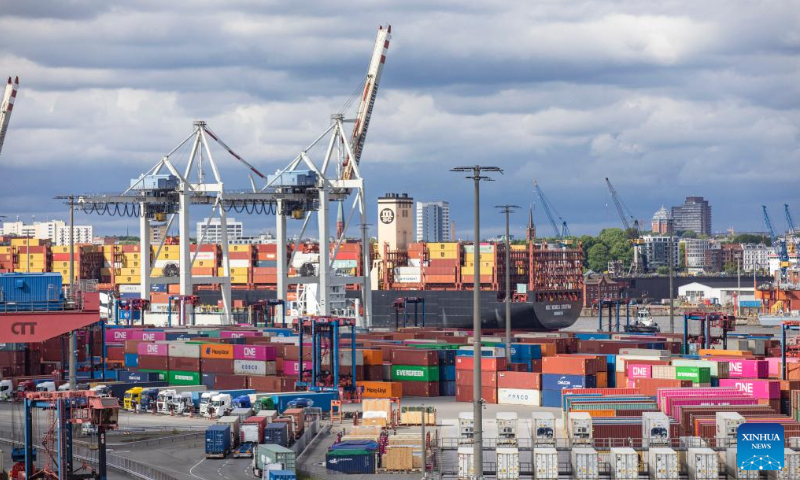
This photo taken on May 28, 2025 shows a view of the Container Terminal Tollerort in Hamburg, Germany. Photo: Xinhua
As Germany's largest port and a crucial sea-rail intermodal hub in Europe, the Port of Hamburg has become the most vivid testament to the close trade links between China and Germany.
The Port of Hamburg's container throughput rose 8.4 percent year-on-year to 6.3 million TEUs (20-foot equivalent units) in the first nine months of this year, according to CCTV News on Tuesday.
While "complications in trade" weighed on US volumes, resulting in a 23.9 percent drop in container trade between Hamburg and the US, the port's container throughput with Asia, especially China, continued its steady growth. Trade with China reached 1.8 million TEUs, up 7.9 percent year-on-year, according to the Seatrade Maritime News.
These figures reflect more than just structural shifts in international trade. They reveal the underlying resilience of China-Germany economic relations amid a fragile global recovery and escalating geopolitical uncertainties.
Further reinforcing this trend, Chinese customs statistics showed that in the first 10 months of this year, China's exports to Germany rose by 9.7 percent year-on-year, with bilateral trade up by 3.5 percent.
China again replaced the US as Germany's largest trading partner in the first eight months of 2025, according to data released in October from Germany's Federal Statistical Office. The robust trade is rooted in the complementary nature of the two economies, which has long transcended simple import-export transactions and become deeply integrated into the fabric of industrial collaboration.
Nowhere is this complementarity more evident than in industrial cooperation. In traditional sectors such as automobiles, mechanical equipment, and chemical pharmaceuticals, the two countries have established close industrial chain cooperation. Germany's high-end manufacturing technology aligns perfectly with China's huge market, while China's complete industrial chain provides stable support for German businesses.
Even in the automotive industry, where competition has been intensifying, strong industrial complementarity can still be observed after further breaking down the details of trade goods. Germany mainly exports high-end internal combustion engines, precision electrical devices, and gearboxes to China, while China primarily ships batteries, braking systems, and other components to Germany.
Beyond traditional sectors, emerging areas such as green transformation, intelligent manufacturing, and digitalization offer new avenues for cooperation. China's scaled production capacity and Germany's technological strengths are already fostering new growth opportunities.
The partnership is not without challenges. In Germany, some have hyped so-called concerns over trade deficits and supply chain dependencies. Yet it is clearly unfair to simply view these issues with the "unfair competition" or so-called "supply chain threats" rhetoric. Germany's trade deficit with China is largely a result of the in-depth localization strategy implemented by German businesses in China, since many products exported to Germany are actually manufactured by German companies operating in China.
Moreover, German investment in China continues to grow, reflecting long-term market confidence. For instance, German car manufacturers accounted for about two-thirds of German investment in China from 2020 to 2024, and that spending has accelerated in recent years, growing 69 percent between 2023 and 2024 to reach 4.2 billion euros ($4.87 billion), Bloomberg reported on Sunday, citing the Mercator Institute for China Studies, a Berlin-based think tank.
For example, BASF, the German chemicals giant, just opened an 8.7 billion euro complex in China, its largest-ever investment. If anything, these real German investments in China speak louder than politicized narratives.
In this context, the fourth China-Germany High-Level Financial Dialogue held in Beijing on Monday came at a critical time. As skepticism risks building walls of misunderstanding, dialogue offers a bridge. Replacing speculation with communication and unilateral pressure with pragmatic cooperation represents the most viable path through today's uncertainties.
China remains open to constructive and practical engagement with Germany, demonstrating its commitment as a reliable partner. German products continue to enjoy strong demand in China, and China's ongoing opening-up presents ever-growing opportunities for European businesses. It is hoped that the German side can work with the Chinese side, instead of resorting to accusations and protectionism. By addressing differences through institutionalized dialogue and solving challenges with practical cooperation, both nations can further unlock the potential of their economic partnership.
RELATED ARTICLES