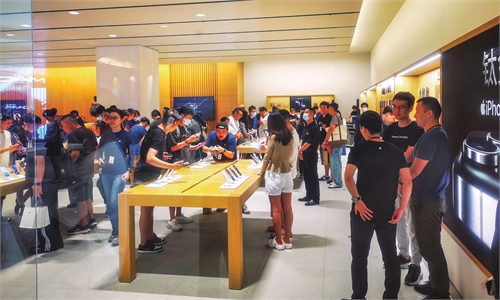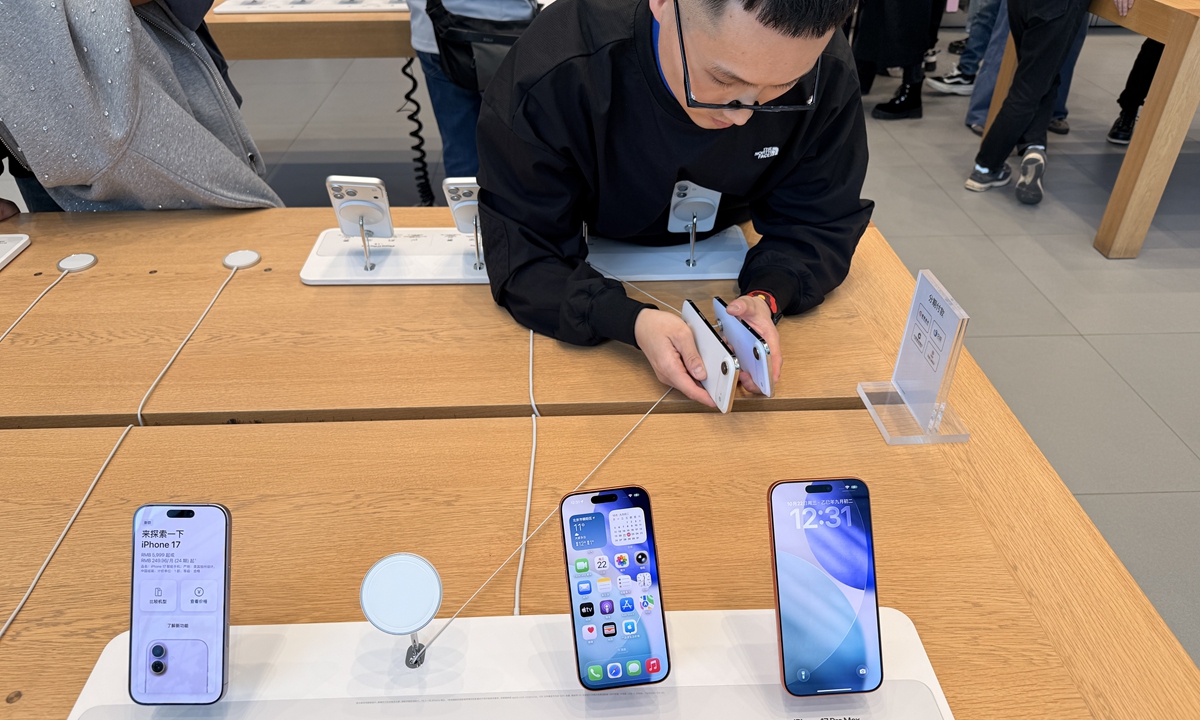
A consumer checks newly launched iPhone Air at an Apple store in Beijing CBD on October 22, 2025. Photo: Tao Mingyang/GT
Apple posted a strong performance in China's smartphone market in October, with sales rising 37 percent year-on-year on the back of strong iPhone 17 demand and its market share climbing to 25 percent, according to data released by Counterpoint Research on Tuesday.
This is the first time since 2022 that Apple's monthly market share has exceeded the 25 percent mark, the data showed.
The October surge highlights Apple's continued strength in China's premium smartphone segment despite rising competition, and strong holiday demand and wider sales promotions helped amplify the iPhone 17 series' appeal, a Beijing-based analyst told the Global Times on Tuesday.
The iPhone 17 series accounted for more than 80 percent of Apple's total shipments in October, with all models — from the 5,999-yuan ($845) iPhone 17 to the 8,999-yuan iPhone 17 Pro Max — recording double-digit growth. The strong performance helped lift China's overall smartphone sales by 8 percent year-on-year. The Mid-Autumn Festival and National Day holidays in October also concentrated consumer demand, creating favourable conditions for the surge by the iPhone 17 series, Counterpoint Research data showed.
Counterpoint Research data also indicated that China's smartphone market is undergoing a structural adjustment. In the third quarter, overall shipments slipped 0.6 percent year-on-year, with vivo retaining the top spot at a market share of 17.3 percent, followed by Apple at 15.8 percent and Huawei at 15.2 percent, underscoring an intensely competitive landscape.
Competition is especially fierce in the high-end segment above 6,000 yuan, where Huawei holds a 30.7 percent share and Apple leads with 51.1 percent. The iPhone 17 series has reached a 69 percent penetration rate in this price band, the data showed.
Counterpoint analyst Ivan Lam said that higher average selling prices will further amplify Apple's revenue growth, and its market share is expected to strengthen through the fourth quarter.
Recent moves by Apple's CEO, along with the company's earnings results, reflect Apple's strong focus on the Chinese market and the continued pull that China holds for the company's global growth, an expert said.
At Apple's fiscal fourth-quarter earnings call on October 31, CEO Tim Cook said that the iPhone 17 series had received a strong response in the Chinese market and that the company expected growth in China to recover in the coming quarter, according to media reports.
Cook made a surprise appearance on a Douyin Apple Store livestream on October 13, announcing that pre-orders for the iPhone Air in China would open at 9 am on October 17, with sales starting on October 22.
It marked Cook's first livestream appearance on the platform since Apple's official flagship store joined Douyin Mall in August.
On October 16, Chinese Minister of Commerce Wang Wentao met with Cook in Beijing. They exchanged views on China-US economic and trade relations and the development of Apple's business in China, according to a release on the ministry's official WeChat account. Wang told Cook that "we welcome Apple to continue deepening its cooperation with China and expanding its investment in the country."
Liu Dingding, a Beijing-based veteran industry observer, told the Global Times that Apple's strength in the Chinese market had already become evident during the Double 11 shopping season.
"Apple consistently topped JD.com's smartphone rankings, and even in single-model charts, the leading spots were dominated by iPhones. Some models from last year still ranked near the top this year, which reflects Apple's strong product capability and brand appeal."
Liu added that the Chinese market is one of Apple's largest markets globally. Despite the numerous local smartphone brands and intense competition, Apple will localize its strengths in the future and make every effort to capture the hearts of Chinese consumers.
RELATED ARTICLES