ARTS / CULTURE & LEISURE
A tribute to veterans of the 15th National Games
By Published: Nov 18, 2025 11:19 PM
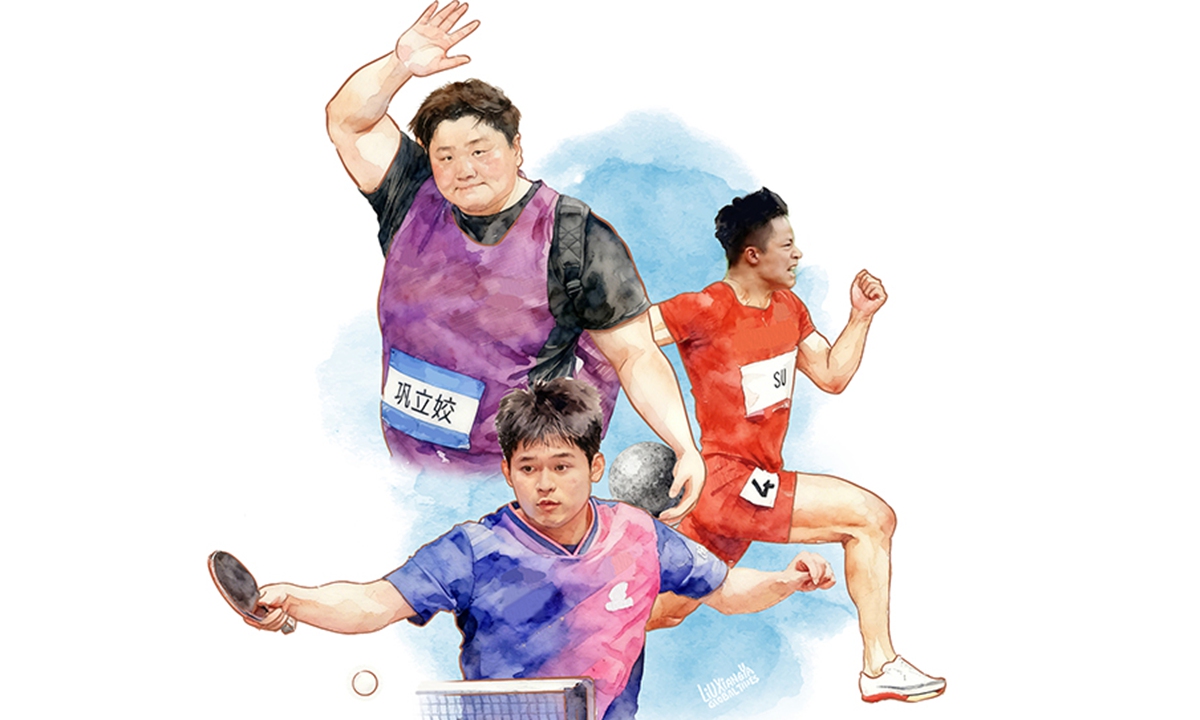
Illustration: Liu Xiangya/GT
Greatness in sports is rarely measured at its loudest moment, but in the hush that follows the final act. At the ongoing 15th National Games being jointly hosted by multiple regions - South China's Guangdong Province, the Hong Kong Special Administrative Region (SAR) and the Macao SAR - the most luminous images have not only been the raised arms of new champions, but also the trembling tears of veterans bowing out after long time in the arena. Their exits are narratives more profound and moving than any victory alone could ever be.
The shot put circle witnessed one such powerful farewell as Gong Lijiao, with a final mighty heave of 19.68 meters, secured a historic fifth consecutive National Games title. Yet, the champion's tears spoke of a deeper story. "It's been 288 days since my mom passed away," she shared, her voice thick with emotion. "I truly wish she could have shared this gold medal with me."
Victory and grief collided in a single embrace, reminding us that every medal carries the weight of a whole life. Across the venues, similar farewells unfolded like quiet ceremonies. For instance, Badminton player He Bingjiao lost in the round of 16 and declared her career "complete, without regret."
Thirty-year-old diver Chen Aisen took his last dive from the 10-meter platform, bowed low to the crowd that had roared for him for 15 years, and called the journey "incredible, joyful, perfect."
These were not exits forced by defeat, but deliberate, graceful closures - final conversations between athletes and sports. They chose the National Games, the domestic sport summit, as their stage for departure.
And in doing so they wrote the most eloquent footnotes to the spirit of sportsmanship: begin with fire, end with dignity. Perseverance, not podiums, was their true gold.
Thirty-eight-year-old boxer Liu Wei, after a quarter-final loss, folded his uniform with ceremonial care, laid it in the center of the ring, knelt, and kissed the floor. No National Games gold was ever hung around his neck, yet his 25-year odyssey across five Games shone brighter than any medal.
"Boxing raised me like a parent," he said, eyes red but steady. He had wanted to quit countless times; love alone kept him punching.
Gong Lijiao distilled her own 25 years into three words: perfect, regretful, persistent. Perfect for the achievements she owns; regretful for injuries and for the loved ones who never saw the finish line; persistent because shot put was no longer a profession for her, it was a part of her no less integral than a limb. Even after winning Tokyo Olympic gold with the score of 20.58 meters in 2021, she still dreamed of breaking 21 meters, simply because the circle is home.
Their legacy operates on two levels.
First, reverence. Table tennis immortal Ma Long, taking part in his sixth National Games, candidly shared: "It's been a long time since I've played in such an official competition. Returning to the arena, I feel a mix of excitement and nerves."
Despite having won six Olympic gold medals, he continues to approach every match with utmost seriousness. This attitude exemplifies the profound reverence veteran athletes hold for their sport.
Second, transmission. In the dying seconds of Liu Wei's last fight, the crowd roared, "Fight on, Liu Wei! No regrets!" That spurred Liu to muster every last ounce of strength. This fighting spirit, even in the face of defeat, serves as the most powerful motivation for younger athletes watching from the sidelines.
Every farewell clears space for renewal. As veterans departed, 20-year-old table tennis prodigy Lin Shidong marched into the men's singles final - an unbroken relay across generations.
Yet veterans never truly leave the track. Gong will stay in the sport-relevant areas; Liu Wei vowed, "I will never part from it"; sprinter Su Bingtian is trading spikes for the lecture hall as an associate professor.
Hoping to conclude his athletic career with a "spectacular" final race, Su Bingtian, the "Asian flying man," announced he will retire after the 15th National Games, held in his home province, Guangdong Province.
As the first Asian runner to break the 10-second barrier in the men's 100 meters, his achievements have long been etched into history. Although bidding farewell due to injuries and age, Su will not leave the sport of track and field. As an associate professor at Jinan University, he plans to dedicate more effort to nurturing the next generation of athletes, passing on his experience and spirit.
The body steps aside, but the spirit remains to coach, mentor, and guard the flame. Goodbye, then, is only a change of uniform. Gong Lijiao's parting words were simple and devastating: "Because I love it, I persist."
Those tears that fell beneath the floodlights were not sorrow but gratitude offered back to the arenas that cradled them and to a nation that will remember their grace long after anthems fade.
In the end, the veterans of the 15th National Games teach us the deepest truth of sports: The heaviest medal is the one forged by time, tempered by loss, and worn closest to the heart.
The author is a reporter with the Global Times. life@globaltimes.com.cn
RELATED ARTICLES