ARTS / CULTURE & LEISURE
Stone artifacts made by Homo erectus discovered at Hexian hominid site
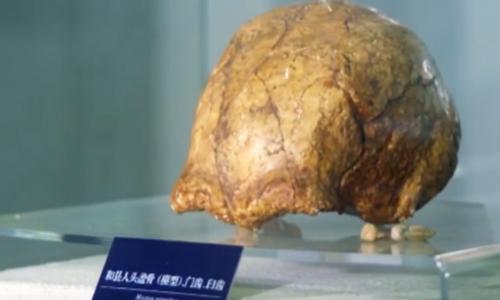
A model of the skull of Hexian Man Photo: Screenshot of CCTV video
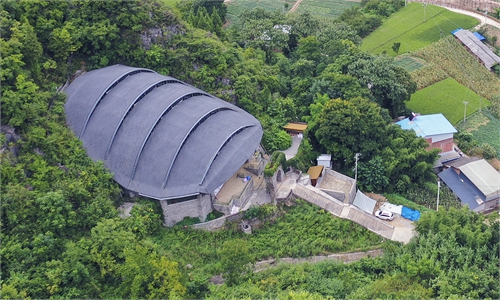
Researchers at the Hexian hominid site in He county, Ma'anshan City, East China's Anhui Province, have recently made a major archaeological breakthrough with the discovery of two new Homo erectus tooth fossils and the site's first confirmed stone artifacts produced by Homo erectus, the Global Times learned from the Institute of Vertebrate Paleontology and Paleoanthropology of the Chinese Academy of Sciences on Tuesday.
The National Cultural Heritage Administration had approved a 35-square-meter excavation area for the 2025 field season. Archaeologists divided the site into four sections: A, B, C and D, progressing from west to east, with Area D designated as the primary excavation zone. The unearthed Homo erectus tooth fossils include a right maxillary third molar, the first fossil from this anatomical position ever unearthed at the site, according to Jimu News.
"The proactive archaeological work carried out this year was mainly conducted in coordination with the slope-protection project at the Hexian hominid site," said Dong Zhe, head of the site's excavation program, when speaking about the origin of the latest fieldwork.
"Through this excavation, we also hope to uncover more hominin fossils, stone artifacts and bone tools, so as to address questions concerning the site's chronology and the behavioral adaptations of Hexian Homo erectus," Dong noted.
With these latest finds, the total number of known "Hexian Man" fossils has risen to 17, providing crucial physical evidence for research into the evolution of Homo erectus. Researchers also identified and confirmed, for the first time at the site, stone tools made by Homo erectus, along with numerous bones, antler, and tooth artifacts showing clear signs of modification and use.
These artifacts exhibit refined craftsmanship, with some bone tools displaying repeatedly retouched edges, suggesting that late Homo erectus at the site possessed relatively advanced manufacturing skills and behavioral capabilities, according to Jimu News.
The discovery of Hexian hominid site can be traced back to the winter of 1973, when local villagers accidentally blasted open a cave on the northern cliff of a hillside while constructing an irrigation channel. The explosion revealed a large number of vertebrate fossils, marking the beginning of a discovery that would unlock evolutionary clues spanning several hundred thousand years, according to the He County Cultural Tourism Bureau.
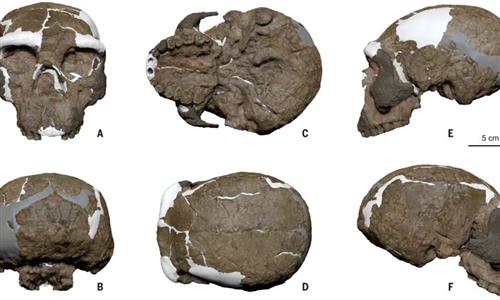
From 1980 to 1981, the archaeological team conducted three rounds of archaeological excavations at the site. A total of 15 hominin fossils were unearthed, including one skull, two cranial fragments, a mandibular fragment with two teeth, and 11 isolated teeth, representing at least six individuals of different ages. Among the finds was an almost complete Homo erectus skull, later named "Hexian Man."
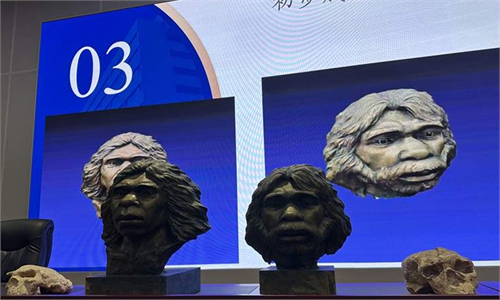
The skull, which belonged to a male around 20 years old, displays both the primitive traits of Peking Man and more advanced evolutionary features. It fills a gap in the discovery and study of ancient human fossils in Anhui Province, providing key evidence for the model of continuous evolution accompanied by hybridization in East Asia. It is also the best-preserved Homo erectus cranium of its period found in China to date, according to the He County Cultural Tourism Bureau.
In 1988, the Hexian hominid site was designated a national key cultural relic protection unit by the State Council, establishing it as a significant location for exploring the origins of humanity.
Existing data suggest that "Hexian Man" lived between 300,000 and 412,000 years ago. If this range can be further refined through advanced scientific dating methods, it would provide crucial support for testing the hypothesis of continuous human evolution in China.
RELATED ARTICLES