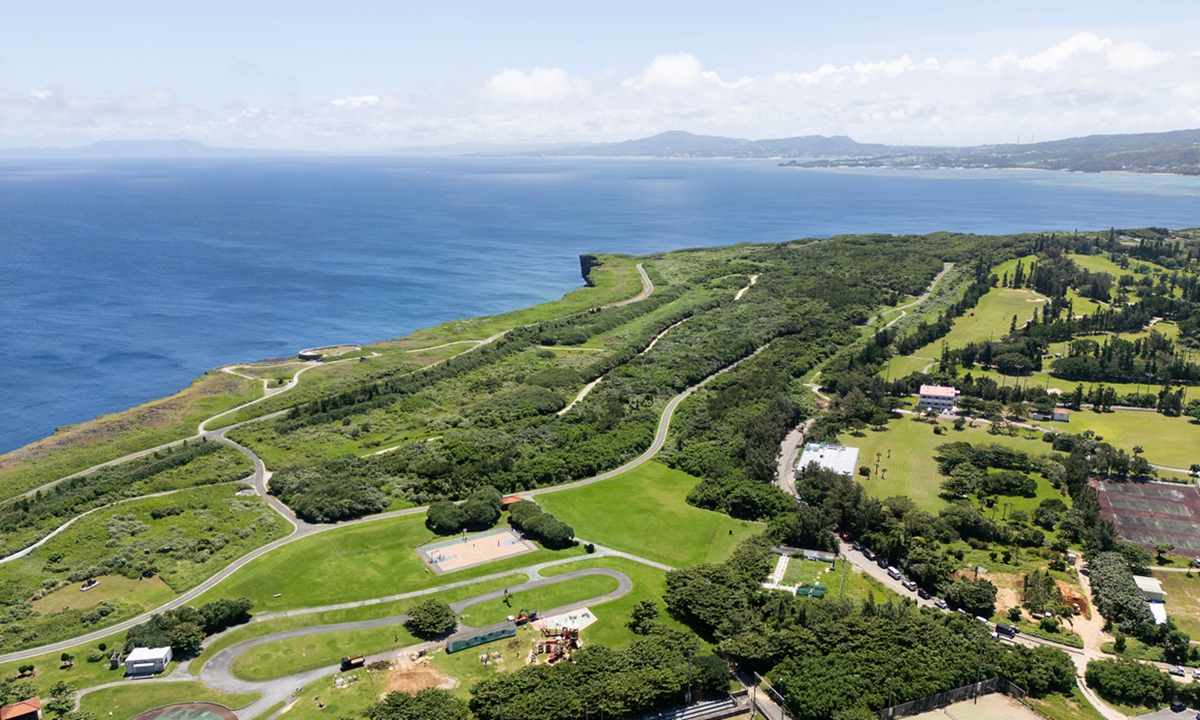
View of Okinawa Photo: VCG
Recently, the "Ryukyu studies" academic program, the first of its kind in China and initiated by Fujian Normal University, has been officially approved in China and is now formally launched. It is attracting widespread attention both domestically and internationally. The geopolitical position, strategic choices, and future trajectory of the Ryukyu Islands not only determine their own fate but also profoundly affect the security concerns of neighboring countries and regions.
In recent years, scholarly interest in the Ryukyu (Okinawa) issue has continued to rise both in China and abroad, yielding a steady stream of research achievements. This has gradually evolved into the construction of a full-fledged academic system, making the establishment of "Ryukyu studies" a natural and inevitable development.
The Ryukyu Islands lie between China's Taiwan island and Kyushu island of Japan, facing Fujian Province of China across the sea. As early as 1372, the Ming Dynasty (1368-1644) formally established a tributary relationship with the Ryukyu Kingdom: Ryukyu acknowledged Chinese imperial authority and followed the Chinese calendar, while China treated Ryukyu with exceptional generosity under its "give much, ask little" policy.
In 1609, Satsuma forces from Japan invaded and brought Ryukyu under its control. In 1872, the Meiji government unilaterally created the "Ryukyu domain" as the first step toward annexation, yet Ryukyu managed to maintain its tributary relationship with China to certain extent. In 1879, Japan forcibly abolished the Ryukyu Kingdom through military coercion and established Okinawa Prefecture, completing its formal annexation.
After Japan's defeat in 1945, US forces occupied the Ryukyu Islands, and all official administrative bodies and documents during the occupation period continued to use the name "Ryukyu." In 1972, the US and Japan transferred administrative rights over Ryukyu through a private bilateral deal. Since then, the islands have remained under Japanese jurisdiction and were redesignated as "Okinawa Prefecture." From 1879 to the present day, historical and legal disputes over the sovereignty of the Ryukyu Islands have never ceased.
In essence, "Ryukyu studies" is a comprehensive, interdisciplinary field that examines the geography, politics, culture of the Ryukyu Islands as well as China-Ryukyu history and Ryukyu's place in East Asian relations. It stands on equal footing with Sinology, Korean studies, and Japanese studies rather than being merely a subsidiary branch. Its core research revolves around multiple dimensions: Ryukyuan history, culture, and external relations. Historically, this includes the origins of Ryukyu, its tributary relationship with Ming and Qing (1644-1911) dynasties, and the process of Japanese annexation. Culturally, it encompasses the Ryukyuan language, clothing, architecture, music, and religious beliefs. In terms of external exchanges, it covers economic interactions, tribute trade, and relations with neighboring countries. Moreover, the study of modern and contemporary "Ryukyu issues" holds particular significance within "Ryukyu studies." Discussions surrounding a wide range of pressing real-world concerns - such as Ryukyu's status, its current social conditions, US military bases, and many others - all require the academic backing and support that this discipline provides.
"Ryukyu studies" is an academic endeavor that both "deconstructs" and "constructs." On the constructive side, it systematically reconstructs the historical reality of the China-Ryukyu tributary relationship, supplementing and improving research on traditional East Asian diplomatic systems.
On the deconstructive side, it dismantles Japan's one-sided, self-serving narrative of its annexation history. For instance, Japan has aggressively promoted the myth of "common ancestry" between Japanese and Ryukyuans, refused to acknowledge the armed annexation of the Ryukyu Kingdom, and denied the Ryukyu Kingdom's historical status as an independent state.
Furthermore, the Japanese government has persistently pursued policies of discrimination and forced assimilation, attempting to institutionalize and legitimize the sacrifices Ryukyu has been forced to make for Japan's sake. These distorted narratives form the very logical foundation of Japan's assimilation policy toward Ryukyu.
Currently, Japan and the US are accelerating the transformation of the Ryukyu Islands into a "military fortress." This trend has exacerbated deep local anxieties about a new "Battle of Okinawa," with the public generally worried that their homeland will once again become a "shield" for Japan. Therefore, in-depth research into "Ryukyu studies" is of even greater practical significance.
In recent years, both China and Japan have produced a number of important research findings on the Ryukyu issue. Future research on Ryukyu is expected to expand spatially to East Asia and even globally, and temporally to the post-war period and the present.
Systematically promoting the coordinated development of the "Ryukyu studies" discipline, academic system, and discourse system will also inject new connotations into building a harmonious, inclusive, and open East Asian regional culture.
The inclusion of "Ryukyu studies" in the national-level "endangered disciplines" support plan signifies that Chinese academia is participating in the reshaping of East Asian historical narratives with academic rationality. Chinese "Ryukyu studies" will move beyond its previous fragmented and disjointed state, and its future development will exhibit trends of systematization, integration, and internationalization. The value of this field of study is by no means confined to the level of academic gap-filling or disciplinary expansion, but also about the enduring maintenance of regional peace, the upholding of historical justice, and the construction of China's discourse system within a complex geopolitical landscape. Only by delving into the historical context can we find a more inclusive and sustainable path to coexistence in the future.
RELATED ARTICLES