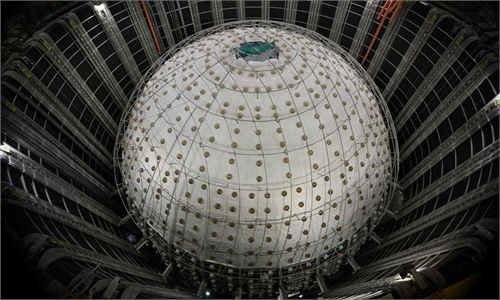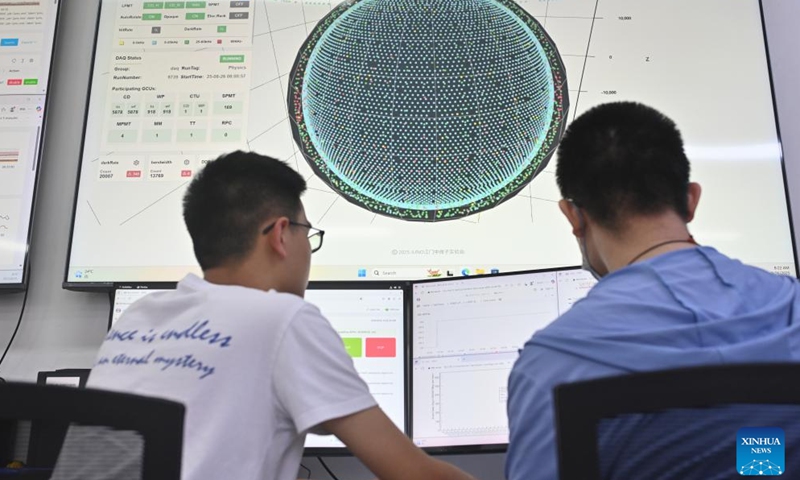
Researchers work at a control room of the Jiangmen Underground Neutrino Observatory (JUNO) in Jiangmen, south China's Guangdong Province, Aug. 26, 2025. The world's largest transparent spherical detector began operation in China on Tuesday, making it the world's first operational ultra-large scientific facility dedicated to neutrino research with ultra-high precision. Having completed the filling of its 20,000-tonne liquid scintillator detector, JUNO in Guangdong began taking data after more than a decade of preparation and construction. (Photo by Liu Yuexiang/Xinhua)
The Jiangmen Underground Neutrino Observatory (JUNO) in South China’s Guangdong Province reported its first physics result on Wednesday, just two months after its commissioning, Xinhua News Agency reported.According to the report, researchers conducted an in-depth analysis of 59 days of data collected by the JUNO from its official commissioning on August 26 this year to November 2. Using the data, they measured two neutrino oscillation parameters, with a factor of 1.5 to 1.8 better precision than previous experiments, Xinhua said.
The two parameters, originally determined by solar neutrinos, can also be precisely measured by reactor antineutrinos. Earlier results from the two approaches showed a mild 1.5-sigma discrepancy, known as the solar neutrino tension, hinting at a possible new physics theory, Xinhua reported.
"Achieving such precision within only two months of operation shows that JUNO is performing exactly as designed," said Wang Yifang, JUNO project manager and spokesperson, per Xinhua.
"With this level of accuracy, JUNO will soon determine the neutrino mass ordering, test the three-flavour oscillation framework, and search for new physics beyond it," Wang added.
Since neutrinos rarely interact with ordinary matter, they can easily zip through human bodies, buildings, or even the entire Earth without being felt, earning them the nickname "ghost particles." Due to their elusive nature, neutrinos are the least understood fundamental particles, requiring massive detectors to capture their faintest traces, according to Xinhua.
Located 700 meters underground near Jiangmen, Guangdong, JUNO detects antineutrinos produced by the Taishan and Yangjiang nuclear power plants both 53 kilometers away and measures their energy spectrum with record precision. At the heart of JUNO is a liquid-scintillator detector with an unprecedented mass of 20,000 tons, housed at the center of a 44-meter-deep water pool, Xinhua reported.
As the world's first operational ultra-large scientific facility dedicated to neutrino research with ultra-high precision, the JUNO is designed to determine the neutrino mass ordering and measure oscillation parameters with sub-percent precision. It will also study solar, atmospheric, supernova and geoneutrinos, and search for physics beyond the standard model of particle physics.
Moreover, JUNO is designed to have a scientific lifetime of up to 30 years. It can be upgraded into a world-leading research facility that probes the absolute neutrino mass scale and tests whether neutrinos are Majorana particles — particles that are identical to their own antiparticles. It will address fundamental questions across particle physics, astrophysics, and cosmology, profoundly shaping the understanding of the universe, Xinhua reported.
Global Times
RELATED ARTICLES