US congressional committee’s report claiming China creating supply-chain risks a ‘political tactic’ in futile attempt to justify its containment against China: expert
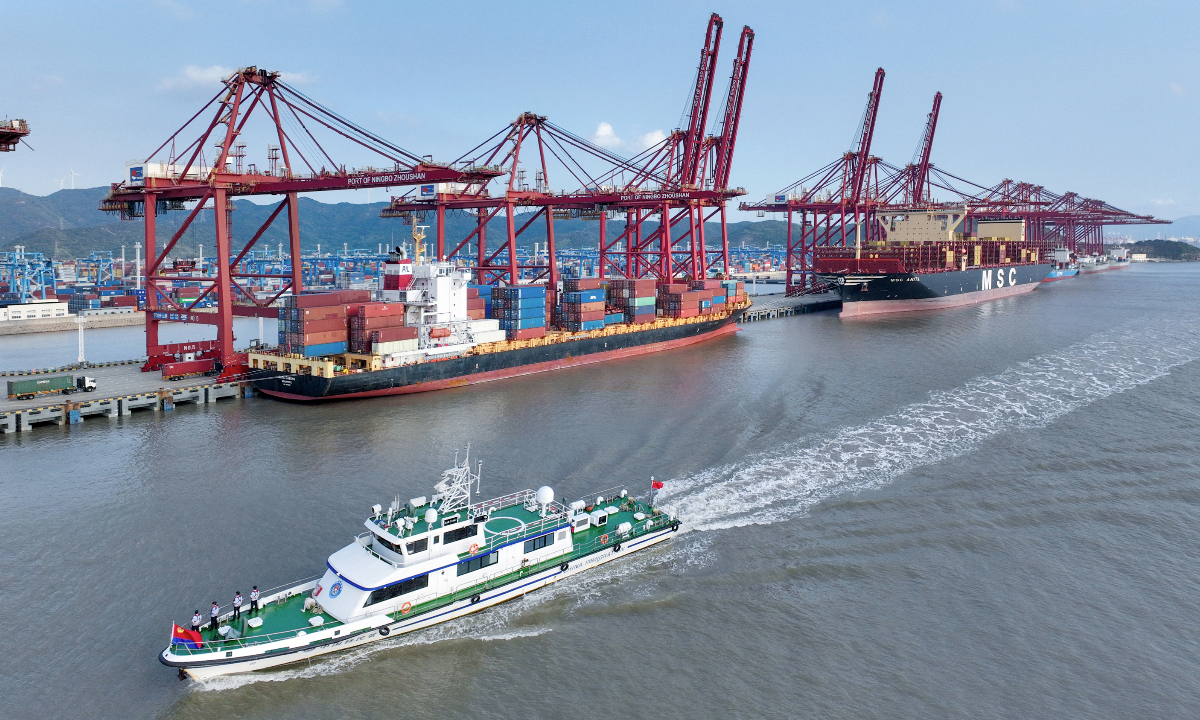
View of a container terminal of Ningbo Zhoushan Port in East China's Zhejiang Province on October 13, 2025. Photo: VCG
A US congressional commission on Tuesday local time released its annual report warning that China's economic, technological and security moves are creating growing systemic risks for the US and its allies, urging lawmakers to bolster supply-chain resilience and technological competitiveness. Chinese experts dismissed the report as highly biased, saying it reflects a unilateral US perspective and unfairly portrays China's normal economic activities as a threat in a political tactic and futile attempt to justify its call for tougher measures against China and contain China, which will be doomed to fail.
The US-China Economic and Security Review Commission (USCC), which issues annual policy recommendations to Congress, warned that without action, China could seize control of vulnerable US supply chains and severely weaken the US military in a potential conflict, according to the Washington Post.
Chinese experts said the commission's reports have for years relied on biased and selective narratives aimed at discrediting China. China has consistently called for deeper cooperation with the US, Europe and other partners in science, technology and industrial governance, seeking to build stable, complementary and well-coordinated global supply chains. In contrast, they said, Washington has increasingly politicized economic issues, pursued an "America First" agenda, pushed for artificial supply-chain decoupling and even paralyzed the WTO appellate mechanism, undermining the rules-based system for resolving trade disputes and disrupting global market order.
The commission also claimed that this mix of so-called "industrial overcapacity" and consumer stagnation positions China to scale new technologies aggressively while creating risks for global market resilience and the competitiveness of other economies.
"China is not the source of global supply chain disruptions — it is a stabilizing force," Zhou Mi, a senior researcher at the Chinese Academy of International Trade and Economic Cooperation told the Global Times on Wednesday. "The recent fragility in global supply chains stems largely from the US' tariff actions and restrictive measures, which have unsettled market expectations and amplified supply-demand imbalances. In contrast, China has continued to provide steady and predictable supply capacity, helping global companies reduce uncertainty, strengthen resilience and reinforce the foundations of industrial development."
Chinese expert Song Zhongping told the Global Times that accusations from some US politicians are unfounded, arguing that China's expanding output of new products and services has broadly benefited global markets, especially developing economies.
By contrast, they note that Washington's shift toward de-globalization — from tariffs to supply-chain severing — has pushed up prices, increased pressure on developing economies and ultimately raised costs for US consumers. China, they stress, behaves as a responsible major economy and exports goods in line with partner countries' standards, while it is US-driven disruptions that have unsettled the original supply order.
The report says that China "leveraged its monopoly over the processing of rare earth elements in trade negotiations with the US," imposing export restrictions on "critical minerals and magnets essential to a range of manufacturing industries and defense technologies." While Beijing has "recently relaxed some of these restrictions," the commission notes that it is also "tightening its enforcement capabilities for the future," signaling its readiness to "weaponize these chokepoints again when politically advantageous."
"It is the US, not China, that has disrupted global trade," Zhou told the Global Times. "Washington's tariffs have distorted supply and demand, leaving many countries unable to sell their products or purchase raw materials easily, and injecting deep uncertainty into global trade expectations.
China has never forced its exports or engaged in dumping; our firms participate in international trade based on normal market behavior. We work with host countries to safeguard market stability and reduce the damage that global supply-chain reshuffling can inflict on businesses, Zhou said.
"China is a major participant in global trade and has always adhered to multilateral rules," Zhou told the Global Times. "We take international law and supply-chain stability seriously and act responsibly, as seen in our proactive cooperation in areas such as global steel coordination. China is always willing to work with all partners to reduce policy-driven shocks — including tariffs — and create the conditions needed for stable and sustainable supply chains," he said. What the international community truly opposes, the expert stressed, is the rising acts of trade protectionism and unilateralism.
RELATED ARTICLES