ARTS / CULTURE & LEISURE
‘Fierce-fire fried rice’ embodies wisdom of warm-hearted governance
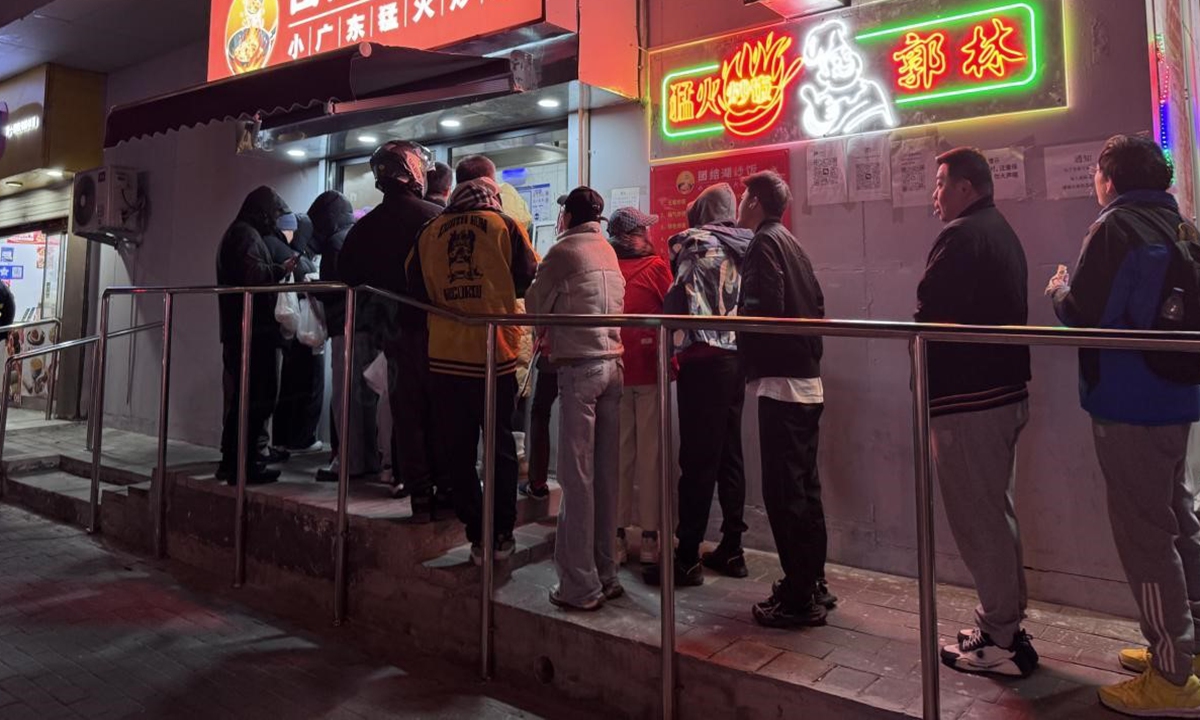
People line up to buy "Little Guangdong Fierce-Fire Fried Rice" in Tuanjinhu, Beijing on November 16, 2025. Photo: Xu Liuliu/GT
For a taste of fried rice, some people are willing to sprint across an entire street. That's how popular "Little Guangdong Fierce-Fire Fried Rice" has become popular in Beijing's Tuanjiehu neighborhood.
The rise of "fire rice" began as a simple street-side aroma drifting through the late-night air. For months, crowds gathered long past midnight, following the scent to a tiny mobile cart where 42-year-old Wang Xinlin stir-fried rice over fierce flames with blistering speed.
What eaters found wasn't just a quick meal, but a taste of authenticity, including fair prices and a kind of street-level vitality that big cities often yearn for but struggle to preserve.
A customer, surnamed Zhang, recalled her first encounter with the fried rice back on an August night, when Wang was still running a makeshift street stall. "It was late, but there were still many people waiting around him," she told the Global Times.
She said the price, which is just 10 yuan ($1.40), or about 20 yuan with extra toppings, was reasonable and her fried rice was fresh from the wok.
On social media platforms, such as Xiaohongshu, posts mapped out the location of the stall, documented wait times and raved about the real "wok hei" flavor, or "breath of a wok" flavor, that is increasingly hard to find in big cities.
What makes Wang's stall remarkable is not just the culinary appeal but the way the situation eventually unfolded. Previously, Wang was operating without proper permits. He had been cited several times for occupying public sidewalks and running an unlicensed stall. His reliance on a portable gas cylinder further heightened safety risks.
Instead of responding with a strict crackdown, local authorities took a more thoughtful route. Recently, the Tuanjiehu Street Office and Urban Management Bureau worked with Wang to find a solution that addressed public safety needs without extinguishing the small-scale entrepreneurship that brings character and warmth to the city.
Wang officially moved from his makeshift street stall into a legitimate storefront-style booth in a prime corner of Tuanjiehu. The space is modest, but it is clean, legal and equipped with brand-new cooking tools. The gas company even installed a dedicated fuel line for him.
"Having a place to settle down, I feel so much at ease," Wang said. "I'm grateful for the understanding and help that gave me a stable home."
His words capture why this story has resonated so widely. It is not merely about personal success; it is about a city choosing empathy over rigidity.
Recent cases in cities ranging from Beijing to Jingdezhen in Jiangxi Province, where local officials helped relocate a popular street vendor known as the "Chicken Chop Guy" rather than force him out, signal a shift toward warmer, smarter governance.
In the past, the "cat-and-mouse" game between street vendors and urban management both strained enforcement resources and fell short of residents' needs. But these new approaches strike a golden balance between order and vitality, Bu Xiting, an associate researcher at the School of Cultural Industries Management at the Communication University of China, told the Global Times on Wednesday.
This approach is pragmatism with a human touch, and ensures sanitation, safety and order while nurturing the small businesses that make a city feel alive. Most importantly, it shows residents that public service can have both rules and warmth.
The establishment of a permanent home for a bowl of fried rice reflects a broader lesson in warm-hearted governance. "When governance meets the needs of everyday life, and the bustle of street vendors becomes part of the city's cultural and tourism backdrop, such urban stories are bound to draw more people to explore and stay," noted Bu.
RELATED ARTICLES