EC launches probe into Chinese robotic mowers; expert slams it as baseless protectionism, says it would harm bloc’s industry and consumers
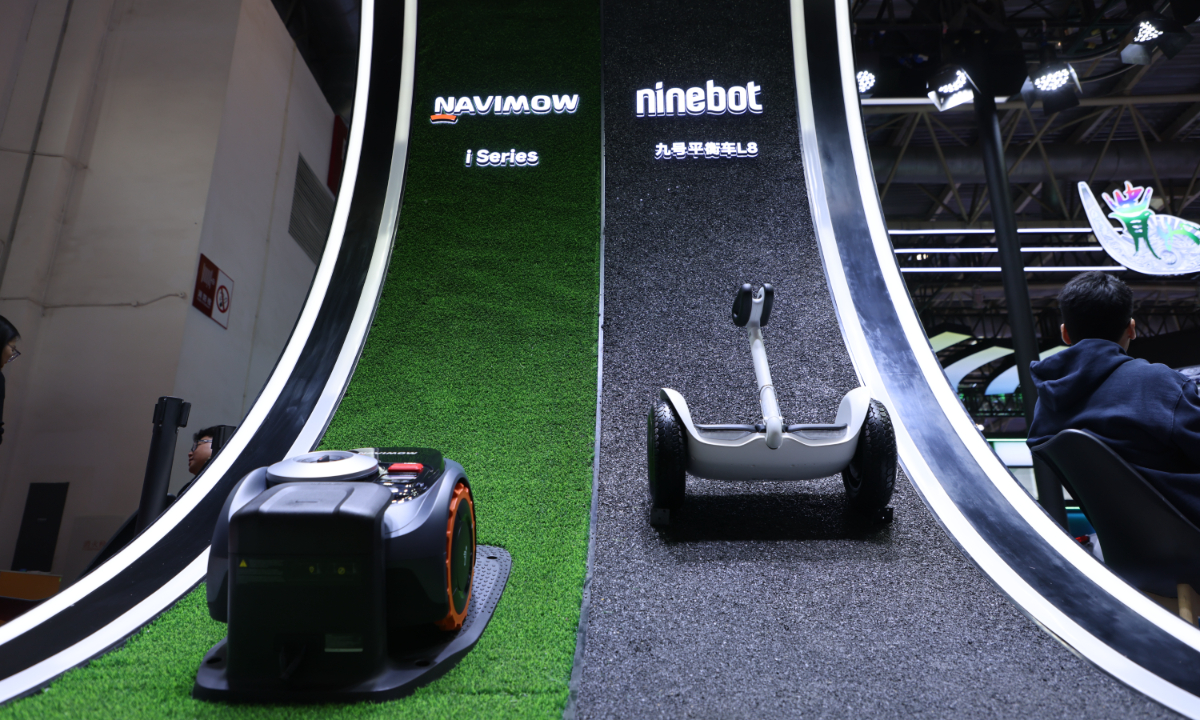
A Navimow robotic lawn mower from Segway-Ninebot on display at the 2024 China International Supply Chain Expo, on November 18, 2024. Photo: VCG
The China Chamber of Commerce for Import and Export of Machinery and Electronic Products (CCCME) said on Thursday that it will coordinate a collective legal defense on behalf of the industry in response to the anti-dumping investigation launched by the European Commission (EC) against Chinese robotic lawn mowers, aiming to secure a favorable outcome.
The commission launched the probe on Wednesday. A Chinese trade expert said that it was driven by protectionist motives rooted in stereotypes and prejudice rather than factual evidence. The expert warned that it would distort fair market competition and ultimately harm EU consumers.
According to a notice on the EU's official website, following a complaint filed by Husqvarna Manufacturing CZ s.r.o., the EC deemed that information available indicates the prices and costs of Chinese electric robotic lawn mowers are affected by significant distortions, causing injury to its own industry.
This investigation concerns electric robotic mowers that cut grass in lawns, parks, and sports grounds, without direct human control, according to the notice. The probe is set to be completed within 14 months. Any provisional measures, if required, are due within seven or no later than eight months from the announcement date.
The CCCME said in a case briefing on Thursday that it would also organize collective legal defense for the industry based on the willingness of the involved companies and the specifics of the case, aiming to secure a favorable ruling for the entire industry through multi-faceted efforts.
This accusation is yet another example of the EU implementing protectionist measures against Chinese products based on stereotypes and prejudice, said Li Yong, a senior research fellow at the China Association of International Trade. "These allegations are untenable because the actual selling prices of Chinese lawn mowers in the EU market are higher than in the Chinese domestic market, which itself does not meet the legal definition of 'dumping'," Li said.
More than 40 percent of China's robotic lawn mower exports by volume are shipped to the 27-member bloc, according to Chinese customs data. However, the average unit price of those lawn mowers sold to the EU was $207.30, which was 43 per cent higher than China's global export average for the machines of $144.60, the South China Morning Post reported.
The EU needs to confront the fundamental reasons its own industry lags behind China's, gaps in market competition, economies of scale, technological innovation, and patents, not alleged unfair pricing or subsidies enjoyed by Chinese companies, Li told the Global Times on Thursday.
European buyers are willing to buy Chinese robotic lawn mowers not just because of the price, but because they offer reliable performance and technological innovation, Li emphasized.
Compared with North America, Europe is especially attractive for robotic lawn mowers because households typically have smaller lawns that are better suited to them, according to the China Mobile Robot Alliance. Additionally, Europe's stronger emphasis on environmental protection, coupled with rising labor costs, fuels greater demand for such equipment, industry analysts said.
Bolstered by technological innovation, some Chinese companies have developed boundary-free robotic mowers, which can even be pre-programmed for "lawn printing" and creating specific patterns, according to China Central Television. China's exports of intelligent robotic lawn mowers reached $1.01 billion in the first quarter of 2025, a year-on-year increase of nearly 60 percent.
Li warned that the EC's protectionist approach would not achieve its goal of protecting local industry. "It will distort fair market competition, protect outdated production capacity, stifle incentives for technological innovation, harm industrial development, and ultimately damage consumers by raising production costs and product prices," he added.
Segway-Ninebot, one of China's major producers, responded to investor inquiries on Wednesday regarding the EU's planned probe into robotic mowers, saying that the matter will have a limited impact on its overall business and will not significantly affect its operational performance, according to a post on an information platform of the Shanghai Stock Exchange.
It added that the company's products focus on the middle- to-high-end market, with core competitiveness stemming from technological innovation and user experience, rather than price competition. The company emphasized that leading manufacturers, with mature supply chain management, sufficient capital reserves, and global operation experience, are likely to use this opportunity to further increase their market share and consolidate competitive advantages.
The EU has recently launched a series of trade investigations and actions targeting China, including scrutiny of Chinese company acquisitions. The new investigation could further escalate trade tensions, Li said, adding that some EU politicians view China through a lens of prejudice and misjudgment, which will affect the long-term healthy development of China-EU relations and is detrimental to the stability of the global economy and trade.
"We hope relevant parties will honor the commitment to openness, respect the principles of the market economy and fair competition, refrain from politicizing trade and economic issues and turning them into security issues, and provide a fair, transparent, and non-discriminatory environment for companies from all countries," Mao Ning, a spokesperson of the Foreign Ministry, said on November 5, in response to inquiries about the EU's probe of Anglo American's plan to sell its nickel mining business to Chinese company MMG.
RELATED ARTICLES