Visually impaired person shares experience traveling alone using AI; technology hailed as their 'eyes'
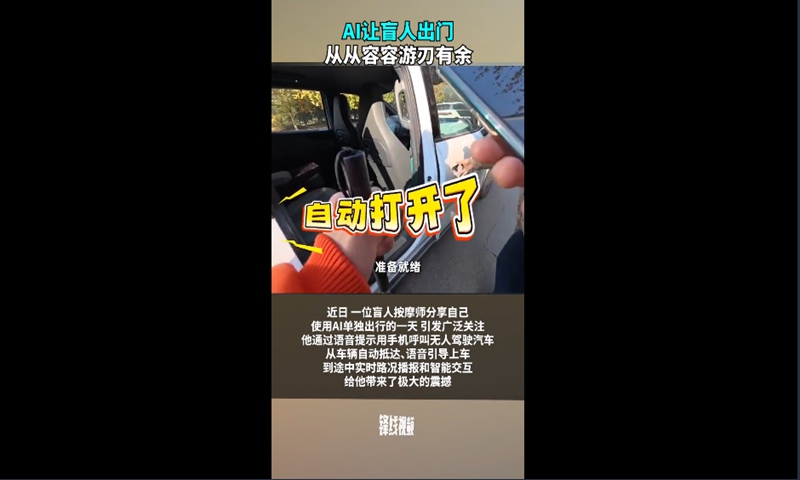
A visually impaired massage therapist recently travels alone using AI assistance. Photo: screenshot from The Paper
In China, where over 17 million people live with visual impairments, artificial intelligence is quietly reshaping their life. Recently, a visually impaired massage therapist's solo trip using AI assistance captured public attention, according to The Paper.
While traditional aids like white canes and guide dogs remain essential, AI is now opening doors to unprecedented independence. Through voice commands on his smartphone, the visually impaired massage therapist hailed a self-driving car, received real-time navigation and traffic updates, and completed an entire journey independently, according to a video shared by the Paper on November 13.
"AI has expanded our world," he shared. "It's like gaining a pair of eyes and a guiding hand."
By serving as both eyes and companion, technology is offering not just function—but warmth and possibility. As one netizen put it: "If technology has a purpose, it's this."
According to media reports, AI not only addresses the perceptual gaps left by traditional aids like white canes and guide dogs but also enables functions such as traffic light recognition, obstacle alerts, real-time bus information, and indoor navigation—significantly expanding the mobility range of visually impaired individuals. Technologies like smart glasses and multimodal navigation assistants are gradually building a more inclusive environment for independent travel.
The Paper
RELATED ARTICLES