ARTS / DANCE
Shanghai to Xinjiang, a modern ‘Journey to the West’
Railway adventure
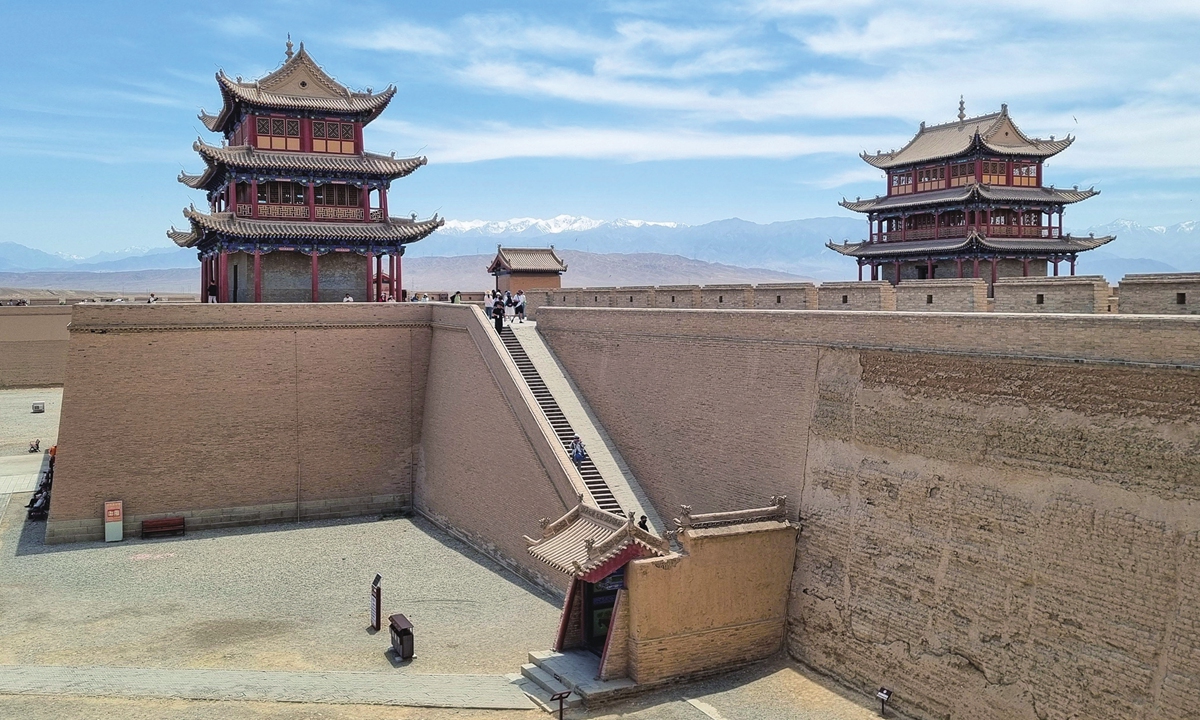
The fortresses in Jiayuguan, Northwest China's Gansu Province, marks the western end of the Great Wall, with the Qilian Mountains in the background. Photos: Hilton Yip
A vast country with more than 5,000 years of history, China is rich in cultural, geographical and regional diversity.To experience this firsthand, I embarked earlier this year on a solo "journey to the West" by train, traveling from Shanghai to Xinjiang, covering over 3,000 kilometers, 19 days and seven places.
Except for Shanghai, which I had previously visited several times, all the other places I explored on this journey were entirely new to me.
Although I am more than familiar with Shanghai's skyline and the Bund's historic waterfront, the metropolis never fails to impress, especially at night, when China's tallest towers are lit up and stand like giant sentinels of the country's prosperity.
This time, I also ventured to a less visited part of Shanghai's Baoshan district, which lies alongside the Yangtze River Delta. There, the great river is so broad that one can barely see the other side.
My next stop was Zhengzhou. While less glamorous, it is a major hub and the capital of Central China's Henan Province, China's historic heartland. There, I visited one of the country's best history museums, the Henan Museum, and later saw the legendary Yellow River, widely recognized as the birthplace of China's civilization.
Partly following the Yellow River, the next stop on my journey was Lanzhou, the capital of Northwest China's Gansu Province.
Here, I could walk alongside the river and even put my hands in its waters. On my way to this historical city, I excitedly realized I was venturing into China's great northwest.
On the map, Gansu is easily recognizable because of its distinctive narrow, elongated shape. Surrounded by the much larger Inner Mongolia Autonomous Region, Qinghai Province and Xinjiang Uygur Autonomous Region, Gansu played a vital historic role, especially due to the Hexi Corridor, a key artery of the ancient Silk Road.
The northern segment of the Silk Road also ran along this corridor to Xi'an, in Northwest China's Shaanxi Province.
Nowadays, Gansu still offers a unique travel experience, attracting visitors with majestic landscapes and fascinating historic sites linked to the history of the Silk Road.
Dunhuang sits in western Gansun, with approximately 1,000 kilometers between Lanzhou and Dunhuang.Dunhuang's fabled Mogao Grottoes, the most richly endowed, and longest used treasure house of Buddhist art, comprise hundreds of caves filled with ancient Buddhist murals going back over 1,700 years ago.
At Mingshashan dunes, I stepped foot in a desert for the first time and viewed Yueyaquan, a crescent-shaped oasis lake.
I admit that I thought Jiayuguan would be less interesting in comparison to other historic destinations, but I was pleasantly surprised by it. This final section of the Great Wall, its western end, consists of three sites - the actual fortress, the remains of the first watchtower, and a portion of the wall which goes up and over a hill.
Intrigued by the upward walkway, I decided to climb to the top of the tower. Standing on the ramparts looking out across the plain, framed by the majestic Qilian Mountains to the south, I got a little emotional thinking that over 1,000 years ago, Chinese soldiers stood guard on these very walls against invading nomads.
I then crossed over into Xinjiang via a 7-hour journey aboard a packed slow green train with sleeper compartments.

Tourists enjoy a view of Turpan's Flaming Mountains.
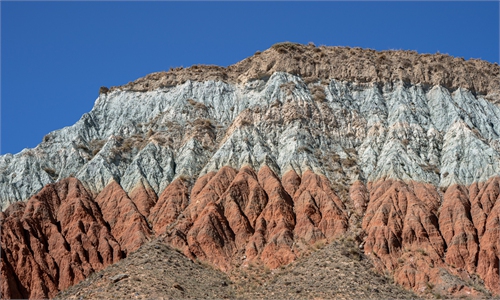
Turpan in the Xinjiang Uygur Autonomous Region is known as the hottest place in China, a reputation well deserved, as the surface temperature can reach a mind-boggling 80 C there.Turpan's main attraction is the Flaming Mountains. About 100 kilometer long, this mountain range is so dry and barren that no trees or vegetation grow there.
However, the Flaming Mountains have famously been featured in the literary work "Journey to the West" as the place where Sun Wukong the Monkey King and his companions confront a wall of fire.
Next, I ventured to Tuyugou village, a picturesque Uygur settlement nestled in a valley in the Flaming Mountains, where one can walk freely and explore Turpan's distinctive flat-roofed houses.
Despite extremely hot weather, Turpan has been continuously inhabited for over 2,000 years and is home to sets of ancient city ruins. I visited the larger and older one, the Jiaohe Ruins, former capital of a local kingdom situated atop a plateau and abandoned in the 13th century. Walking through the stone ruins of the city's buildings was a surreal experience.
Turpan also houses China's largest minaret, the 44 meter-tall Sugong Pagoda, built in 1777 in honor of a Uygur general who fought side by side with soldiers of the Qing Dynasty (1644-1911).
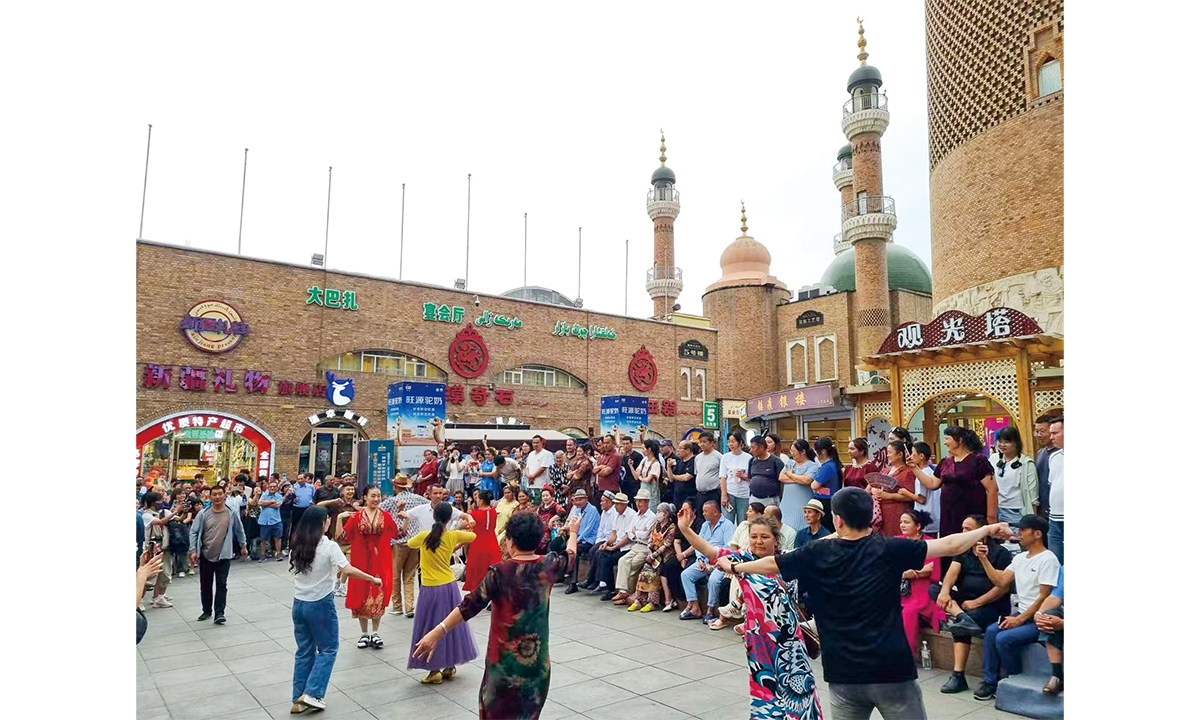
Residents dance in the Grand Bazaar in Urumqi, capital city of Xinjiang Uygur Autonomous Region.
My final stop was Urumqi, just about one hour by Electric Multiple Unit train from Turpan but a modern metropolis with a subway and freeways.Whereas Turpan is predominantly Uygur, in Urumqi the population is far more diverse, with Han, Kazakh and other ethnic communities present as well.
The Xinjiang Museum was fascinating, showcasing artifacts from Uygur, Han and many other ethnic groups who reside in Xinjiang.
Urumqi's main night market is the Grand Bazaar, which features an outside food court and malls selling local delicacies.
The most spectacular site I visited was the Tianshan Tianchi Scenic Area.
Located just one hour away from Urumqi and living up to its name, Tianchi, which literally means "Heavenly Lake," is a beautiful crater lake surrounded by lush mountains.
Throughout my journey, whether on trains or in cities or towns, I encountered virtually no inconvenience and I felt very safe.
This certainly speaks to how remarkably safe travel across China is: From east to west, one can move comfortably, and with peace of mind.
At the end of my trip, I felt like I had traveled back in time and forth throughout Chinese history, and the skyscrapers of Shanghai, which I had left just three weeks earlier, felt like a world away.
Though strikingly different, Shanghai, Henan, Gansu and Xinjiang remain interconnected by history, infrastructure and culture, and they are a testament to the magnificent historical and cultural wealth of China.
RELATED ARTICLES