China-Laos Railway cargo volume hits new high in first 10 months with 12.8% increase y-o-y
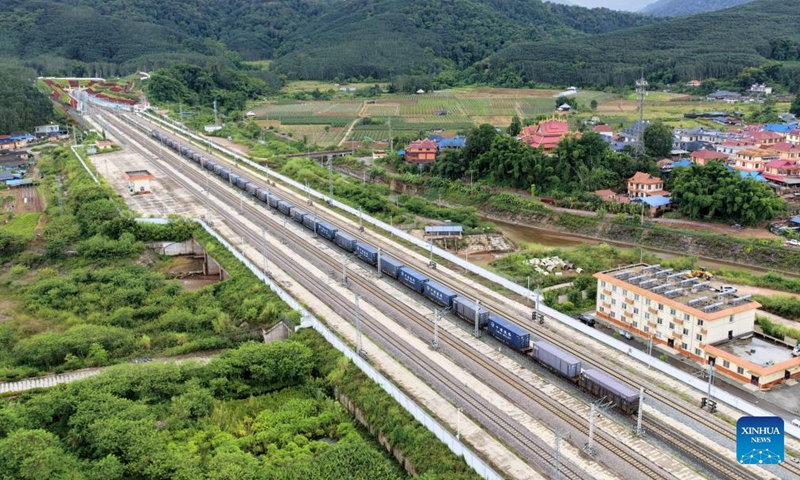
An aerial drone photo taken on Sept. 21, 2025 shows freight trains running past the Mohan Railway Station of the China-Laos Railway in southwest China's Yunnan Province. Photo: Xinhua
In the first 10 months of this year, cargo volumes handled via the China-Laos Railway reached a record high of 4.506 million tons, up 12.8 percent year-on-year, China Media Group (CMG) reported on Thursday, underscoring the line's strong transport capacity and broad development prospects.
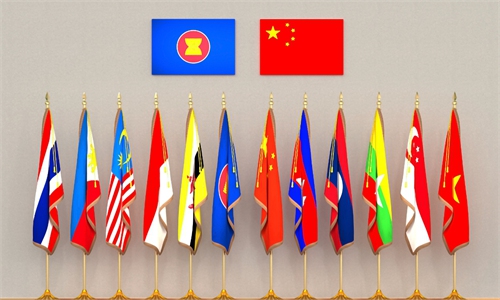
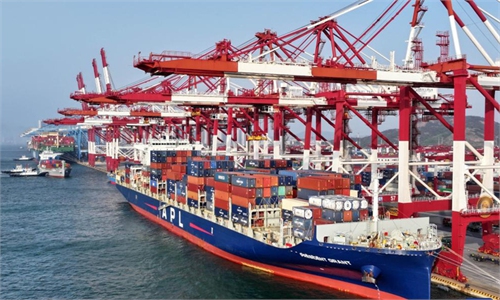
Notably, trade in high-tech products between China and ASEAN emerged as another highlight, with exports of items such as new-energy vehicles soaring by more than 285 percent. Imports of ASEAN fruits and other agricultural products rose by more than 27 percent.
Total cargo value reached 22.07 billion yuan ($3.10 billion), up 45.1 percent year-on-year. An expert noted that this reflects new achievements under China-ASEAN free trade cooperation, according to the report.
Since the China-Laos Railway began operations nearly four years ago, it has handled close to 16 million tons of imports and exports worth nearly 70 billion yuan in total. CMG reported that the "golden route" has boosted regional industrial and supply chain coordination, enabling greater efficiency and complementarity.
As a flagship project of the Belt and Road Initiative, the China-Laos Railway has played an important role in advancing connectivity between China and ASEAN countries, experts noted.
China continues to export labor-intensive products, but it has also seen rapid growth in exports of the "new trio" - electric vehicles, lithium batteries and photovoltaic products - demonstrating its rising technological sophistication and global competitiveness in high-tech sectors, Song Wei, a professor at the School of International Relations and Diplomacy at Beijing Foreign Studies University, told the Global Times on Thursday.
Song added that digital trade has become a new driver of regional integration. The adoption of technologies such as artificial intelligence and big data is also accelerating China's export growth to ASEAN.
Recently, more positive signals have emerged in China-ASEAN trade openness, including the formal signing on October 28 of the Upgrade Protocol of the China-ASEAN Free Trade Area (CAFTA) 3.0, marking a new stage in bilateral cooperation, said China's Ministry of Commerce (MOFCOM).
Amid rising global protectionism and pressure from supply-chain restructuring, CAFTA 3.0 provides a new model for global economic governance through its threefold innovations in institutional, economic and strategic resilience, MOFCOM said.
China and ASEAN countries have remained each other's largest trading partners for five consecutive years, with bilateral economic ties continuing to strengthen, according to a CMG report on Thursday.
Since 2022, China-ASEAN trade has maintained steady momentum, with the value of imports and exports exceeding $900 billion for three consecutive years, the report said. It added that in the first 10 months of 2025, China-ASEAN trade reached $862.7 billion, up 8.2 percent year-on-year, underscoring the vast potential of economic cooperation.
Song noted that China-ASEAN industrial chain cooperation will continue to deepen, moving from the traditional vertical division of labor toward more horizontal, coordinated models. China will supply core products and key components, while ASEAN countries will take on certain stages of assembly and manufacturing, fostering a more complete and higher-end regional industrial chain.
"China will further strengthen its advantages in new quality productive forces and high-end technologies, and drive broader regional integration through intelligent manufacturing," said Song.
Since the China-Laos Railway began operations, it has recorded a strong performance in cargo transport.
As of the end of October, the line had operated a total of 63,000 freight trains, with cargo volumes exceeding 70 million tons, including 16 million tons of cross-border shipments. Its network now reaches 19 countries and regions, data from the Yunnan State-owned Assets Supervision and Administration Commission showed.
RELATED ARTICLES