China’s AgiBot robot completes 100km cross-province walk, earns Guinness World Record
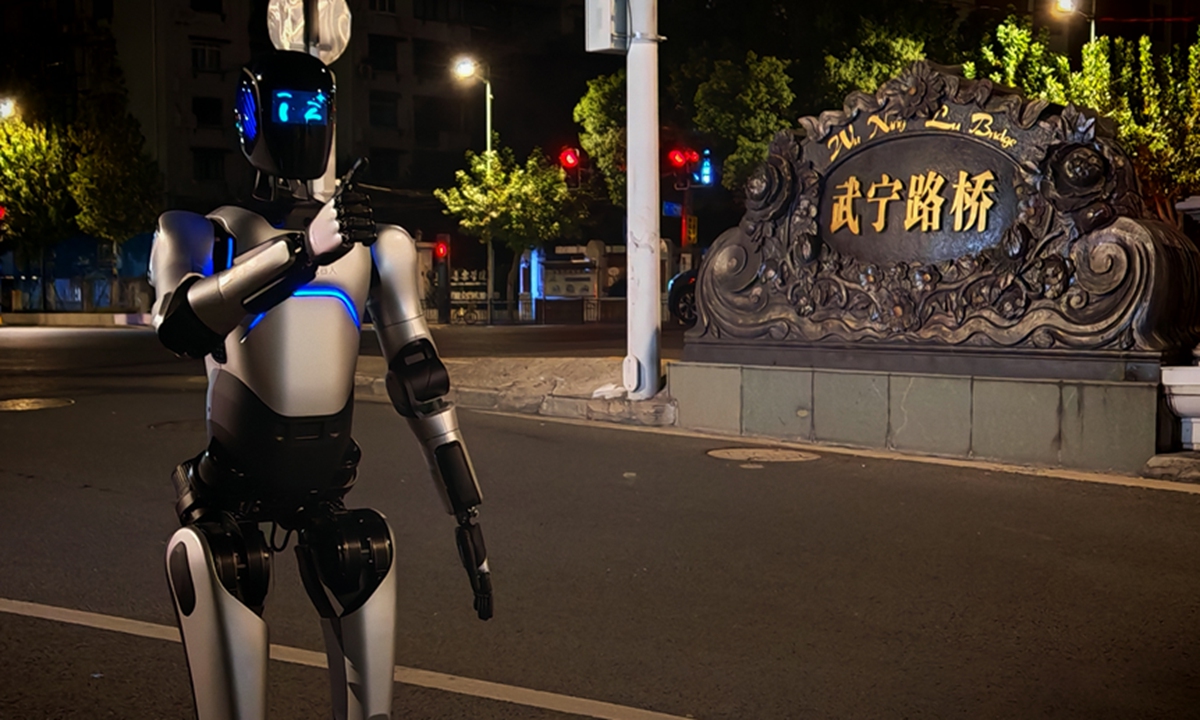
Chinese tech company AgiBot's robot completes a 100-kilometer cross-province walk on November 20, 2025, earning official recognition from Guinness World Records and becoming the holder of the title "Longest journey walked by a humanoid robot." Photo: courtesy of AgiBot
Chinese tech company AgiBot's robot on Thursday completed a 100-kilometer cross-province walking challenge, earning official recognition from Guinness World Records.
AgiBot's A2 completed a 100-kilometer cross-province trek from Suzhou's Jinji Lake in East China's Jiangsu Province to Shanghai's Bund. On Thursday, a Guinness World Records adjudicator confirmed its total walking distance of 106.286 kilometers, naming it the holder of the record for the "Longest journey walked by a humanoid robot," according to a statement AgiBot sent to the Global Times.
The A2 was able to complete the entire route without powering off, supported by AgiBot's hot-swappable battery system that allowed it to keep operating continuously during the challenge, per the statement.
During the challenge, the robot passed through city streets, scenic areas, national and provincial highways, encountering a mix of surfaces including asphalt, tiled pavements, bridges, tactile paving and slopes, as well as stretches with limited night lighting. It followed traffic rules throughout the route and ultimately arrived at the Bund in Shanghai, the company said.
Wang Chuang, partner and senior vice president of AgiBot, said that the cross-province walk was meant to illustrate the reliability and stability of humanoid robot technology. "Walking from Suzhou to Shanghai is difficult for many people to do in one go, yet the robot completed it," he noted. The outcome, he added, shows advances in hardware durability, balance control and overall endurance that are important for future commercial deployment.
Despite walking more than 100 kilometers, the A2 robot remained in good condition, with only some wear observed on the rubber layer of its foot soles, per the statement.
Wang said that the A2 robot used in the challenge was a standard, mass-produced commercial unit with no customized modifications and was identical to the robots delivered to clients. For this walk, he noted, the robot was equipped with dual GPS modules along with its built-in lidar and infrared depth cameras, giving it the sensing capability needed for accurate navigation through changing light conditions and complex urban environments.
Upon reaching the North Bund, the A2 robot briefly interacted with reporters, calling the journey a "memorable experience" in its "machine life" and joking that it might now "need a new pair of shoes." Wang said walking is only one basic capability, noting that the robot already supports multilingual interaction, facial recognition and memory, autonomous guiding and delivery tasks. He added that the model surpassed 1,000 units in shipments in 2025, placing it among the global leaders in full-size humanoid deployment.
"The leap from last year's robot marathon to this week's 100-kilometer robot walk shows how rapidly China's robotics sector is advancing," Liu Dingding, a veteran industrial expert told the Global Times on Thursday.
Achieving such progress within just around half a year highlights the speed at which core technologies such as locomotion algorithms and system integration are maturing. This development marks a pivotal moment as humanoid robots move from controlled laboratory environments into demanding real-world scenarios, he said.
Liu noted that this milestone demonstrates significant improvements in robot reliability, endurance, motion control and environmental adaptability, giving strong momentum to the embodied-intelligence industry. As these capabilities continue to evolve, Liu said, the idea that robots could match or even surpass humans in certain physical tasks is no longer distant but an increasingly visible direction of technological progress.
RELATED ARTICLES