Illustration: Liu Rui/GT
Is a complete industrial chain the key advantage supporting Shenzhen's robust capability to cultivate unicorn companies at scale? Data from Shenzhen Fabu, the city's official WeChat account, provides evidence.This not only highlights the city's unique advantages in nurturing innovative enterprises, but also offers an important way to understand China's innovation ecosystem and its economic transformation toward high-quality development.
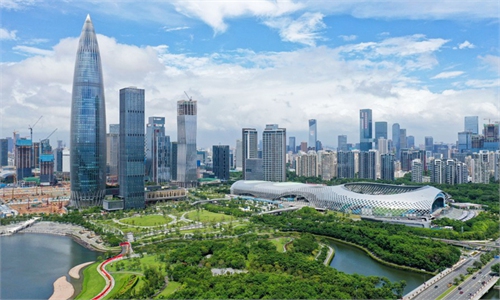
Shenzhen has cultivated 42 unicorn companies - about 10 percent of China's total - with a combined valuation of nearly 1.2 trillion yuan ($169 billion), including 13 new unicorns and four super-unicorn companies in 2024, according to Shenzhen Fabu, which cited data from the Shenzhen Unicorn and Gazelle Enterprise Research Report 2025.
This growth reflects Shenzhen's local innovation vitality and serves as a vivid example of China's emerging innovation momentum and competitive advantages.
A unicorn company generally refers to a privately held start-up that has a valuation exceeding $1 billion, and possesses unique core technologies, distinct competitive advantages, and strong market potential. Unicorns are characterized by high innovation capability, rapid growth, and strong market recognition, making them a bellwether of new driver of economic growth.
Why has Shenzhen become the fastest-growing city for unicorns in China? Liu Shu, co-founder of artificial intelligence (AI) start-up Smartmore, noted that the company became a unicorn just 18 months after its founding, crediting Shenzhen's complete industrial chain and targeted policy support, according to Shenzhen Fabu.
Shenzhen's rapid rise of unicorns is driven primarily by its highly complete and agile industrial ecosystem. The city hosts clusters across information technology, electronics manufacturing, and AI, and works in synergy with the industrial chain cluster. This enables companies to complete the full cycle from prototype design and pilot testing to mass production within the same region, significantly reducing costs and accelerating iteration.
Thanks to this industrial chain, the speed from "idea" to "commercial products" in Shenzhen is continuously being redefined. Figures from the Shenzhen Special Zone Daily illustrate this efficiency: A 3D printer can be assembled in just two minutes, and a drone can go from concept to mass production in just three months.
Moreover, Shenzhen's policy environment is characterized by a "pilot-first" approach, offering city-level testing grounds for emerging industries such as drones, autonomous driving, digital currency, and smart cities. Policies prioritize commercialization and large-scale deployment rather than pure research funding. This ensures that new technologies are not only developed, but can also be validated and commercialized in real-world scenarios.
Importantly, Shenzhen is not an isolated case, but a microcosm of China's broader innovation landscape. China is building a multi-center innovation network, with Shanghai and Zhejiang Province in East China, Sichuan Province in Southwest China, and other regions establishing unicorn-development mechanisms focusing on emerging and future industries. The rise of unicorns is not merely a city-level phenomenon, but the result of national industrial upgrading.
Globally, China's industrial chain advantages stand out even more. Silicon Valley, for example, excels in software, research and development (R&D), and venture capital, but many companies relies heavily on international supply chain, which leads to higher costs and longer scaling cycles. In contrast, China - especially Shenzhen - provides full-chain support from R&D to mass production, creating a robust environment for commercialization in sectors such as robotics, drones, smart hardware, and the Internet of Things.
Thus, Shenzhen is both a showcase of China's advancing technological capabilities and a strategic pillar for developing differentiated advantages in global competition. As Shanghai, Zhejiang, Sichuan and other regions establish layered cultivation systems for emerging industries, China is forming a multi-node, collaborative unicorn ecosystem.
This regional synergy strengthening the link between innovation and industrialization becomes a new driver of China's economic growth. With continued policy support and evolving manufacturing capabilities, China is poised to build a broader landscape for unicorn growth and propel high-quality development.
The author is a reporter with the Global Times. bizopinion@globaltimes.com.cn
RELATED ARTICLES