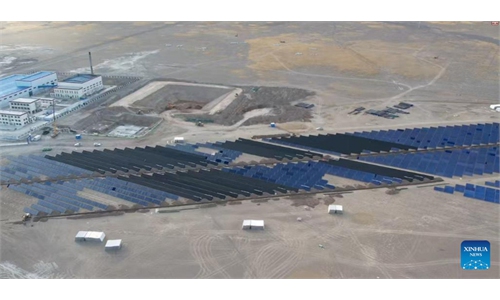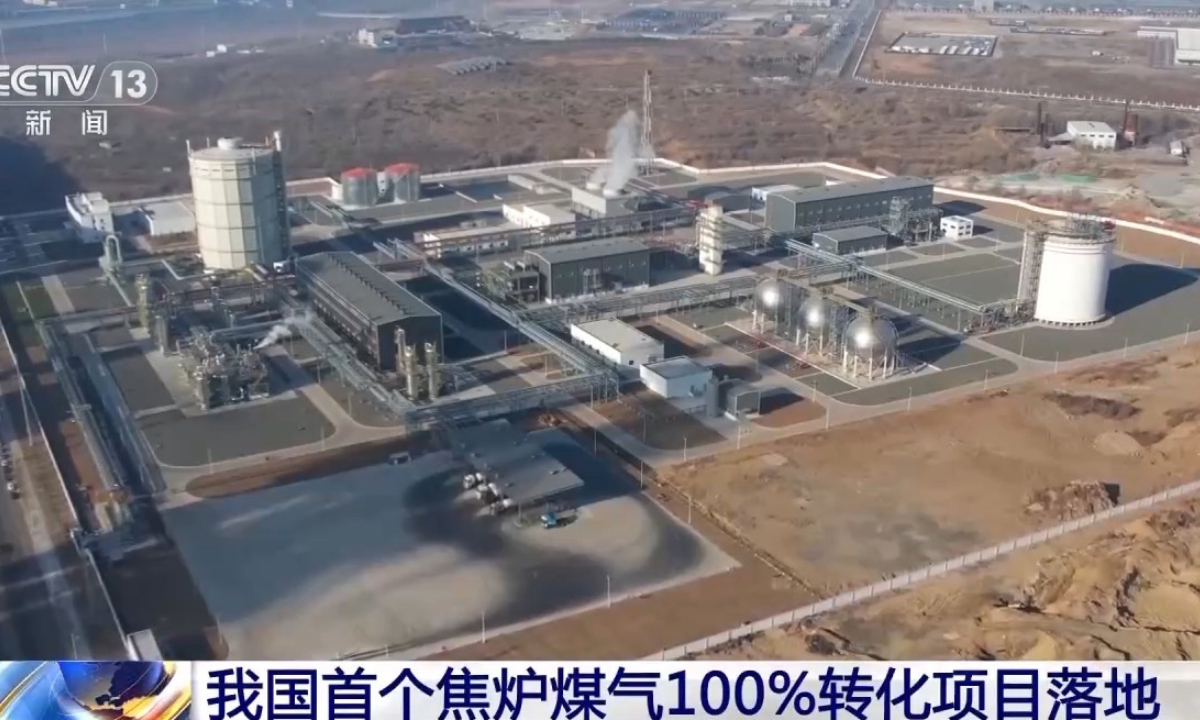
China's first project achieving full conversion of coke oven gas to clean energy has officially come online in Lingyuan, Northeast China's Liaoning Province. Photo: screenshot from China Media Group
China's first project achieving 100-percent conversion of coke oven gas to clean energy has come online in Lingyuan, Northeast China's Liaoning Province, opening up a new pathway for green development in the steel industry, China Media Group (CMG) learned from China International Marine Containers on Monday.
Coke oven gas is one of the industrial tail gases produced in steelmaking and has historically suffered from low comprehensive utilization rates. At a newly built energy facility in Lingyuan, technicians used next-generation separation and synthesis technologies to convert the coke oven gas fully into liquefied natural gas (LNG), liquid ammonia, and hydrogen, according to the report.
Cai Xinbo, project manager of the facility, was quoted as saying in the report that the waste gas is transformed into three high-value products. LNG is the cleanest fossil fuel available, liquid ammonia is a foundational chemical feedstock, and hydrogen is the clean energy carrier with the greatest future potential. "That's how we've achieved 100 percent conversion," Cai said.
The natural gas and ammonia produced through conversion are liquefied and stored in massive spherical and cylindrical tanks that tower 30 to 40 meters high. A single tank of LNG can supply heating to approximately 200,000 households for an entire month, while the liquid ammonia can be further processed into agricultural fertilizers, refrigerants for cold-chain logistics, or even rocket propellants, the report said.
The cost of producing hydrogen from coke oven gas is typically only 30 percent to 50 percent of that associated with conventional coal- or natural gas-based hydrogen production. This significant cost advantage has driven rapid growth in the market for coke oven gas-derived hydrogen, according to the report.
Hydrogen from coke oven gas is finding expanding applications in high-end manufacturing. The purity of the hydrogen produced has been pushed from 99.999 percent to 99.9999 percent, and achieving that extra 0.0009 percent was far from straightforward.
According to Wang Wenge, an engineer at the facility, the key lies in the next-generation molecular sieve. Wang said in the report that as the gas stream passes through the sieve, impurity gases will be selectively adsorbed, allowing only hydrogen molecules to pass through its micropores. This produces ultra-high-purity hydrogen that can be applied in cutting-edge sectors such as electronics manufacturing, aerospace, and high-end chemical engineering.
Lin Boqiang, dean of the China Institute for Studies in Energy Policy at Xiamen University, told the Global Times on Monday that transforming waste gas to clean energy represents another achievement in China's green transformation.
"The conversion technology has market potential. China is the world's largest producer, with both its production and utilization primarily taking place domestically. If the economic viability of this model is validated and proves scalable, it can be promoted nationwide to achieve resource recovery and recycling of coke waste, driving the development of a circular economy and generating substantial green economic and environmental benefits," Lin noted.
According to CMG, China is the world's largest coke producer, generating about 210 billion cubic meters of coke oven gas annually. If 30 percent of the volume is comprehensively utilized, it will cut the steel industry's carbon emissions by about 45 million tons per year, while creating more than 100 billion yuan ($14.07 billion) in additional industrial output value and driving innovative development in the traditional steel sector, said the report.
RELATED ARTICLES