Hebei to conduct forward-looking research on maglev trains between Beijing and Xiong’an in next 5 years
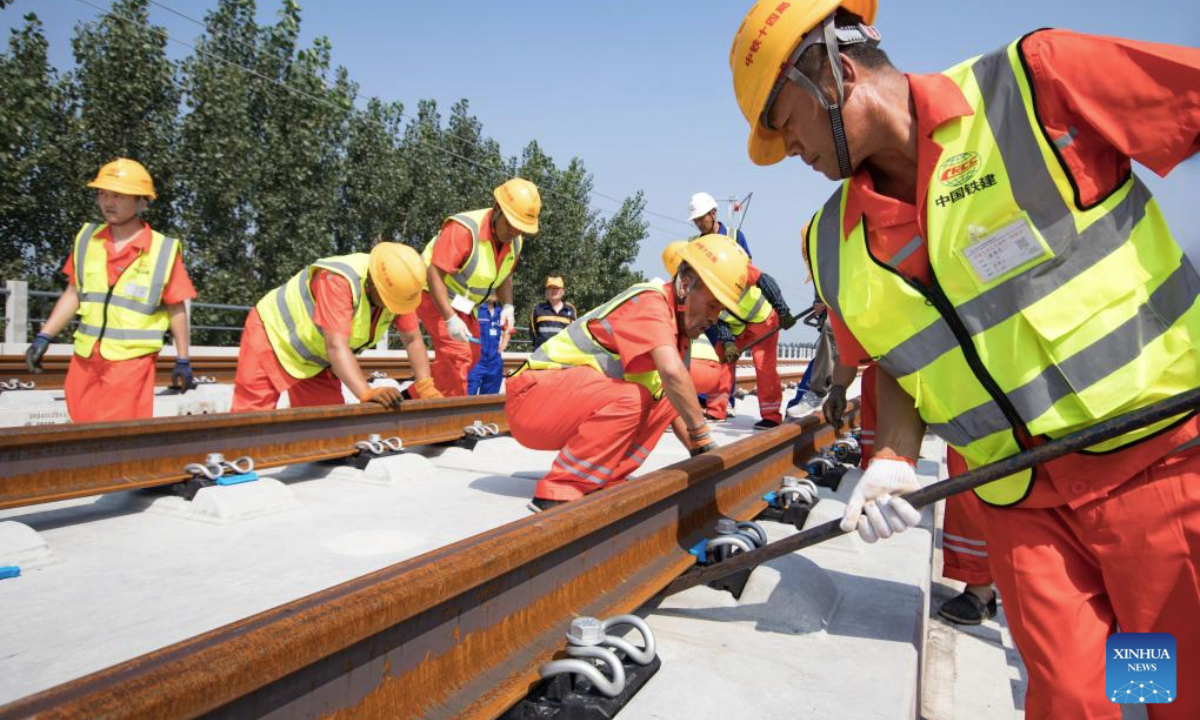
Workers operate at the track laying construction site of the Xiong'an-Shangqiu high-speed railway in Hejian city, north China's Hebei Province, September 1, 2025. Photo: Xinhua
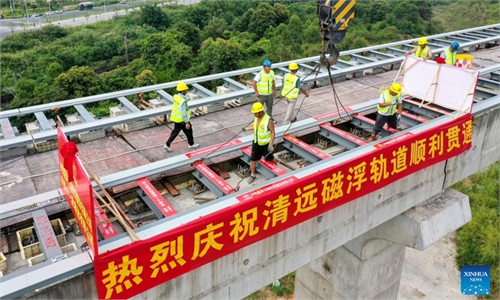
North China's Hebei Province will conduct forward-looking research on maglev trains and other future transportation modes between Beijing and Xiong'an in the next five years, according to the recommendations of the Hebei Provincial Committee of the Communist Party of China on formulating the 15th Five-Year Plan (2026-30) for Hebei Province's economic and social development posted on the website of the Shijiazhuang government on Monday.
According to the recommendations, Hebei will promote the high-standard and high-quality development of the Xiong'an New Area, in order to build it into a high-level modern city during the next five years. Efforts include promoting the planning and construction of major transportation infrastructure and conducting forward-looking research on maglev trains and other future transportation modes between the capital and the new area.
"The inclusion of maglev trains in the provincial document indicates that the high-tech transport mode has become the major study target for future transport between Beijing and Xiong'an, which will promote its research, implementation and application between the two regions," Sun Zhang, a railway expert at Shanghai's Tongji University, told the Global Times on Monday.
Sun noted that given the Xiong'an New Area's positioning as a city of science and technology, conducting forward-looking research on maglev trains between the national capital and the new area carries demonstrative significance in innovation and pioneering application.
"It will also enhance Xiong'an's appeal to related high-caliber researchers, technology enterprises, and innovation resources," Sun added.
According to the recommendations, Hebei will promote the connectivity of transportation infrastructure, enhance the accessibility and convenience of the "Beijing-Tianjin-Hebei region on rail," advance the implementation of a number of major highway connectivity projects, and jointly build a world-class airport cluster and port cluster in the Beijing-Tianjin-Hebei region.
Once the maglev project is implemented, it will improve the transportation network of the Beijing-Tianjin-Hebei region and accelerate the in-depth integration of coordinated development in the region, Sun noted.
China embarked on maglev technology development comparatively late, yet through the path of "importing, assimilating, absorbing and then re-innovating," combined with indigenous innovation, it has realized a leap from catching up to taking the global lead.
According to the Xinhua News Agency, China's new high-speed maglev train, with a designed top speed of 600 kilometers per hour, rolled off the production line in 2021.
It was domestically developed, according to the China Railway Rolling Stock Corp (CRRC). The company said that the new breakthrough demonstrates that the country has mastered a complete set of high-speed maglev train engineering technologies, including system integration, vehicle production, traction power supply, rail trails, and transport control and communication, Xinhua reported.
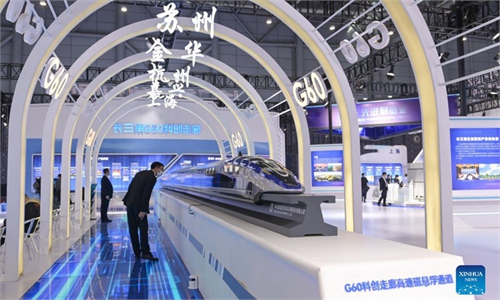
At the 12th World Congress on High-Speed Rail held from July 8 to 10 this year, the country's first superconducting electric high-speed maglev train, developed by CRRC Changchun, officially debuted. It can operate at a maximum speed of 600 kilometers per hour, according to Xinhua.
Sun noted that China possesses a relatively mature reserve of maglev technology. Future commercial applications will fill the speed gap between high-speed rail and civil aviation, further improving the country's high-speed transportation network, thus accelerating inter-city connectivity within urban clusters, the expert noted.
RELATED ARTICLES