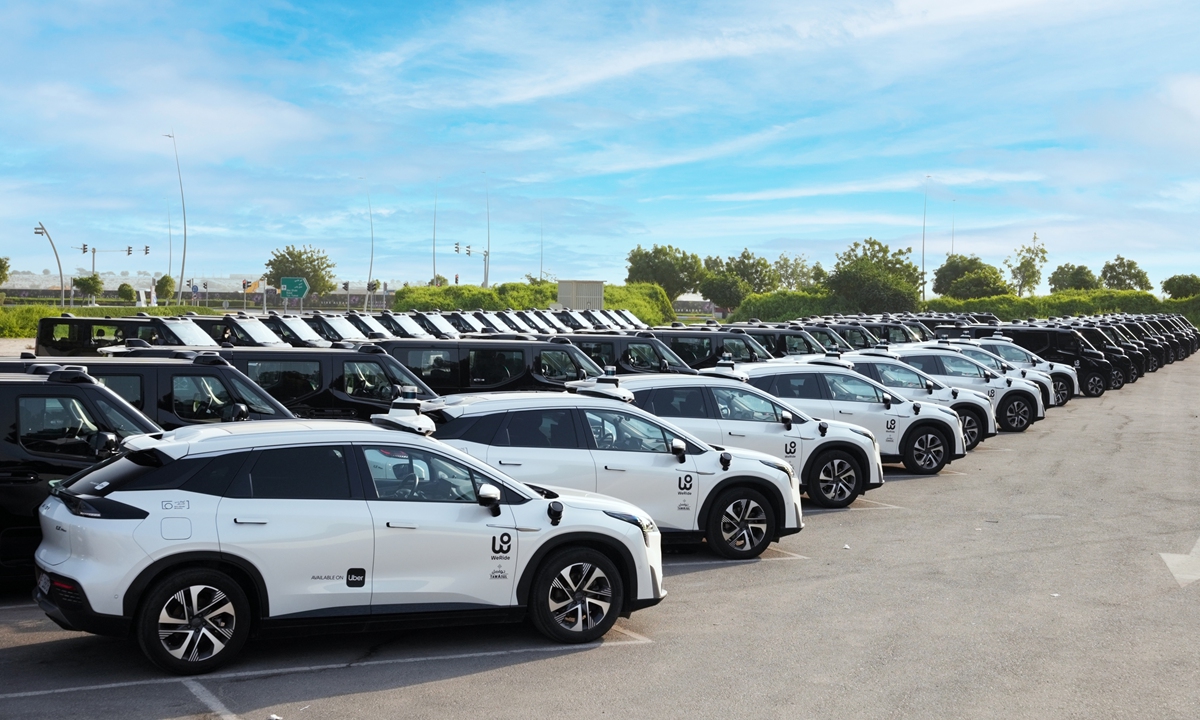
WeRide's Robotaxi fleet operates in Abu Dhabi on November 26, 2025. Photo: Courtesy of WeRide.
Chinese companies in the autonomous taxi sector are accelerating their push overseas on the back of rising commercial maturity, as shown by a leading industry player's move into the Middle East market on Wednesday.China-based autonomous driving technology leader WeRide said in a statement sent to the Global Times on Wednesday that it has launched fully driverless Level-4 robotaxi commercial operations in Abu Dhabi in partnership with international ride-hailing giant Uber.
It's the first deployment of fully driverless robotaxi services in the Middle East, making Abu Dhabi the first city outside the US to offer fully driverless rides on the Uber platform, according to the statement.
On the same day, the company began offering fully driverless robotaxi services to the public on Yas Island, with no safety operator on board. Passengers can access WeRide's robotaxis via UberX or Uber Comfort, or directly through the newly added "Autonomous'' category, Uber's first dedicated autonomous driving option worldwide.
This was only the latest development this month. The Estonian ride-hailing platform Bolt has a partnered with the Chinese self-driving company Pony.ai to bring autonomous vehicles to Europe, Euro News reported on Tuesday. The partnership will integrate Pony.ai's Level 4 autonomous driving technology, which is capable of operating without human intervention in specific conditions, into Bolt's network, according to the report.
Chinese experts said that Chinese autonomous driving firms' overseas expansion is underpinned by strong underlying logic and a solid industrial foundation.
China's autonomous driving sector has developed in step with the rest of the world, but thanks to the country's strong new-energy vehicle (NEV) manufacturing base, vehicles reached the market at a much faster pace, enabling China to take a leading position in the global race to iterate and upgrade autonomous driving technologies, Ma Jihua, a veteran industry analyst, told the Global Times on Wednesday.
After multiple rounds of technological upgrades, China has accumulated some of the world's most extensive experience in scenario deployment, road testing and real-world operations. Against this backdrop, the push for autonomous driving technologies to expand overseas has become a natural progression.
On November 10, Baidu's Apollo Go received one of the first licenses for fully driverless commercial operations issued by the Integrated Transport Centre of Abu Dhabi. A day later, Apollo Go expanded its cooperation with UAE autonomous mobility firm AutoGo, with plans to build the emirate's largest fully driverless fleet.
On October 22, Apollo Go reached a strategic partnership with PostBus, the public transport operator under Swiss Post, to roll out its autonomous mobility service "AmiGo'' in Switzerland. According to the Shanghai Securities News, initial fleet testing is scheduled to begin in December in the cantons of St. Gallen, Appenzell Ausserrhoden and Appenzell Innerrhoden, with plans to quickly transition to regular, fully driverless operations.
The move signals that China's leading autonomous mobility services have successfully entered the European market, known for its stringent standards and regulatory requirements, winning broad recognition and support from both cantonal and federal authorities in Switzerland, Ma said.
China's autonomous driving market is estimated to have reached about 120 billion yuan ($16.9 billion) in 2024, up roughly 30 percent year-on-year, according to an industry report. The strong momentum is expected to continue into 2025, with the market likely to exceed 160 billion yuan. The compound annual growth rate is projected to remain above 25 percent in the coming years, the report said.
Ma noted that the evolution of the tech industry shows that networks, devices and applications advance as an integrated whole. China is at the forefront of 5G and 6G network build-out, leads in exports of telecommunications equipment, and has amassed vast practical experience in application-level scenarios and road tests.
He added that Chinese autonomous driving firms will continue to pursue mutually beneficial cooperation when expanding abroad, aiming to support local industry development. While deploying Chinese vehicles and technologies, companies also ensure that local partners benefit, using technological empowerment to improve operating efficiency and help grow local mobility ecosystems, Ma noted.
RELATED ARTICLES