ARTS / CULTURE & LEISURE
Ancient DNA from Shimao ruins confirms continuity of Chinese civilization
By Published: Nov 27, 2025 03:04 PM

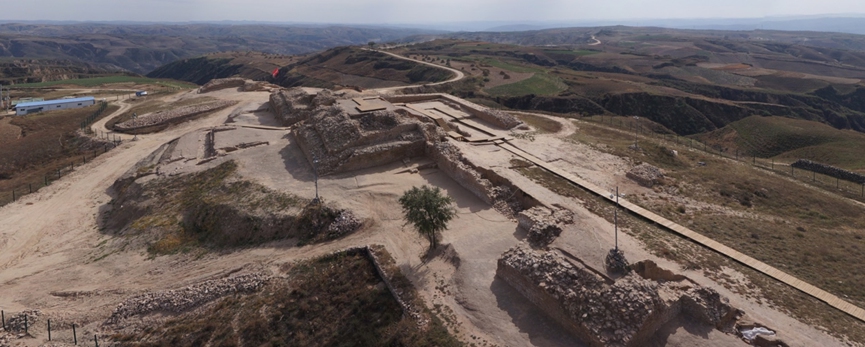
Shimao ruins, an important prehistoric site located in Northwest China's Shaanxi Province Photo: Courtesy of National Cultural Heritage Administration
A groundbreaking genetic study of China's Shimao ruins, an important prehistoric site located in Northwest China's Shaanxi Province, has provided definitive evidence that the core population of the Shimao culture descended from late Yangshao communities in northern Shaanxi Province, reinforcing the theory of China's civilization having evolved continuously on its own soil, experts announced at a press conference held by the National Cultural Heritage Administration (NCHA) on Thursday.The research, published in Nature on Wednesday, represents the largest-ever genetic analysis of a prehistoric settled community and reveals a sophisticated social hierarchy with power transferred through male lineages at the Shimao ruins, dating back approximately 4,000 years, according to a press release that the NCHA sent to the Global Times on Thursday.
The research was led by Fu Qiaomei from the Institute of Vertebrate Paleontology and Paleoanthropology, Chinese Academy of Sciences, in collaboration with other institutions including the institutes of archaeology from Shaanxi Province and North China's Shanxi Province.
Over 13 years, Fu's interdisciplinary team, collaborating with multiple institutions, analyzed 169 ancient human skeletal samples from Shimao ruins, surrounding sites, and southern Shanxi Province.
Their high-resolution genomic study marks the first reconstruction of the social organization and kinship-based hierarchy of the largest prehistoric city in China, exhibiting clear early-state characteristics.
Located at the junction of the Loess Plateau and the Mu Us Desert, the Shimao ruins encompass a cultural sphere of over 200,000 square kilometers. Its intricate defensive systems, diverse ritual remains, and high-status artifacts reflect a sophisticated early state structure, long debated by scholars regarding its population origins and social organization.
"Deciphering kinship in such a large-scale site required integrating genomic data with archaeological evidence, from burial styles to grave goods, using complex modeling approaches," Fu told the Global Times, noting it was the first global study of a site with large-scale human sacrifice and burial practices.
Technological breakthroughs were pivotal to the research. The team developed advanced ancient capture and short-fragment DNA extraction techniques, alongside other cutting-edge technologies, enabling them to "'communicate' with 4,000-year-old populations," according to Fu.
The team developed specialized capture methods and automated protocols to improve efficiency and reduce contamination when working with poorly preserved specimens. They also created data models that incorporated multiple dimensions of archaeological information, such as settlement patterns, tomb structures, burial goods, and residential remains, enabling cross-verification between genetic lineages and archaeological cultures.
Genetic analysis revealed remarkable consistency among the core Shimao population, whose genetic makeup matched that of late Yangshao groups in northern Shaanxi, confirming the continuity of Shimao's cultural and population development. These findings address long-standing academic debates about the origins of the Shimao people.
Furthermore, the study revealed surprising connections between the Shimao population and other contemporary cultures: the Taosi culture people from southern Shanxi Province, populations with steppe-related ancestry, and southern rice-farming communities. These connections reveal extensive interaction among prehistoric farming and pastoral groups across a vast geographical expanse, according to the press release.
Archaeological findings complemented the genetic data. Recent excavations have clarified the structure of Huangchengtai, the core area of the Shimao site, revealing a large building foundation covering 16,000 square meters, workshop areas for weaponmaking workshops, and ritual spaces connected by roads.
"The discovery of public ritual skull pit sacrifices and human sacrifices in noble tombs further underscores the society's stark class stratification," said Shao Jing, deputy director of Shaanxi Provincial Institute of Archaeology.
Most notably, the team reconstructed four-generation family lineages centered on high-status male ancestors, uncovering a social hierarchy rooted in patrilineal kinship. "This provides the first direct genetic evidence for models of political power inheritance in early East Asian states," Fu said.
Experts hailed the findings as a "chain of evidence for early Chinese civilization." This research reveals the population history and genetic structure of China's first state-level civilization, offering crucial insights into early civilizational development in China and East Asia as a whole, commented leading scholars in the field, the press release noted.
During the announcement, officials from the NCHA announced plans to continue the project to trace the origins and development of Chinese civilization and the "Archaeology in China" initiative, strengthening interdisciplinary collaboration and scientific archaeology.
RELATED ARTICLES