China’s action plan to spur wide range of consumption
Sound alignment of supply, demand benefits formation of unified market
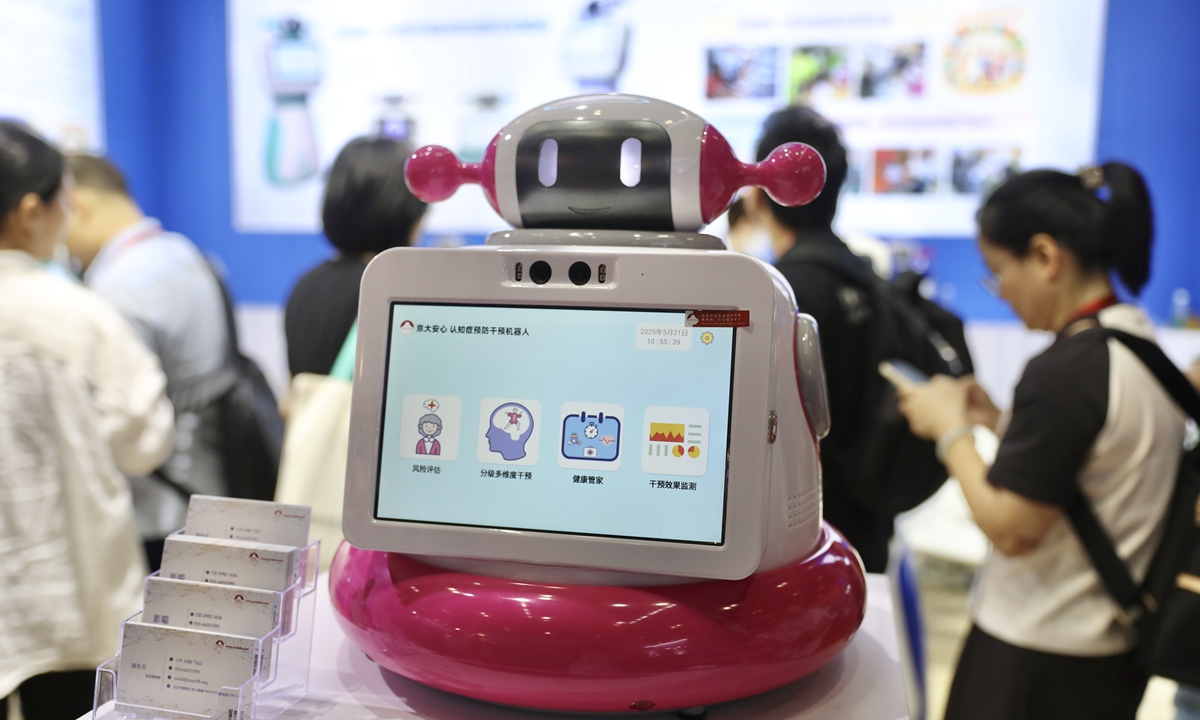
A service robot welcomes visitors at an eldercare service expo in Beijing on May 21, 2025. The expo displays a variety of products, including companion robots and smart household products. Photo: VCG
By 2027, eldercare products, internet-connected smart vehicles, and consumer electronics will become 1 trillion yuan ($141.2 billion) consumption market in China, a senior official from the Ministry of Industry and Information Technology (MIIT) said on Thursday.
Xie Yuansheng, Vice-Minister of the MIIT, made the remarks after six Chinese government departments released an action plan on Wednesday to enhance the alignment between supply and demand to further unleash China's consumption potential, vowing to cultivate three consumption levers each worth 1 trillion yuan and 10 consumption hotspots of 100 billion yuan each by 2027.
Xie noted that these targets are set by the ministry, based on a comprehensive analysis of the country's consumption trends and ongoing technological transformations.
Taking eldercare products for an example, Xie explained that the market size has expanded from 2.6 trillion yuan in 2014 to reach 5.4 trillion yuan in 2024, with a compound annual growth rate of 7.3 percent, which now becomes a major pillar of the silver economy.
In addition, 100 billion yuan consumption hotspots include fitness equipment, outdoor gear, pet food supply, consumer drones, trendy collectibles and jewelry and accessories, as well as guochao (China chic) apparel. These sectors have demonstrated strong growth momentum and massive development potential, injecting the consumer market with greater vitality, according to Xie.
"Promoting overall alignment between supply and demand can maximize the unleashing of consumption potential and facilitate the smooth circulation of Chinese economy,"Xie said.
According to Xie, the government plan will include coordinated efforts across multiple dimensions - supply, demand, channels and logistics - to enhance the adaptability and flexibility of the supply ecosystem.
"As Chinese people's living standards continue to rise and technological progress accelerates, personalized and customized consumption services will become widely popular. Therefore, it is vital to understand consumers' real needs," Li Chang'an, a professor at the Academy of China Open Economy Studies at the University of International Business and Economics, told the Global Times on Thursday.
Wang Peng, an associate researcher at the Beijing Academy of Social Sciences, told the Global Times that the plan, leveraging AI to enhance efficiency across the entire value chain, will cultivate new consumption scenarios that integrate online and offline channels, and foster a diversified consumption ecosystem in the country.
In addition, the government is rolling out tiered policies targeting different consumer groups to expand the supply of distinctive products in fields such as green consumption, rural consumption, leisure products and more, Wang said.
Li noted that as various segments of the consumption market face issues such as poor circulation and disconnects between supply and demand, the recently introduced plan - aimed at removing bottlenecks and invigorating market vitality - is highly timely. It represents a significant move in advancing the construction of a unified national market, he added.
According to the National Bureau of Statistics, China's retail sales totaled 4.629 trillion yuan in October, growing by 2.9 percent year-on-year. In the first 10 months, retail sales reached 41.217 trillion yuan, up by 4.3 percent.
Xie said that "alignment" refers to the proactive alignment of the supply side of consumer goods production with evolving consumption trends. Starting from product design, it should precisely match diverse consumer demands, achieving a two-way convergence between supply and demand, and dynamically aligning in terms of quality, structure, functionality, and utility.
"As uncertainties in the external environment intensify, prioritizing domestic demand as the primary driver can significantly enhance economic resilience," Wang said.
Li noted that in the 15th Five-Year Plan period (2026-30), the country will continue to focus on boosting consumption through supply-side innovation, promoting high-quality economic development.
RELATED ARTICLES