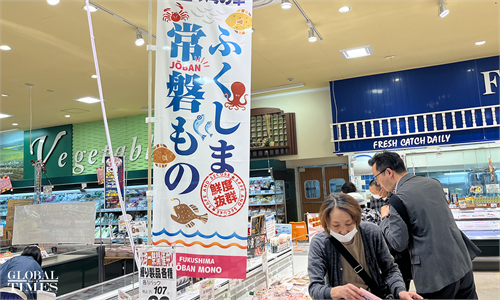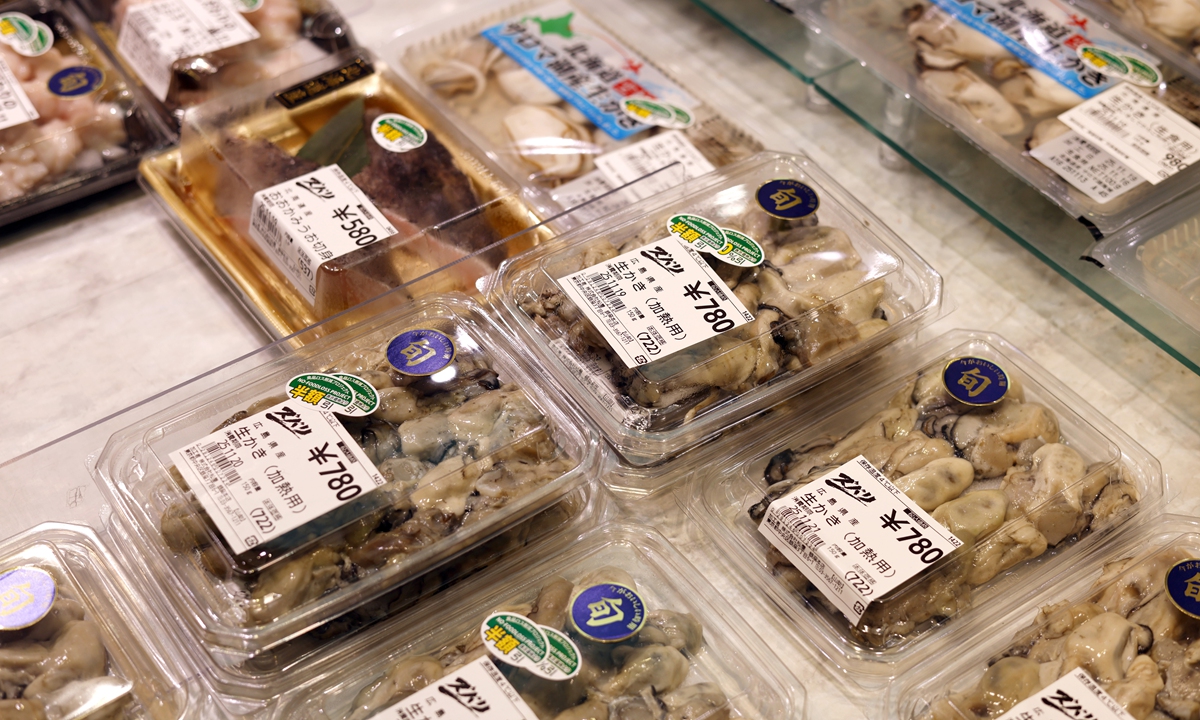
A view of a seafood store in Tokyo, Japan, on November 19, 2025 Photo: IC
The Hong Kong government has prohibited the import of certain aquatic products from 10 Japanese prefectures, a fresh move against Japan's discharge of nuclear-contaminated water at the Fukushima Nuclear Power Station, the city's Food and Environmental Hygiene Department said on Friday.
In response to the Japanese government's plan to discharge nuclear-contaminated water at the Fukushima Nuclear Power Station, the Director of Food and Environmental Hygiene issued a Food Safety Order which prohibits all aquatic products, sea salt and seaweeds originating from the 10 metropolis/prefectures, namely Tokyo, Fukushima, Ibaraki, Miyagi, Chiba, Gunma, Tochigi, Niigata, Nagano and Saitama, from being imported into and supplied in Hong Kong, according to a statement released on the Hong Kong Special Administrative Region Government's official website on Friday.
For other Japanese aquatic products, sea salt and seaweeds that are not prohibited from being imported into Hong Kong, the Centre for Food Safety (CFS) of the Food and Environmental Hygiene Department is conducting comprehensive radiological tests to verify that the radiation levels of these products do not exceed the guideline levels before they are allowed to be supplied in the market, according to the document.
From Thursday noon to Friday noon, the CFS conducted tests on the radiological levels of 241 food samples imported from Japan, which were of the "aquatic and related products, seaweeds and sea salt" category. No sample was found to have exceeded the safety limit, according to the statement.
The Hong Kong Observatory has also enhanced the environmental monitoring of the local waters. No anomaly has been detected so far.
From August 24, 2023, to Friday noon, the CFS and the Agriculture, Fisheries and Conservation Department have conducted tests on the radiological levels of 183 820 samples of food imported from Japan (including 119 439 samples of aquatic and related products, seaweeds and sea salt) and 41 064 samples of local catch respectively. All the samples passed the tests, said the statement.
Global Times
RELATED ARTICLES