ARTS / CULTURE & LEISURE
China’s dinosaur fossil discovery reveals behavioral secrets of early Jurassic theropods

In a groundbreaking analysis of 413 early Jurassic theropod footprints unearthed in Southwest China's Sichuan Province, scientists have unlocked unprecedented insights into the behaviors and agile movements of these ancient carnivores, reshaping people's view of prehistoric life. The landmark study of 413 early Jurassic theropod footprints discovered in Sichuan suggested that these early theropods may already have exhibited complex behaviors and movement patterns remarkably similar to modern birds. Photo: Xinhua
In a groundbreaking analysis of 413 early Jurassic theropod footprints unearthed in Southwest China's Sichuan Province, scientists have unlocked unprecedented insights into the behaviors and agile movements of these ancient carnivores, reshaping people's view of prehistoric life.The landmark study of 413 early Jurassic theropod footprints discovered in Sichuan suggested that these early theropods may already have exhibited complex behaviors and movement patterns remarkably similar to modern birds, according to the Xinhua News Agency.
"This discovery provides crucial evidence for understanding the evolutionary pathway from dinosaurs to avian locomotion," Xing Lida, a dinosaur expert, and an associate professor at the China University of Geosciences (Beijing), told the Global Times on Sunday.
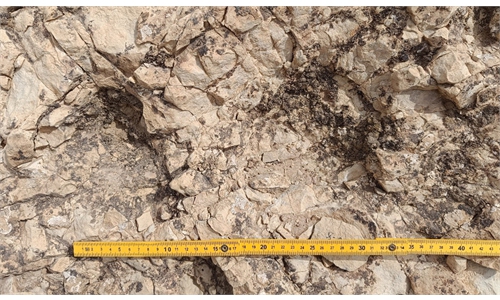
This dinosaur research focused on an exceptional tracksite in Fushun County in Sichuan, where eight stone slabs have preserved an extraordinary density of three-digit footprints.
According to Xing, the tracks are primarily classified as Grallator, averaging 14.5 centimeters in length, with some larger specimens, identified as Eubrontes — reaching up to 22.5 centimeters.
"The study's most significant finding comes from detailed biomechanical analysis indicating these small theropods had employed a 'ground-running' gait comparable to modern birds managing estimated speeds between 5.8 and 8.6 kilometers per hour," Xing said.
Equally important was the identification of rare tail drag marks alongside these footprints. These traces, measuring 20 to 40 centimeters long and 2 to 3 centimeters wide — represent one of the few documented cases of bipedal dinosaur tail impressions, according to Xinhua.
Xing suggested these marks likely resulted from theropods moving slowly in lakeside environments, possibly while pausing to observe their surroundings or during social interactions that involved aggressive displays.
According to the expert, the discovery enriches our understanding of Early Jurassic dinosaur faunas in the Sichuan Basin. It not only provides an important Asian example of classic ichnotypes found worldwide, but also suggests that these early theropod dinosaurs may already have possessed bird-like locomotor abilities and associated complex behaviors, opening a new window for reconstructing ancient ecosystems.
The origin of these fossils was rather dramatic. In July 1998, two brothers from Wuli village, Ding Yongfu and Ding Yongjian, quarried several long, slab-shaped stones and laid them around their home as stepping stones, according to the Guangming Daily.
As knowledge about dinosaur footprints became more widespread, in April 2017, Ding Yongfu's daughter, Ding Li, posted photos of the stones online seeking advice. The images caught the attention of the Zigong Dinosaur Museum, which confirmed in May that they were important dinosaur footprint fossils. The museum subsequently collected the stones for protection and research.
"Later, this research fundamentally advanced our understanding of early Jurassic ecosystems in the Sichuan Basin," explained Xing.
The Sichuan Basin during the Jurassic period was much larger than it is today — bounded roughly by the Daba Mountains to the north, the Longmen Mountains to the northwest, extending southward to central Guizhou, connecting with the central Yunnan Basin to the southwest, and stretching into western Hubei to the southeast, forming a vast inland sedimentary basin, according to The Paper.
In the early period of Early Jurassic, the basin floor was relatively flat. The Paper reported that the region north of the Jiangyou-Zitong-Pengan-Liangping line consisted of humid swamp and lakeshore environments, where lacustrine sandstones, fluvial conglomerates, and coal-bearing strata were deposited. In contrast, the extensive southern area, shallow-lake environment, was characterized by thin layers of purplish-red mudstone and fine-grained sandstone.
Lush vegetation typically flourished around these lakeshore and shallow-lake settings, providing ideal habitats and abundant food sources for dinosaurs and other animals. They lived and reproduced in these environments, achieving rapid development and entering their first major flourishing stage in the Middle Jurassic, according to The Paper.
RELATED ARTICLES