China’s fusion push is bolstered by constant scientific advances, enthusiastic innovators
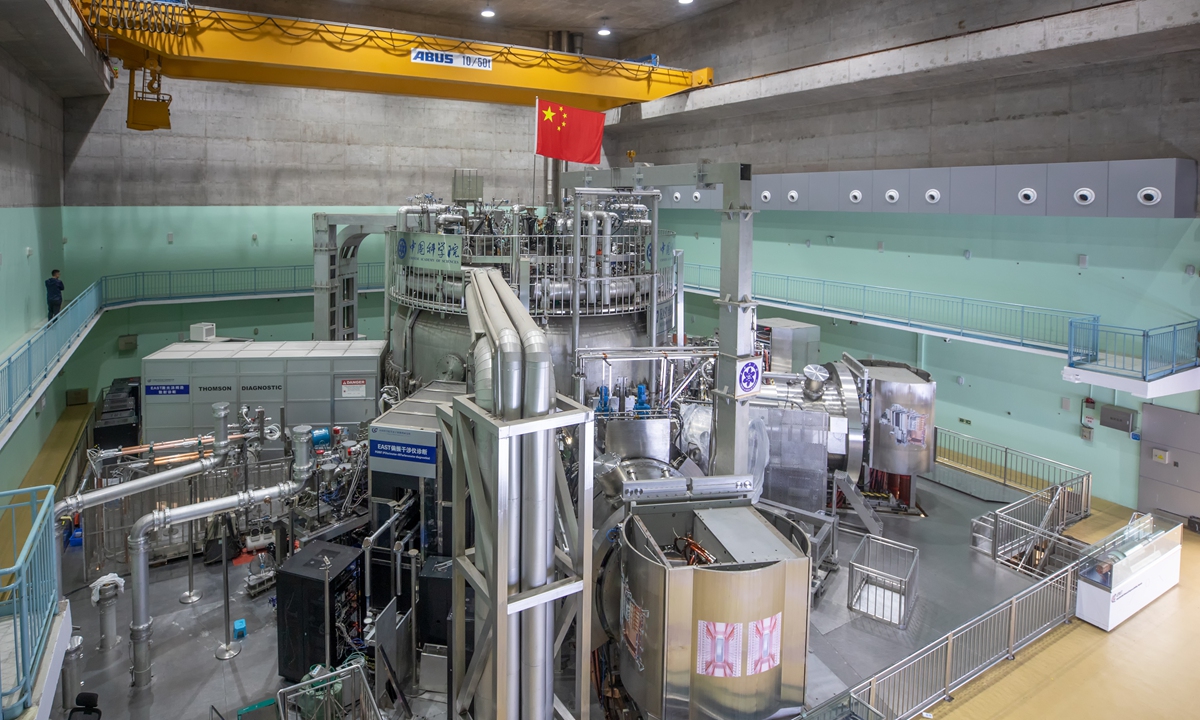
A view of the Experimental Advanced Superconducting Tokamak (EAST), dubbed China's "artificial sun," in Hefei, East China's Anhui Province Photo: VCG
China launched an international science program focused on fusion burning plasma research in Hefei, capital city of East China's Anhui Province, on November 24, while opening major fusion research platforms to global scientists for joint scientific innovations, the Xinhua News Agency reported.
The international research program, initiated by the Chinese Academy of Sciences (CAS)' Institute of Plasma Physics, will provide global access to the country's multiple fusion research platforms, including the Burning Plasma Experimental Superconducting Tokamak (BEST) facility in Hefei.
Nicknamed as China's next-generation "artificial sun," the BEST device is scheduled for completion by the end of 2027. It will conduct deuterium-tritium burning plasma experiments targeting 20 to 200 megawatts of fusion power and achieving net energy gain, Xinhua reported.
This initiative aims to push China toward achieving net-energy-gain fusion and demonstrating fusion power generation, Chinese experts said.
Fusion is widely seen as the "ultimate energy," replicating the process that powers the sun. But igniting a "man-made sun" on Earth requires extraordinary conditions - temperatures of hundreds of millions of degrees, steady confinement, and materials and control systems far beyond today's engineering limits.
For decades, scientists worldwide have worked to push fusion devices to the extremes, with the burning-plasma stage broadly viewed as the critical gateway to reaching commercial power generation. Latest data from the International Atomic Energy Agency (IAEA) shows that, currently, there are 174 fusion devices worldwide, with the US operating 52, Japan 28, Russia 14 and China 13.
Collective scientific bid
In recent years, China's tokamak facilities have repeatedly set global records. In January, the Experimental Advanced Superconducting Tokamak (EAST) developed by the Institute of Plasma Physics under the CAS sustained a 100-million-degree plasma for over 1,000 seconds. In March of this year, another national team - the Southwestern Institute of Physics under China National Nuclear Co - achieved "dual 100-million-degree" operation on its HL-3 device. In October, China's compact fusion experiment BEST installed its key cryostat base, pushing the project into a new phase of construction.
Song Yuntao, vice president of Hefei Institute of Physical Science, told the Global Times that the BEST device is designed to push China into the most critical stage of fusion engineering - the burning-plasma regime. "This is when the fusion reaction begins to sustain itself like a flame, relying on its own heat rather than external heating, which sets the basis for future steady-state power generation," he said.
Song admitted that the burning-plasma regime is essentially "uncharted territory," posing formidable scientific and engineering challenges. For instance, the transport behaviour of alpha particles, which are crucial for sustaining ultra-high temperatures, remains not fully understood by scientists. "By leading this international science program, we aim to leverage China's strengths in tokamak research while bringing in global expertise to tackle the frontier problems together," he said.
Alongside the device construction, China is also advancing in critical materials. Fusion systems demand components that can endure extreme stresses and temperatures, and second-generation high-temperature superconducting tapes - essential for generating ultra-strong magnetic fields - depended on imported metal substrates, which is a major vulnerability in the supply chain.
The Institute of Metal Research under CAS has broken through the bottleneck in metal substrate production, achieving mass manufacturing of C276 substrates at 0.046 mm thickness and 2,000 meters in length, with surface roughness of just 20 nanometers. Key performance indicators now match - and in some cases surpass - imported materials, laying the groundwork for China to build its own high-field "superconducting magnets" for future fusion reactors.
Rong Lijian, a researcher at the CAS told the Global Times that his team has nearly 20 years of experience in high-purity materials, and that ultra-clean alloys are key to making long, ultra-thin metal substrates.
"We broke through the processing bottleneck in less than two years and scaled up long-length production," he noted, calling it a crucial step toward securing China's autonomy in next-generation high-temperature superconducting materials.
Lin Boqiang, director of the China Center for Energy Economics Research at Xiamen University, told the Global Times that fusion is essentially a "man-made sun," replicating the way the sun releases energy, with the ultimate goal of delivering stable, clean power to support long-term global low-carbon transition.
Lin said that the significance of fusion lies not in short-term power generation, but in the transformative impact it will unleash. How fast commercialization will arrive depends on the combined strength of science, engineering and capital. As more Chinese research institutes, companies and investors enter the race, he said, technological breakthrough is likely to accelerate.
Commercial players surge
Now in China, the number of commercial fusion startups is growing rapidly, creating a landscape where state-led research teams take the lead, followed by many private enterprises. Since 2024, investment in the fusion sector has surged, with the fusion index up more than 60 percent and multiple startups collecting sizable funding, according to Yicai.com.
Nova FusionX was launched in Shanghai in April this year and raised 500 million yuan ($70 million) in an angel investment round three months later, with Alibaba among its investors. In late October, Z-pinch startup Anton Fusion secured nearly 100 million yuan from investors such as Legend Star. More recently, Xeonova closed a multi-hundred-million-yuan pre-A round led by Ant Group, with Zijin Mining also participating in its investment, Yicai reported.
Policy support has ramped up too. In September, China enacted the Atomic Energy Law, bringing fusion under a dedicated legal framework for the first time. In October, fusion was included in the 15th Five-Year Plan (2026-2030) as part of the country's emerging industries.
China is strengthening its supply chain with rapid localization of key materials. The CAS' Institute of Metal Research has signed a deal with Eastsuper Superconducting Technology to supply 20 tons of C276 substrates, realizing domestic production of second-generation high-temperature superconductors. The progress helps reduce reliance on foreign materials critical to the "artificial sun," Rong said.
Industry insiders said that China's drive toward commercial fusion is underpinned by its full-stack industrial ecosystem, strong engineering capability, and consistent government support through long-term strategic planning.
China has developed a coordinated fusion ecosystem in which state-owned enterprises build large-scale infrastructure, research institutes tackle core scientific challenges, and private firms pursue differentiated engineering paths, said Wang Peng, an associate researcher at the Beijing Academy of Social Sciences, noting the fusion push is bolstered by constant scientific advances and enthusiastic innovators.
RELATED ARTICLES