China achieves breakthrough as Shanxi launches mass production of high-performance carbon fiber
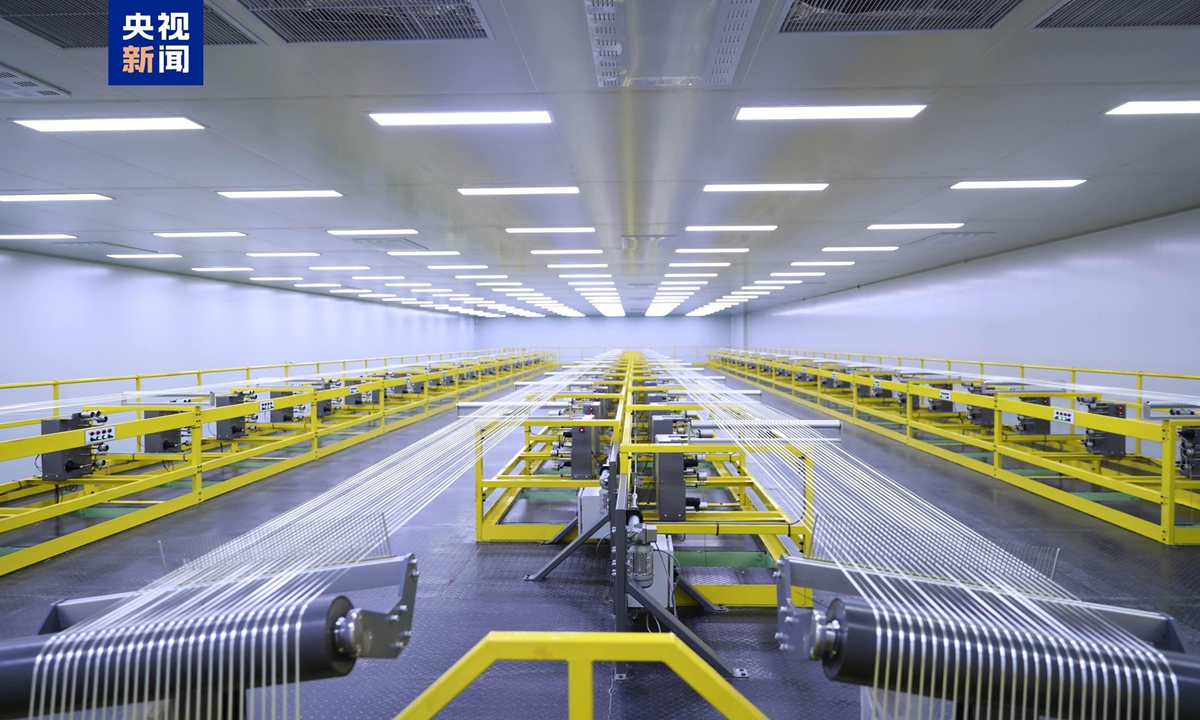
A high-performance carbon fiber project comes online in Datong, achieving a major breakthrough in China's ability to mass-produce T1000-grade 12K carbon fiber in North China's Shanxi Province on November 30, 2025. Photo: screenshot of China Central Television's report
A high-performance carbon fiber project in Datong, North China's Shanxi Province, was completed and put into operation on Sunday, a major breakthrough in China's efforts to mass-produce T1000-grade 12K small-tow carbon fiber domestically, China Central Television (CCTV) reported.
Often described as the "king of new materials," high-performance carbon fiber is considered the backbone of advanced technologies, cutting-edge defense capabilities, and the upgrading of traditional industries. It is also a key pillar of China's strategic emerging industries.
Construction of the first phase of the 1,000-ton high-performance carbon fiber project, designed for 200 tons of annual output and built by Huayang New Materials Group in Shanxi, began in June 2024.
Joint testing began in June 2025, and it went into operation on November 30, according to a company announcement filed on Sunday with the Shanghai Stock Exchange.
The project's T1000-grade carbon fiber features single filaments just 6 to 7 microns in diameter, which is less than one-tenth the width of a human hair, yet it delivers tensile strength of more than 6,400 megapascals, according to the CCTV report.
A one-meter bundle of Huayang's T1000-grade carbon fiber weighs only 0.5 grams but can carry more than 200 kilograms, the report said.
Combining high strength, light weight, resistance to extreme temperatures, corrosion and friction resilience, and strong thermal and electrical conductivity, Huayang's T1000-grade product is seen as an "ultra-strong material" that helps end China's reliance on imported high-end carbon fiber.
The material is expected to be widely used in national defense, aerospace, rail transit, and the fast-developing low-altitude economy, playing an important role in securing supplies of strategic materials, according to the report.
The project will help China break foreign technological bottlenecks in high-end carbon fiber and advance autonomous, controllable development of the industry, according to an earlier report by the Shanxi Daily.
Carbon fiber is valued for its outstanding mechanical properties and chemical stability. It has a lower density than aluminum, greater strength than steel, and significantly better corrosion resistance than stainless steel. Among mass-produced high-performance fibers, it offers the highest specific strength and specific modulus.
"China is already a major global producer of carbon fiber, but it long faced a bottleneck in scaling up production of high-quality grades. The Datong project represents a key step in overcoming this challenge," Xiang Ligang, director-general of the Beijing-based Information Consumption Alliance, told the Global Times on Sunday.
As domestic manufacturers continue to overcome technical barriers and ramp up production, carbon fiber costs will fall sharply, Xiang said. That will open the door to far broader adoption, such as in shipbuilding, transportation equipment, vehicle components, and unmanned logistics vehicles, reshaping the foundations of multiple industries, in particular emerging technologies.
The project is designated a major provincial engineering initiative. With nearly 1 billion yuan ($1.41 billion) invested in civil construction and equipment, it covers about 116 mu (about 7.7 hectares), according to a post on the Datong city government website.
China's high-tech development priorities have shifted from filling gaps to pursuing breakthroughs and leadership in next-generation industries such as quantum computing, 6G communications, and humanoid robotics - all of which require cutting-edge new materials, Xiang noted.
The Recommendations of the Central Committee of the Communist Party of China for Formulating the 15th Five-Year Plan (2026-2030) for National Economic and Social Development call for accelerating the development of industrial clusters in strategic areas including new energy, new materials, aviation and aerospace, and the low-altitude economy.
Industry data released in November showed that China's output of new chemical materials in 2024 rose 69 percent from 2020, with output value surging 85 percent, while the self-sufficiency rate increased by 10 percentage points - marking breakthroughs in both scale and supply capacity, China Industry News reported.
RELATED ARTICLES