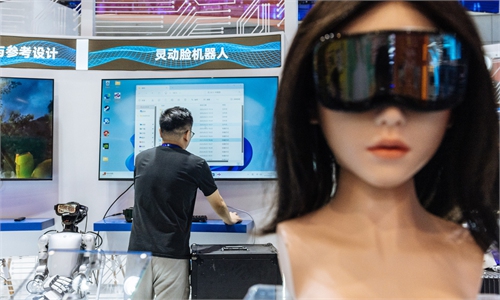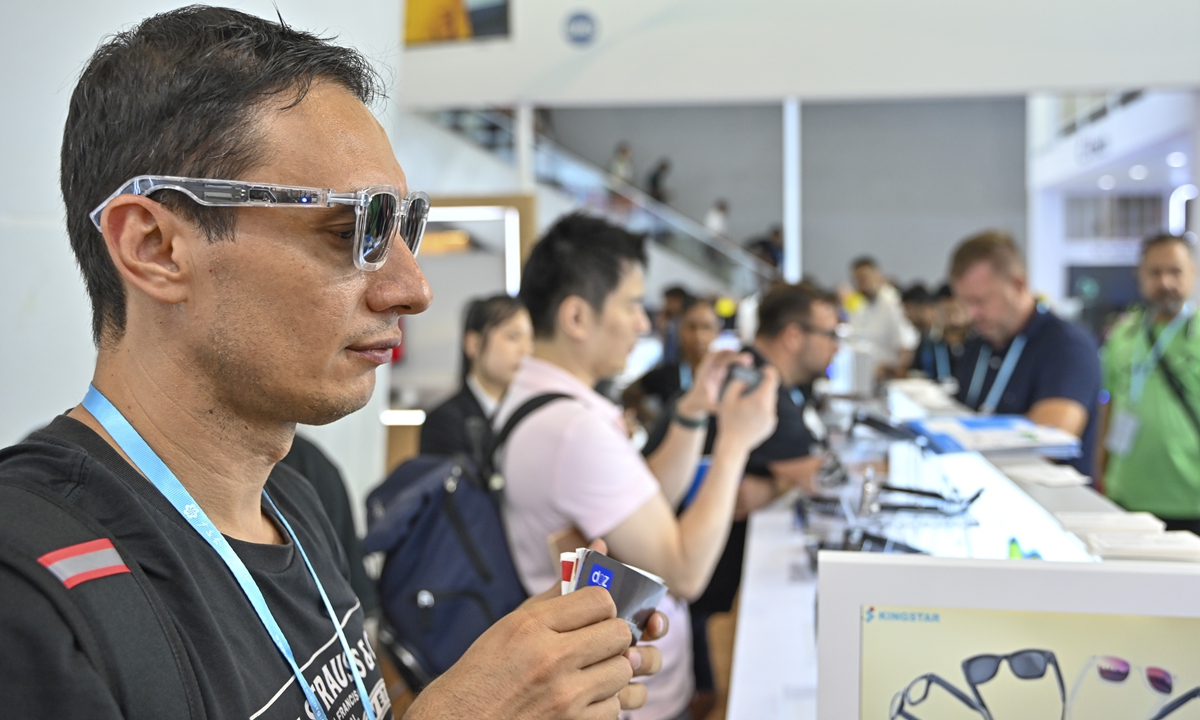
Visitors test AI glasses at the Canton Fair in Guangzhou, South China's Guangdong Province, on October 17, 2025. Photo: VCG
At tech exhibitions across China in recent months, artificial intelligence (AI) glass stands have quietly become some of the busiest spots in the exhibition halls. Visitors rotate through different frames, ask about battery life and comfort, or record the demo screens on their phones. Lines form during peak hours, and staff are explaining non-stop.
The shift is noticeable: what was once a futuristic showpiece is now drawing consumers who want to know whether the devices can take notes, handle translation, or simply capture clear footage in daily use.
AI glasses have emerged as one of the most tested devices at tech and trade fairs over the past year. Several exhibitors told the Global Times that visitors are increasingly willing to stop, try on different models, and ask about specific functions - a shift that signals consumer interest moving from novelty to practicality.
A similar trend is taking shape globally. Google has announced to cooperate with China's XREAL to develop Project Aura, a flagship augmented reality glasses for the Android platform. Meta is expanding the capabilities of its Ray-Ban Meta, combining hands-free imaging with an AI assistant for everyday use. Such efforts signaled that AI glasses have once again emerged as a focal point of global tech innovation, according to media reports.
Since the beginning of this year, the AI smart glasses industry has entered an accelerated development phase. As a new form of intelligent terminal, AI glasses have become a hotly contested track that Chinese manufacturers are eagerly racing to seize on the AI edge side. The field is drawing a wide range of players: dedicated smart-glasses companies such as Rokid and INMO; hardware makers including Xiaomi; Internet firms like Baidu; and even automakers such as Li Auto.
International Data Corporation (IDC) said that the smart-glasses market is entering a new phase of scalable growth, driven by strategic positioning, early-adopter demand and improving AI capabilities.
From product cycles to ecosystem integration, China is emerging as one of the most active and fast-moving frontiers for AI-glasses innovation, an industry expert said.
Scaling up
While global players remain cautious, China is moving at a markedly faster clip. On November 13, Baidu debuted its Xiaodu AI Glasses Pro at its annual Baidu World Conference; later that evening, Rokid and BOLON unveiled their new BOLON AI Glasses. On November 27, Alibaba's Quark rolled out six models across its S1 and G1 series powered by the Qwen assistant. And on December 3, Li Auto is set to introduce its Livis AI glasses, according to media reports.
Alibaba told the Global Times in a statement that its new Quark AI Glasses series is now available on major e-commerce platforms such as Tmall and JD.com, and has entered 604 offline stores across 82 cities. The S1 supports swappable batteries for all-day use, while the 40-gram G1 targets lightweight, everyday recording. As large-model capabilities expand into daily tasks, the appeal of AI glasses is becoming more defined, the company said.
INMO's GO3, released in October, adopts a more traditional eyewear design with ultra-slim arms, a light-blocking display and a fashion-focused frame. Analysts say this "lighter, better-looking" approach could help AI glasses move beyond tech enthusiasts and reach a broader mainstream audience.
Beyond the domestic market, Chinese makers are also expanding overseas. INMO staff told the Global Times that as of November 28, the INMO Air3 had raised more than $1 million through crowdfunding. The Air3 - described as the first mass-produced binocular full-color AI-plus-AR glasses - has gained swift traction overseas, a sign of both technical readiness and growing user demand.
Chen Jing, vice-president of the Technology and Strategy Research Institute, told the Global Times that the renewed interest from capital and major tech firms reflects the convergence of technological maturity, market potential and emerging ecosystems. He said that advances in on-device large-model capabilities, improvements in optical production and a saturated smartphone market are enabling AI glasses to move from novelty to everyday devices.
Toward everyday use
As more brands enter the field, AI glasses are moving quickly from a niche experiment toward broader consumer adoption. A survey by RUNTO showed that 75.5 percent of respondents are willing to buy or use smart glasses, suggesting growing user readiness. Research by Huajin Securities indicated that consumers prioritize practical AI functions, first-person imaging and smooth interaction, while weight, battery life, design and price remain secondary but still important considerations.
As China's supply chain scales up, falling component costs are making AI glasses more accessible to mass consumers. According to a report by Guotai Haitong, costs for these components have fallen by about 40 percent from earlier levels, and could drop further as domestic suppliers advance in display drivers and optical lenses - potentially pushing hardware costs below 150 yuan ($21).
Against this backdrop, brands are taking different approaches to push AI glasses into daily use.
Ye Ziling, a staff member at Rokid, told the Global Times that its joint release with BOLON pairs smart modules with professional optical design to balance function and style. Rokid data showed that users average almost eight hours a day and have logged over 15 million sessions as of the mid-November, supported by service partnerships spanning navigation, flight updates, property viewing and smart ordering.
Chen said that AI glasses are now in a "consumer validation phase," and the real turning point will hinge on whether they can support stable, repeatable use in high-frequency tasks such as translation, navigation and first-person recording. "They will only sell when a genuine everyday need emerges," he said, noting that high return rates show many buyers are still just trying them out.
He noted that key bottlenecks remain in optical module yields, device weight, battery life and heat management, but said battery and display technologies are the most likely areas to see breakthroughs in the next two to three years.
These improvements, he added, will be critical for shifting AI glasses from something users "can wear" to something they "want to wear" every day. "In the end, the real competition is about finding the right user scenario, cutting costs and giving users a reason to use the device daily," he said.
RELATED ARTICLES