IN-DEPTH / IN-DEPTH
Tradition under fire: Why is Hong Kong’s bamboo scaffolding difficult to replace?
By Liang Rui, and Zhao Jingru Published: Dec 01, 2025 11:17 PM

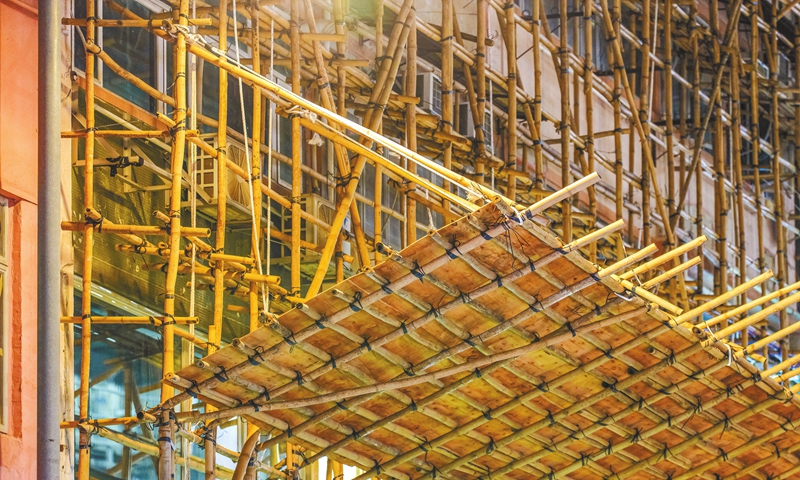
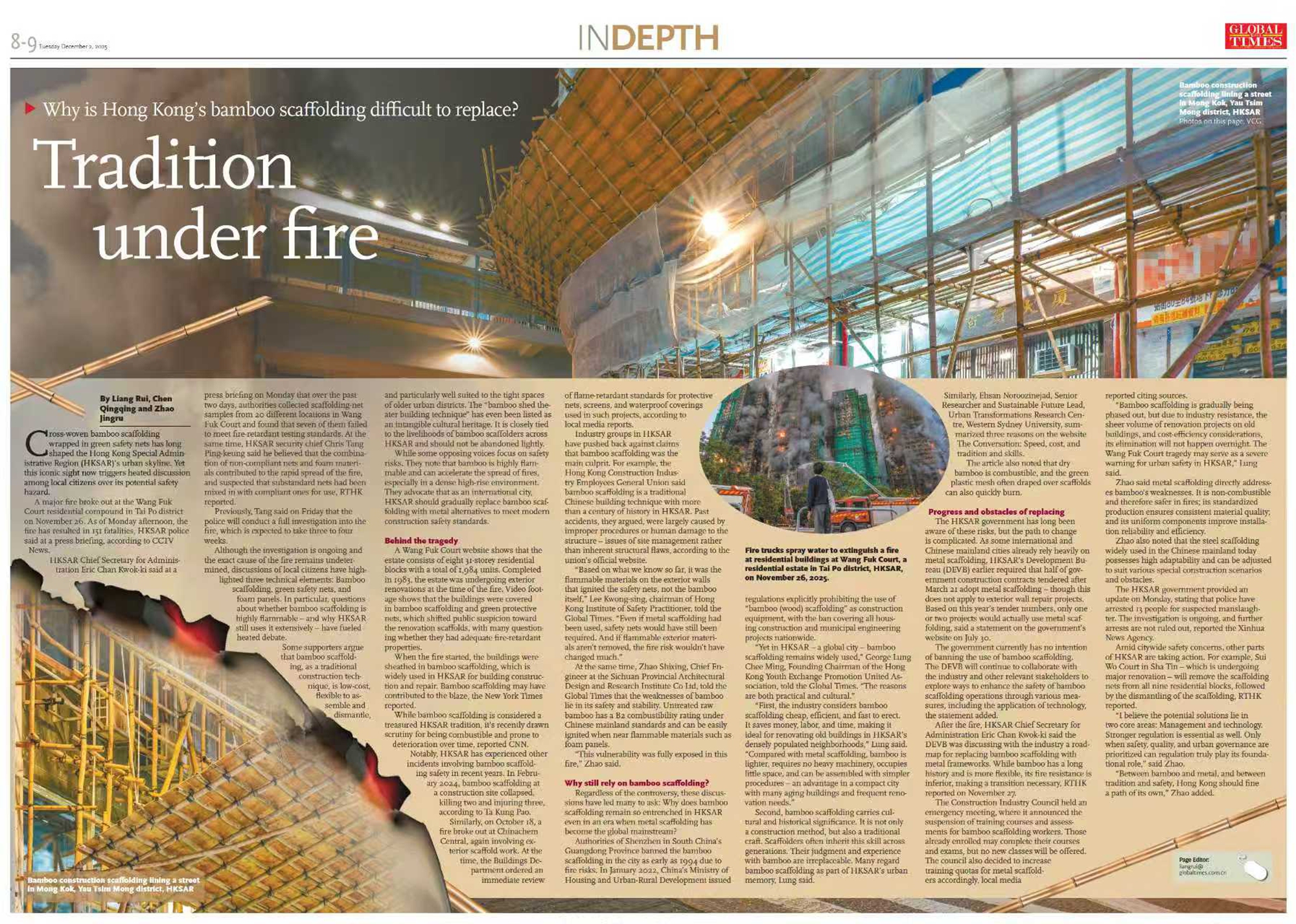
Bamboo construction scaffolding lining a street in Mong Kok, Yau Tsim Mong district, HKSAR Photos on this page: VCG
Cross-woven bamboo scaffolding wrapped in green safety nets has long shaped the Hong Kong Special Administrative Region (HKSAR)'s urban skyline. Yet this iconic sight now triggers heated discussion among local citizens over its potential safety hazard.
A major fire broke out at the Wang Fuk Court residential compound in Tai Po district on November 26. As of Monday afternoon, the fire has resulted in 151 fatalities, HKSAR police said at a press briefing, according to CCTV News.
HKSAR Chief Secretary for Administration Eric Chan Kwok-ki said at a press briefing on Monday that over the past two days, authorities collected scaffolding-net samples from 20 different locations in Wang Fuk Court and found that seven of them failed to meet fire-retardant testing standards. At the same time, HKSAR security chief Chris Tang Ping-keung said he believed that the combination of non-compliant nets and foam materials contributed to the rapid spread of the fire, and suspected that substandard nets had been mixed in with compliant ones for use, RTHK reported.
Previously, Tang said on Friday that the police will conduct a full investigation into the fire, which is expected to take three to four weeks.
Although the investigation is ongoing and the exact cause of the fire remains undetermined, discussions of local citizens have highlighted three technical elements: Bamboo scaffolding, green safety nets, and foam panels. In particular, questions about whether bamboo scaffolding is highly flammable - and why HKSAR still uses it extensively - have fueled heated debate.
Some supporters argue that bamboo scaffolding, as a traditional construction technique, is low-cost, flexible to assemble and dismantle, and particularly well suited to the tight spaces of older urban districts. The "bamboo shed theater building technique" has even been listed as an intangible cultural heritage. It is closely tied to the livelihoods of bamboo scaffolders across HKSAR and should not be abandoned lightly.
While some opposing voices focus on safety risks. They note that bamboo is highly flammable and can accelerate the spread of fires, especially in a dense high-rise environment. They advocate that as an international city, HKSAR should gradually replace bamboo scaffolding with metal alternatives to meet modern construction safety standards.
Behind the tragedy
A Wang Fuk Court website shows that the estate consists of eight 31-storey residential blocks with a total of 1,984 units. Completed in 1983, the estate was undergoing exterior renovations at the time of the fire. Video footage shows that the buildings were covered in bamboo scaffolding and green protective nets, which shifted public suspicion toward the renovation scaffolds, with many questioning whether they had adequate fire-retardant properties.
When the fire started, the buildings were sheathed in bamboo scaffolding, which is widely used in HKSAR for building construction and repair. Bamboo scaffolding may have contributed to the blaze, the New York Times reported.
While bamboo scaffolding is considered a treasured HKSAR tradition, it's recently drawn scrutiny for being combustible and prone to deterioration over time, reported CNN.
Notably, HKSAR has experienced other incidents involving bamboo scaffolding safety in recent years. In February 2024, bamboo scaffolding at a construction site collapsed, killing two and injuring three, according to Ta Kung Pao.
Similarly, on October 18, a fire broke out at Chinachem Central, again involving exterior scaffold work. At the time, the Buildings Department ordered an immediate review of flame-retardant standards for protective nets, screens, and waterproof coverings used in such projects, according to local media reports.
Industry groups in HKSAR have pushed back against claims that bamboo scaffolding was the main culprit. For example, the Hong Kong Construction Industry Employees General Union said bamboo scaffolding is a traditional Chinese building technique with more than a century of history in HKSAR. Past accidents, they argued, were largely caused by improper procedures or human damage to the structure - issues of site management rather than inherent structural flaws, according to the union's official website.
"Based on what we know so far, it was the flammable materials on the exterior walls that ignited the safety nets, not the bamboo itself," Lee Kwong-sing, chairman of Hong Kong Institute of Safety Practitioner, told the Global Times. "Even if metal scaffolding had been used, safety nets would have still been required. And if flammable exterior materials aren't removed, the fire risk wouldn't have changed much."
At the same time, Zhao Shixing, Chief Engineer at the Sichuan Provincial Architectural Design and Research Institute Co Ltd, told the Global Times that the weaknesses of bamboo lie in its safety and stability. Untreated raw bamboo has a B2 combustibility rating under Chinese mainland standards and can be easily ignited when near flammable materials such as foam panels.
"This vulnerability was fully exposed in this fire," Zhao said.
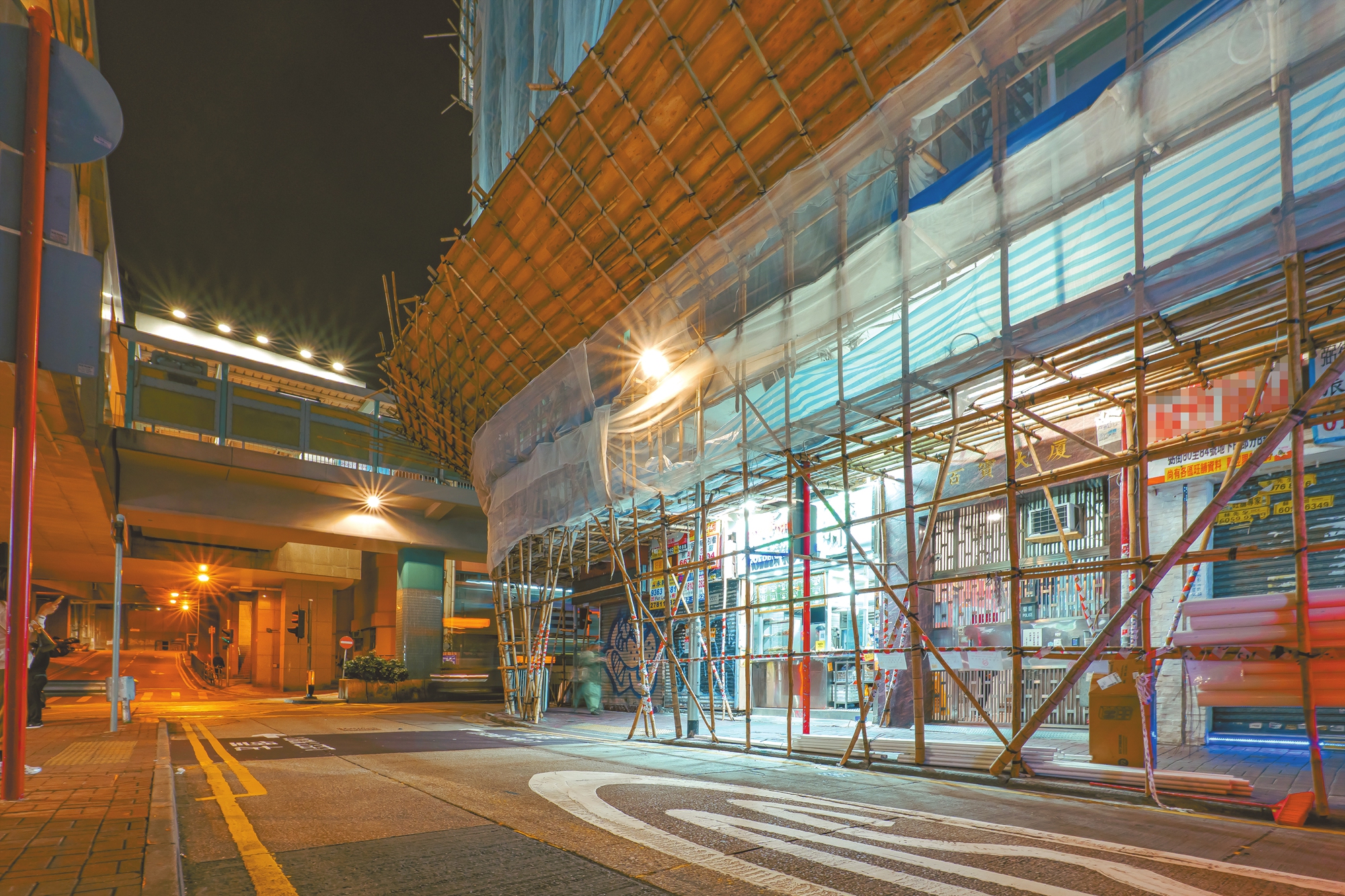
Bamboo construction scaffolding lining a street in Mong Kok, Yau Tsim Mong district, HKSAR
Why still rely on bamboo scaffolding?
Regardless of the controversy, these discussions have led many to ask: Why does bamboo scaffolding remain so entrenched in HKSAR even in an era when metal scaffolding has become the global mainstream?
Authorities of Shenzhen in South China's Guangdong Province banned the bamboo scaffolding in the city as early as 1994 due to fire risks. In January 2022, China's Ministry of Housing and Urban-Rural Development issued regulations explicitly prohibiting the use of "bamboo (wood) scaffolding" as construction equipment, with the ban covering all housing construction and municipal engineering projects nationwide.
"Yet in HKSAR - a global city - bamboo scaffolding remains widely used," George Lung Chee Ming, Founding Chairman of the Hong Kong Youth Exchange Promotion United Association, told the Global Times. "The reasons are both practical and cultural."
"First, the industry considers bamboo scaffolding cheap, efficient, and fast to erect. It saves money, labor, and time, making it ideal for renovating old buildings in HKSAR's densely populated neighborhoods," Lung said. "Compared with metal scaffolding, bamboo is lighter, requires no heavy machinery, occupies little space, and can be assembled with simpler procedures - an advantage in a compact city with many aging buildings and frequent renovation needs."
Second, bamboo scaffolding carries cultural and historical significance. It is not only a construction method, but also a traditional craft. Scaffolders often inherit this skill across generations. Their judgment and experience with bamboo are irreplaceable. Many regard bamboo scaffolding as part of HKSAR's urban memory, Lung said.
Similarly, Ehsan Noroozinejad, Senior Researcher and Sustainable Future Lead, Urban Transformations Research Centre, Western Sydney University, summarized three reasons on the website The Conversation: Speed, cost, and tradition and skills.
The article also noted that dry bamboo is combustible, and the green plastic mesh often draped over scaffolds can also quickly burn.
Progress and obstacles of replacing
The HKSAR government has long been aware of these risks, but the path to change is complicated. As some international and Chinese mainland cities already rely heavily on metal scaffolding, HKSAR's Development Bureau (DEVB) earlier required that half of government construction contracts tendered after March 21 adopt metal scaffolding - though this does not apply to exterior wall repair projects. Based on this year's tender numbers, only one or two projects would actually use metal scaffolding, said a statement on the government's website on July 30.
The government currently has no intention of banning the use of bamboo scaffolding. The DEVB will continue to collaborate with the industry and other relevant stakeholders to explore ways to enhance the safety of bamboo scaffolding operations through various measures, including the application of technology, the statement added.
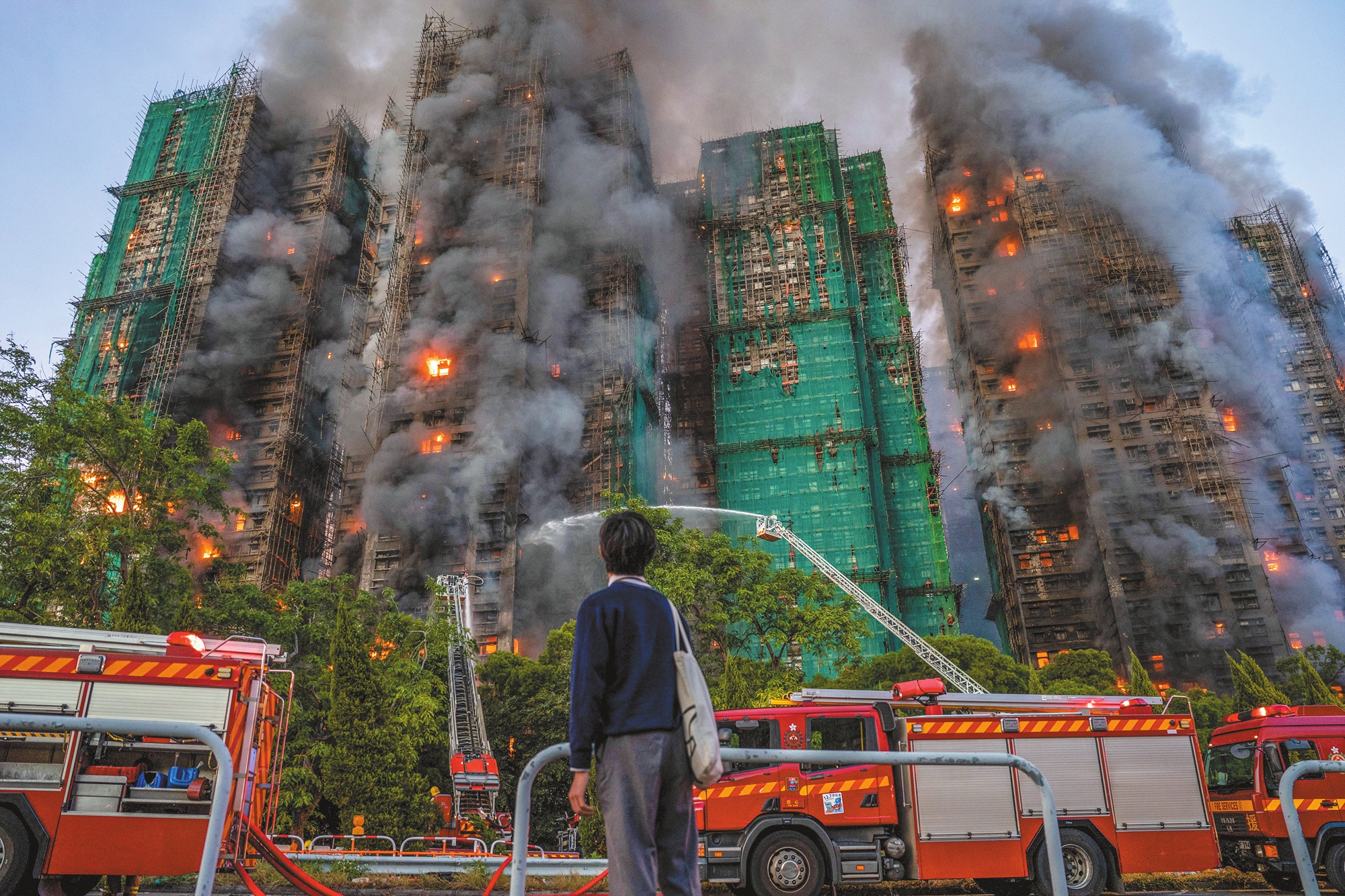
Fire trucks spray water to extinguish a fire at residential buildings at Wang Fuk Court, a residential estate in Tai Po district, HKSAR, on November 26, 2025.
After the fire, HKSAR Chief Secretary for Administration Eric Chan Kwok-ki said the DEVB was discussing with the industry a roadmap for replacing bamboo scaffolding with metal frameworks. While bamboo has a long history and is more flexible, its fire resistance is inferior, making a transition necessary, RTHK reported on November 27.
The Construction Industry Council held an emergency meeting, where it announced the suspension of training courses and assessments for bamboo scaffolding workers. Those already enrolled may complete their courses and exams, but no new classes will be offered. The council also decided to increase training quotas for metal scaffolders accordingly, local media reported citing sources.
"Bamboo scaffolding is gradually being phased out, but due to industry resistance, the sheer volume of renovation projects on old buildings, and cost-efficiency considerations, its elimination will not happen overnight. The Wang Fuk Court tragedy may serve as a severe warning for urban safety in HKSAR," Lung said.
Zhao said metal scaffolding directly addresses bamboo's weaknesses. It is non-combustible and therefore safer in fires; its standardized production ensures consistent material quality; and its uniform components improve installation reliability and efficiency.
Zhao also noted that the steel scaffolding widely used in the Chinese mainland today possesses high adaptability and can be adjusted to suit various special construction scenarios and obstacles.
The HKSAR government provided an update on Monday, stating that police have arrested 13 people for suspected manslaughter. The investigation is ongoing, and further arrests are not ruled out, reported the Xinhua News Agency.
Amid citywide safety concerns, other parts of HKSAR are taking action. For example, Sui Wo Court in Sha Tin - which is undergoing major renovation - will remove the scaffolding nets from all nine residential blocks, followed by the dismantling of the scaffolding, RTHK reported.
"I believe the potential solutions lie in two core areas: Management and technology. Stronger regulation is essential as well. Only when safety, quality, and urban governance are prioritized can regulation truly play its foundational role," said Zhao.
"Between bamboo and metal, and between tradition and safety, Hong Kong should find a path of its own," Zhao added.
Tradition under fire
RELATED ARTICLES