Canon closes Zhongshan printer plant amid global market contraction, remains confident about China market prospects: firm tells GT
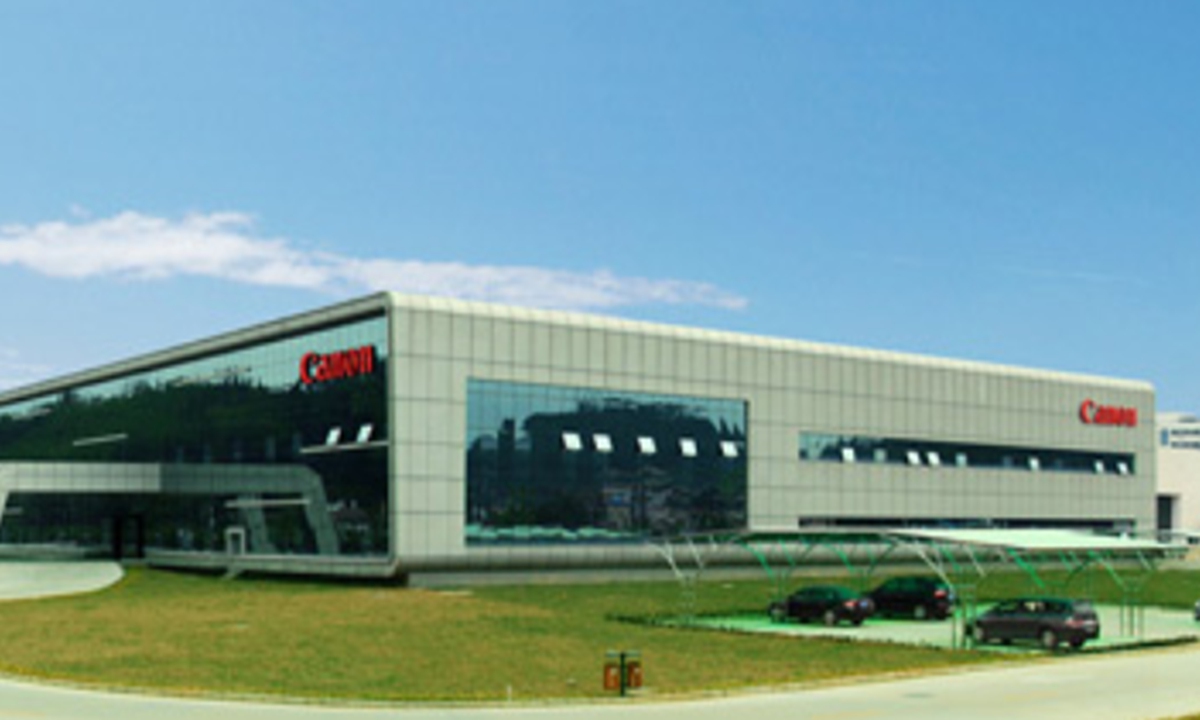
The building of Canon's office equipment company in Zhongshan, South China's Guangdong Province File photo: Screenshot from the company's official website
Japanese imaging and office equipment giant Canon has halted production at its printer plant in Zhongshan, South China's Guangdong Province, citing the continued contraction of the global laser printer market, the company told the Global Times on Tuesday. However, the firm noted that its other manufacturing sites in China remain in normal operation and that it remains confident about the long-term growth potential of the Chinese market.
Industry analysts said that the rapid rise of domestic laser beam printer (LBP) brands and accelerating market restructuring have also weighed on Canon's related businesses. Still, they emphasized that foreign companies that keep pace with market shifts can continue to benefit from the vast opportunities offered by China's consumer base.
In a statement sent to the Global Times, Canon confirmed media reports that the facility had been shut down, saying its office equipment company in Zhongshan ceased production and operation on November 21.
The company attributed the shutdown to a "long-term shrinking trend" in the global laser printer market. Shifts in work patterns have further accelerated the decline in demand for office-use devices, it said, noting that a significant rebound appears unlikely in the foreseeable future. "The Chinese laser printer market is also shrinking significantly, resulting in a sharp decline in orders for Canon Zhongshan, a major production base for laser printers targeting the Chinese market," read the statement.
"We made multiple efforts to sustain factory operations, but the factors mentioned above left the plant unable to continue production," the statement noted, while expressing gratitude to the Zhongshan municipal government, the local industrial group, suppliers, partners, customers and residents for their "tremendous help and support."
However, Canon's other production sites in China continue to operate as usual, according to the statement.
Canon's Zhongshan company was established in June 2001 and served as a major production base for Canon's diversified laser printers, according to the company's official website. Media reports showed that the plant produced a cumulative 110 million laser printers by April 2022 and generated an industrial output value of nearly 3.2 billion yuan ($475 million) that year.
"China is one of Canon's most important markets, with significant potential for growth. We believe that China's business environment will continue to improve in the long run, and we are confident in the development potential and possibilities of the Chinese market. Therefore, Canon will continue to be deeply rooted in the Chinese market, striving for long-term development and sustainable growth, and contributing to China's development," the statement read.
Ma Jihua, a veteran analyst in the electronics sector, described the shutdown as emblematic of a broader industry transition. "The printer market is undergoing profound restructuring. Traditional companies that have long focused on enterprise-level high-end solutions, such as Canon, are now challenged to pivot toward a consumer-driven home-printing market," Ma told the Global Times on Tuesday.
"Affordable, lightweight and easy-to-use home devices are gradually replacing traditional segments," he said. "At the same time, domestic brands - leveraging deeper market insights, higher cost efficiency and user-centric innovation - are eroding the advantages previously held by established players."
Ma also pointed to the growing influence of Chinese firms' integrated ecosystem strategies, such as bundling various devices and services under one brand system. "Companies that react too slowly to local market changes can lose competitiveness rapidly," Ma noted.
According to IDC data cited by media, the market share of domestic A4 laser printer brands in China rose from 16 percent in 2010 to 42 percent in 2024. Canon held a 22.9 percent share of the global laser printer market in 2024, but only 6.4 percent in China.
Despite the setback, Canon remained upbeat about its broader China strategy and the market potential. "Canon (China) will also strive to achieve its goal of becoming the No.1 Canon Group company by 2035, based on the principle of 'selection and focus'," the company said in the statement.
While acknowledging structural adjustments across the sector, Ma said that China's enormous population and household base offer opportunities that, particularly in home-use and flexible-office scenarios, surpass those of the traditional enterprise market.
He added that China's vast consumer scale and strong momentum in digital transformation also open significant prospects for Canon's imaging, network camera and medical equipment businesses. "To capture these growth areas, the company will need to accelerate localized R&D, deepen ecosystem partnerships and keep pace with AI-driven and smart-device trends," Ma said.
Canon's other businesses in China have seen strong growth this year. According to Nikkei Chinese, Canon's digital camera sales in the market are expected to rise more than 10 percent year-on-year in 2025. From January to June, Canon's camera shipments in the country increased 16 percent year-on-year in terms of value, benefiting from young consumers continued shift from smartphones to cameras for higher-quality photos and videos.
Regarding the future placement of workers at the Zhongshan plant, Canon said it will follow relevant laws and regulations, prioritize employee interests, consult with local authorities and labor unions, and provide financial compensation and reemployment support. The company said it has proactively reached out to nearby firms to help match job openings for affected employees.
Canon began operating in China in 1989 and has since built a nationwide sales and service network. Its businesses in the country span imaging systems, office products, industrial equipment and smart IT solutions, according to the firm's website.
China continues to open up its market and improve conditions for foreign enterprises, Ma said, adding that companies that strengthen localized operation and adapt to evolving demand will still find ample opportunities to tap into China's market potential and achieve sustainable, long-term growth.
RELATED ARTICLES