Pomegranates color life with prosperity
Exploring China’s beautiful, harmonious countryside along Xi’s footsteps
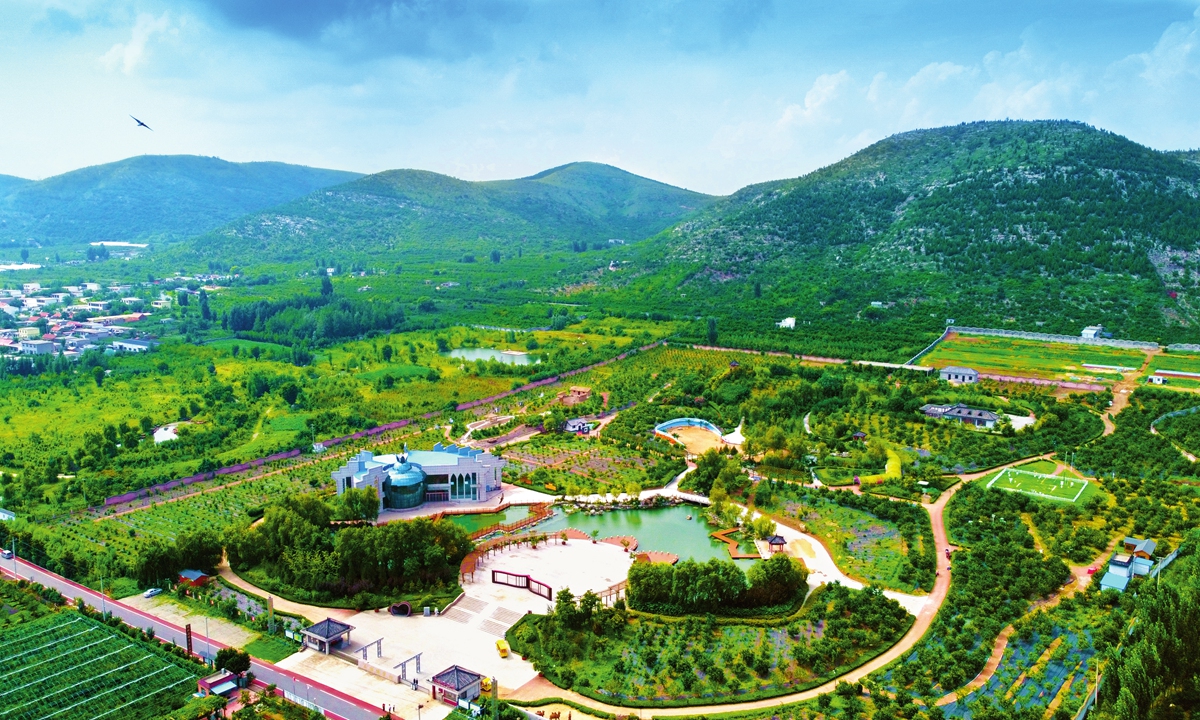
An aerial view of the Pomegranate Cultural Expo Park in Yicheng district, Zaozhuang, East China's Shandong Province Photo: Courtesy of China Rural Revitalization magazine
As you drive from the Zaozhuang high-speed rail station toward the Guanshi Pomegranate Garden in Yicheng, East China's Shandong Province, elements of pomegranates are almost everywhere - from blossom patterns on the streets to fruit-shaped sculptures in the scenic spots and industry-themed posters at bus stops.
Zaozhuang is also home to one of China's largest pomegranate-growing areas, with rich varieties and a complete industrial chain.
Chinese President Xi Jinping made an inspection tour of Zaozhuang on the afternoon of September 24, 2023, on his way back to Beijing from an inspection of East China's Zhejiang Province, the Xinhua News Agency reported.
Xi visited a bank of pomegranate seed resources in Yicheng district, where he observed different pomegranate seedlings and learned about the history of pomegranate planting there, the collection and preservation of pomegranate seed resources, and the development of the related industries.
Xi then came to a pomegranate plantation to ask residents about the harvest of pomegranates and local people's income from the sales of the fruit. He pointed out that with people's living standard improving, the demand for high-quality specialty products is also growing, bringing about a promising future for the pomegranate industry.
Pathway to prosperity
In Zhucun village of Liuyuan township, 70-year-old Sun Suping and her husband manage a 5 mu (0.33 hectare) pomegranate orchard. Thanks to the government's provision of high-quality pomegranate seedlings, their annual income reaches 40,000 yuan ($5,653.27) to 50,000 yuan. Nearly everyone of Zhucun village's more than 400 households grows pomegranates, with the village's total planting area exceeding 3,000 mu.
According to official data, as of 2024, Zaozhuang's Yicheng district was home to 70 pomegranate cooperatives and deep-processing enterprises. Local farmers' per capita income in the pomegranate industry had surpassed 30,000 yuan, about 8,000 yuan higher than the citywide farmers' average - truly making the fruit a "crop of prosperity."
Zaozhuang is one of China's major pomegranate-producing regions, boasting the largest contiguous planting area, the widest range of varieties and one of the country's most complete industrial chains. Since 2005, when locals discovered the commercial potential of crafting pomegranate trees into ornamental bonsai, the industry has gained an additional growth engine.
Today, Liuyuan township has more than 300,000 pomegranate bonsai in inventory and sells about 200,000 annually, generating 650 million yuan in total output value. The sector employs more than 5,000 people, and local bonsai creations have received over 400 awards at horticultural exhibitions at home and abroad.
Technology empowerment
In the past, up to 30 percent of ripe pomegranates could crack overnight during peak season. To solve this long-standing problem, researchers at a local research institute identified a naturally occurring low-cracking variant in Qufu, another city in Shandong. They bred a new variety called "Qiuyan," now the only nationally certified pomegranate variety in China, with a cracking rate below 5 percent. Through seedling selection and hybrid breeding, the institute has also developed six provincially certified varieties and 12 new cultivars with superior color, flavor, maturity periods and crack resistance.
The institute has built China's only national pomegranate germplasm bank, preserving 523 genetic resources. Each year it distributes more than 10,000 free seedlings to farmers, promotes high-quality varieties across 3,000 mu, and renovates poor-quality and aging pomegranate seedlings in about 4,000 mu of orchards - significantly boosting growers' incomes.
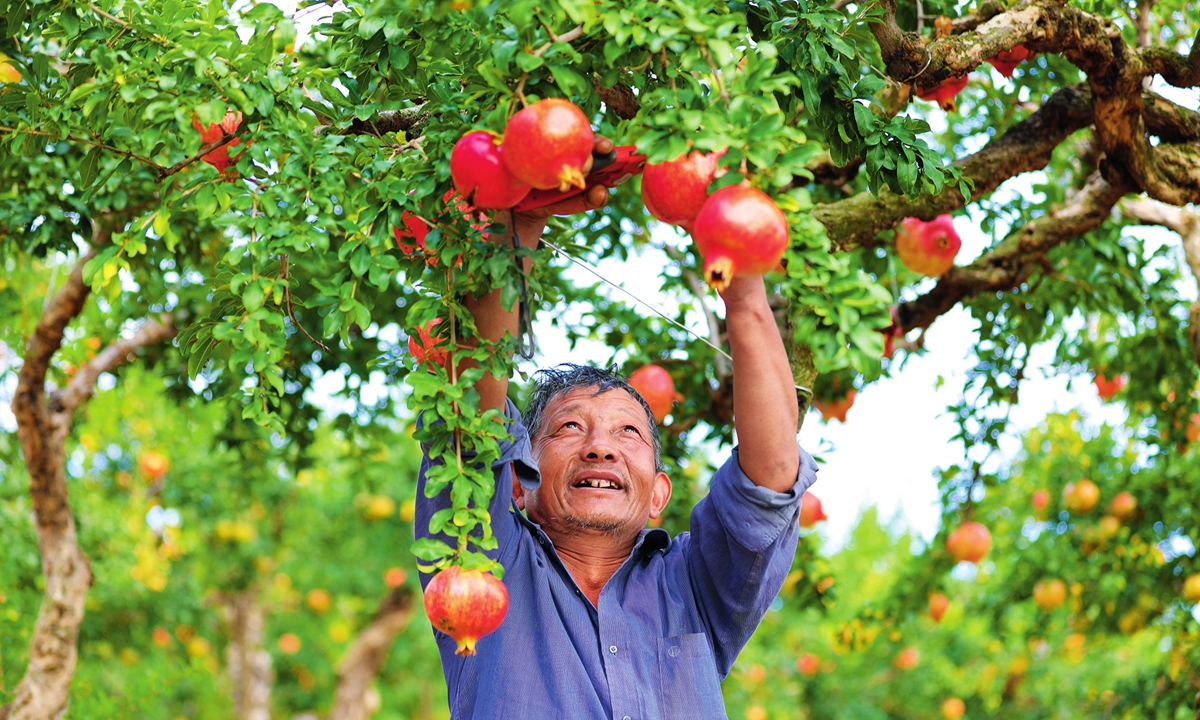
A pomegranate grower picks pomegranates at an orchard. Photo: Courtesy of China Rural Revitalization magazine
Policy support further accelerates industry development. Local authorities have increased subsidies for planting pomegranate, established an expert pool for the pomegranate sector, and rolled out vocational training. E-commerce platforms help farmers expand online sales channels, while pomegranate cultural festivals enhance the brand awareness.
The implementation of the Geographical Indication Product: Yicheng Pomegranate standard sets strict requirements on production zones, soil, and micro-environment, offering strong quality assurance.
Growth across industries
Liuyuan township's bonsai-related elderly care program allows villagers to "adopt" young pomegranate bonsai aged one to four years. The local cooperative buys the bonsai back annually, paying 50 to 100 yuan per pot depending on quality, while providing full technical guidance. In just one year, 153,000 yuan in maintenance fees has been distributed, with some elderly residents tending more than 100 pots and earning notable supplementary income, according to the organizer of the program.
The cooperative plans to expand to 30,000 bonsai at their site, engaging over 300 households, benefiting more than 500 seniors, creating additional jobs for rural laborers, and training specialized bonsai artisans and e-commerce personnel.
From "small bonsai" to "big industry," Zaozhuang is extending the pomegranate value chain from fresh fruit to comprehensive utilization. Nearly 20 deep-processing companies now have developed nearly 200 products - from juice and wine to cosmetics and functional foods. More than 95 percent of roots, peels, seeds and flowers are fully utilized.
The sector is also expanding into cultural tourism. Guanshi Pomegranate Garden has transformed from a simple orchard into an integrated orchard-park-playground, offering 12 sightseeing routes linking 22 tourist attractions. The Pomegranate Culture Expo Park showcases the cultural heritage from ancient stone carvings to modern creative designs. Local homestays offer fruit-picking and themed "pomegranate feasts," while pomegranate woodcarving has been recognized as a provincial intangible cultural heritage.
RELATED ARTICLES