ARTS / CULTURE & LEISURE
Newly uncovered tombs in Henan offer insights into ancient funeral customs
screenshot
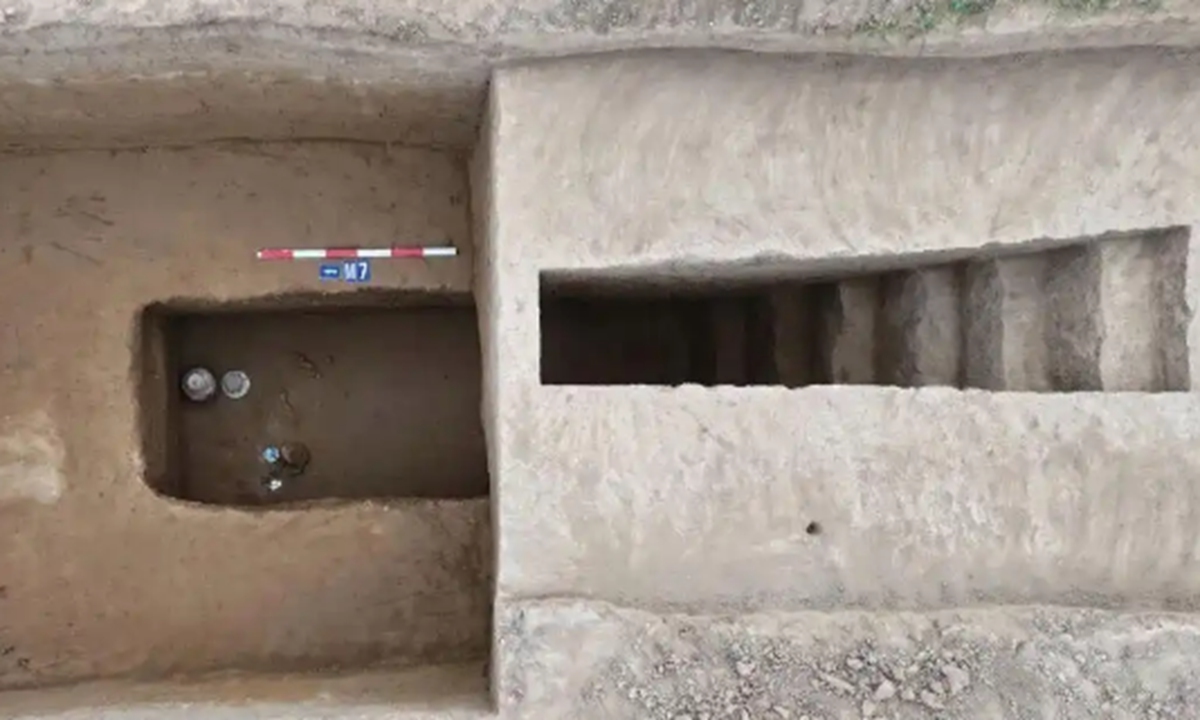
Archaeologists have excavated 45 tombs with burial dates spanning from the Warring States Period (475BC-221BC) to the Qing Dynasty (1644-1911) in Sanmenxia city, Central China's Henan Province. The new discovery provides valuable material for studying the funeral customs of those periods, an expert with the Sanmenxia Yangshao Culture Research Center told the Global Times on Tuesday.
The excavation, which began in August, revealed multiple types of tomb structures, showcasing the distinctive funerary traditions of different historical periods. The western side of the archaeological site is adjacent to the ancient city of Shanzhou and just about 400 meters south of the Yellow River.
Because no epitaph or similar inscriptions were found, the identity of the tomb owner has not been determined. Based on comparisons between the structure of several tombs and the unearthed artifacts with previously discovered tombs in Sanmenxia, it is possible that this was a burial ground for residents during the Warring States Period, the Northern Dynasties (386-581), the Tang Dynasty (618-907), and the Qing Dynasty, Huang Yang, an expert with the Sanmenxia Yangshao Culture Research Center, told the Global Times on Tuesday.
Considered an important branch of Chinese civilization, the Yangshao Culture originated in the middle reaches of the Yellow River 5,000 to 7,000 years ago.
The Yangshao Culture is named after Yangshao village in Sanmenxia. In October 1921, the village along the Yellow River welcomed a group of domestic and international scholars. Using hand shovels, they dug up the painted pottery of a culture dating back 7,000 years, marking the beginning of modern Chinese archaeology, according to a report by Chinese Social Sciences Today.
One of the uncovered burial chambers is a rectangular cave, measuring 1.98 meters in length and 1.3 to 1.66 meters in width. On the eastern side of the chamber is a brick-built coffin platform stretching from south to north. The platform is made of rammed-earth, with an outer layer of gray bricks. Two human skeletons were found on the platform, with their heads to the north and feet to the south. The state of their preservation is relatively poor, according to the research center.
Artifacts unearthed from the tomb include bronze hairpins, bronze rings, bronze coins, and an iron knife, all found on the coffin platform. The bronze artifacts bear similar features with items found earlier in tombs of the Northern Dynasties in Shanzhou ancient city.
The presence of the coffin platform and the practice of joint burials reflect the cultural integration between the people of the Han ethnic group and ethnic minority groups in northern China during the Northern Dynasties.
A relatively large amount of Tang Dynasty tombs were discovered in this excavation. They display particularly distinctive features.
One of the rare artifacts unearthed is a pagoda-shaped jar. The jar features a well-proportioned form, with some pieces still retaining painted decorations in black or cinnabar red, demonstrating the advanced ceramic craftsmanship of the dynasty, said Huang.
A two-footed pottery inkstone unearthed from the tomb still bears visible ink marks inside, providing material evidence for studying the daily life of Tang scholars.
During a forum on Yangshao culture held in October in Sanmenxia, Yang Hongxing, director of the research center, noted that how to make use of the archaeological achievements stemming from research into the Yangshao culture is a key issue at present.
The center has launched the compilation The Grand Compendium of Yangshao Culture, with plans to publish it within three to five years. It will adopt an "encyclopedic" academic framework to present a complete picture of the Yangshao Culture. Work has also begun on establishing a journal of Yangshao studies, Huang said.
RELATED ARTICLES